The RS 2 E and LS 130 EQ Gets A Bit Squirrely - Is There A Better Technique?

onocoffee

Member
Joined
Sep 23, 2024
Messages
1,204
Location
Baltimore, Maryland, USA
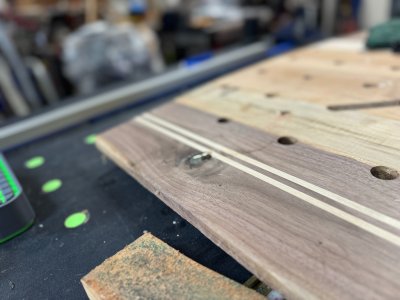
I finally had the chance to take both the RS 2 E and LS 130 EQ for a spin on a real project. Working on my outdoor workbench and it was Sanding Time. Used the RS 2 to keep it flat with P80 and P120 on both sides, then to P180 on the topside.

While using both the RS and LS, I found them to be jump around at times - much like an RO150 would do. The RS would be gliding along and then suddenly, jump and make a hard left turn. I was trying to think about how I might be able to better control the sander. Now, I do have to note that after I finished with the RS 2, I noted some swirl marks and then realized that I forgot to turn down the suction. I ended up backing down to P120 Granat and re-sanding the top with the ETC EC 150/3, and that cleaned it up.

For the final sanding, I used P180 Grant on the LS 130 keeping the pad inline with the grain across the top. But like the RS 2, there were points where the LS would jump and skip. No left turns, just a bit of jumping - and typically in the same spot across the boards in the top. I thought it might be the way I was holding it and wondered if I might be pushing too hard on the top and leaning it forward, but I'm not sure.

At the end, I think the top looks good and is ready for finishing. Planning on using Waterlox as the workbench will live outside.
 

Attachments

  • IMG_0109.jpg
    IMG_0109.jpg
    1.7 MB · Views: 13
Keep in mind that, unlike a random orbital, the RS2 is a flattening sander. If the board in question is not flat, it will do everything it can to flatten it.

I would highly recommend you get some P40 and P60 paper for the RS2. If you have an uneven board and want to flatten it, the P40 then P60 are what is called for.

If you do not want to flatten the stock then you need to avoid using the RS2. And I do mean it seriously. That sander simply does not accept curves convex surfaces and outright attacks undulations. It is a flattening tool first and foremost. The LS 130 with the hard pad would behave in a similar fashion, its linear motion probably even less forgiving to uneven surfaces.

As for the vac, RS2 should be run at a minimum suction when the board is uneven to give you better control. With an even board you can dial the suction to the max and with hardwood it should still be super-smooth.
 
Last edited:
I only ever used an LS130 with a specific round-over shaped pad, for sanding the inside cove profile, on integral backsplashes. It is essentially confined, in that wedge, so there was none of the issue that are having.
Stands to reason though, that it would buck against a not flat surface, especially if the suction is too high.
 
I only ever used an LS130 with a specific round-over shaped pad, for sanding the inside cove profile, on integral backsplashes. It is essentially confined, in that wedge, so there was none of the issue that are having.
Stands to reason though, that it would buck against a not flat surface, especially if the suction is too high.

The LS130 is not meant for flat surface sanding. It will buck (great term for this) even with no dust collection unless held slightly off the surface. The motion is very different from the similar sized and shaped RTS, which is very good on flat surfaces. Also, since the abrasive is simply moved forward and back it tends to make groves as the highest particle of grit keeps cutting on the same line as the tool slowly progresses. When at all possible the sander should be moved around laterally to avoid making obvious ditches.
 
The LS130 is not meant for flat surface sanding. It will buck (great term for this) even with no dust collection unless held slightly off the surface. The motion is very different from the similar sized and shaped RTS, which is very good on flat surfaces. Also, since the abrasive is simply moved forward and back it tends to make groves as the highest particle of grit keeps cutting on the same line as the tool slowly progresses. When at all possible the sander should be moved around laterally to avoid making obvious ditches.
Laterally? As in across the grain? And when you say "held slightly off the surface" are you supposed to hold the LS very lightly?
 
Never liked the LS130 for flat sanding. Love it for contours and trim pieces. Nature of the beast is that it is not very good with a flat pad. I have also never wanted to use anything but a random orbit sander except for very specific sanding tasks (such as molding). I have never found that non-random orbit was better than random orbit.

Seth
 
Laterally? As in across the grain? And when you say "held slightly off the surface" are you supposed to hold the LS very lightly?
Lightly enough (just take some of the weight off) to minimize the bucking. It’s kinda like balancing a large floor polishing machine except much more difficult.

I wouldn’t run the LS 130 across grain unless there were high spots to knock down and it was the only sander on hand. What I mean is slide the machine laterally side to side as you proceed with the grain. Keeping the machine’s back and forth motion parallel to the grain just avoiding driving it like a straight line like a plow ‘cause it will make furrows, clearly visible when the abrasive is coarse.
 
Back
Top