I doubt with spiral flutes on dowels make any difference in withdrawal resistance is water is used instead of glue.
I did not think I could design a test of dowel pull-out that would be even reasonably reliable. I don’t have the tensile tester needed, and the test would require a minimum of 10 to 20 examples to be reliable and I was not that much invested in this project.
Instead, I wanted to see how much the dowels would swell when exposed to water (assuming the use of a water-based glue and not epoxy or urea types).
I had, in closed containers, 3/8” nominal dowels in both the linear fluted style and the helical grooved style.
I submerged both of them in water for 20 minutes—I don’t know if that is a valid time frame—I can re-test if someone comes up with some better choice.
I measured the spiral grooved dowel:
Before soaking: 0.380”
After soaking: 0.382”
Gain: 0.002”
I measured the linear fluted dowel (major diameter only):
Before soaking: 0.370”
After soaking: 0.380”
Gain: -.010”
I only measured 3 pieces of each prior to soaking and only soaked one piece of each—so not much of a test.
I used a digital vernier caliper to measure. Not a world class measuring tool, but I have checked it for accuracy on my feeler gages and I believe it to be accurate.
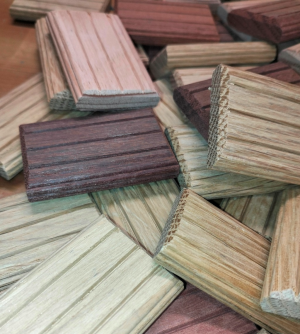
I would be curious of a similar test for factory Festool Dominoes, which are embossed and clearly have been compressed, vs. shop made dominoes.
I think the only important dimension for the dominoes is the thickness. But someone should correct me if that is incorrect.
Also, if any one has a well-reasoned thought on the duration of the soaking process, I would consider re-testing.
I did try measuring the minor diameter (in the ‘V’s of the fluted dowels, but found it impossible to be certain that the blades of my calipers were at the 180 degree opposites of each other.
In any case, it is my belief that the Festool factory-made and (likely) compressed dominoes are probably superior to, even carefully crafted, shop-made dominoes.
I’m not sure that the swelling test will prove that thesis. But I would be interested in the test results.
Testing notes:
1. I used luke warm water—about room temperature—but I did not test for the temperature.
2. I floated the dowels in a shallow dish (about 1.5” deep) and weighted the dowels down with a second dish resting on top of them. All the dowels were completely submerged for the entire testing time.
3. I used a standard kitchen timer of unknown accuracy for measuring the 20 minute cycle. I believe it to be accurate within a few seconds of the indicated time.
4. Once the time was elapsed, I drained the dowels on paper towels and attempted to remove any residual water with the same towels.
5. I made my measurement immediately after drying off the excess water.


 agree
agree