And spiral grooves have most withdrawal resistance, if glue was used.
I suppose you could make diagonal or cross-hatched grooves on Dominoes if max stiction was desired.
I’m not sure I agree with that.
The grooved, fluted dowels are heavily compressed during fluting process, which I assume is a rolling action.
I tested the fluted dowels by drilling for them and then applying water-only and allowing them to dry in the joint. The wood of the dowels expanded enough that it was nearly impossible to separate the joint. It required a mallet to do.
(I would note that I cannot state with certainty that the dowel expanded to make the joint strong or if the plywood expanded to accomplish the same. I suspect that it was some of both. But flattening the flutes seemed to have no effect on the holding power, so I remain comfortable with my process.)
The reason I tested was for some joints I wanted to do a dry-fit that was easily assembled. I roll the fluted dowels on a hard flat surface with a wide, fine, metal working file. It flattens down the flutes and makes assembly easy. But I wondered if it compromised the joint to use those dowels. My water-only test convinced me that it was not a problem.
My dowel jig, designed for cabinet making and sheet goods, has a 32mm spacing between holes. I generally utilize all of the holes, which means that pulling the joint together can be challenging. If I am assembling base cabinets, I will flatten the flutes.
I am not sure if the helical fluted dowels are similarly compressed. I believe they are just milled for the grooves.
I would have to do a water-only test comparing the two types of dowels. The last time I ordered dowels, I got 1,000 8mm dowels and I have a lot left. I am not highly motivated to perform that comparison test.
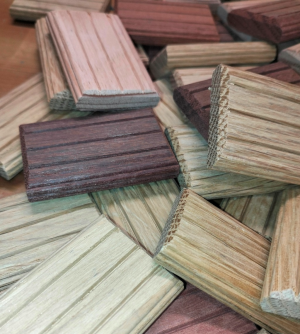
Addendum: I was under the impression that Dominoes manufactured by Festool were also heavily compressed and when they absorb the water from the glue, they will expand. So I am not sure home-made dominoes are a really good option.
Taylor Tools offers discounted dominoes. I’m not sure that they compress their dominoes. I suspect they make then much like shop made dominoes are made. But buying them bypasses the safety issue.
Taytools Beechwood Loose Tenons for Festool Domino DF 500 and DF 700

taytools.com
I have a tenoning jig for my table saw and a mortising jig (I think “Delta”) which I have not used in ages. Aside from the satisfaction of knowing I built something with a mortise and tenon joint, I find that dowels are faster and adequately strong for my work. (I actually made shaker drawers with rails and stiles joined with full saddle joints. I have no idea why I thought that was a good idea. And I am the only one that seemed to have noticed that detail.


 agree
agree