Chess set

Packard

Member
Joined
Nov 6, 2020
Messages
5,597
Location
Hudson Valley, NY
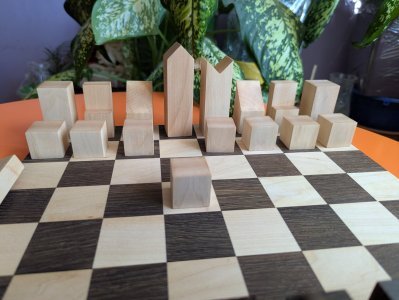
This is a fairly famous Lanier Graham mid-century modern chess set. There is a bit of a learning curve identifying the pieces, but I think I can make them all on the table saw. I will probably need my tenoning jig to make the end cuts. And the question is what size stock to use? 1” square stock, 1-1/4” square or 1-1/2” square.

It looks like, maybe maple? And walnut for the black pieces?

Any thoughts?
1770930139854.jpg
 
If you apply the Golden Mean, working on a cube being 1", that gives a board square of 1.6", which looks pretty much like the board in the pic.

So I'd base the size of the pieces on the relative Golden Mean value of what size the squares will be. Definitely not smaller than an inch though.
 
The Queen (I guess) with the V-notch at the top is going to take some thought on how to fabricate. The rest of the pieces look pretty straightforward.

I’m guessing I set my table saw blade at an angle and use my tenoning jig to hold it. Then turn the piece around and repeat. I would have to use my dado blade. My rip, crosscut and combination blades have alternating carbide tips and would not yield a clean cut in the corner. That would go for the pieces with shoulder cuts too.

So, the pieces don’t look difficult, but will require thought.

$500 for the set seems a bit rich, though.
 
The Queen (I guess) with the V-notch at the top is going to take some thought on how to fabricate. The rest of the pieces look pretty straightforward.

I’m guessing I set my table saw blade at an angle and use my tenoning jig to hold it. Then turn the piece around and repeat. I would have to use my dado blade. My rip, crosscut and combination blades have alternating carbide tips and would not yield a clean cut in the corner. That would go for the pieces with shoulder cuts too.

So, the pieces don’t look difficult, but will require thought.

$500 for the set seems a bit rich, though.
Use a long piece of stock to make/prepare for multiple Queen’s. After the first half-V cut turn the stock over, not around.
 
The dark wood looks like wenge to me. It's quite a splintery wood if you haven't worked with it before, and it's among my least favourite woods to work. I would make all the cuts on the table saw with stock laying down against the crosscut fence/mitre gauge.
 
According to the American Chess Federation, the standard chess board square is 2-1/4”.

The base diameter of the King is 1.75” and the height of the King is 3.75”.

I am allowing myself a lot of leeway, but I think 1-1/2” square stock will be easier to work with than smaller sizes. I will make a few prototype pieces first.
 
This is a fairly famous Lanier Graham mid-century modern chess set. There is a bit of a learning curve identifying the pieces, but I think I can make them all on the table saw. I will probably need my tenoning jig to make the end cuts. And the question is what size stock to use? 1” square stock, 1-1/4” square or 1-1/2” square.

It looks like, maybe maple? And walnut for the black pieces?

Any thoughts?

View attachment 381082
Do you have a bandsaw?
Might be easier on that.
 
The dark wood looks like wenge to me. It's quite a splintery wood if you haven't worked with it before, and it's among my least favourite woods to work. I would make all the cuts on the table saw with stock laying down against the crosscut fence/mitre gauge.
It could also be Palm? which is even worse to work with.
 
The pawns are cubes. The rooks are similar but taller. The King has to be the tallest, the Queen the second tallest. I am undecided on the bishop and the knight—it is not clear which is which.
The Bishop is the wedge top, the Knight is the one that looks like a chair.
Personally, I would add to the tops of the Castles, buy cutting a groove X across the tops. Imagine and old-school White Castle restaurant.
 
The Bishop is the wedge top, the Knight is the one that looks like a chair.
Personally, I would add to the tops of the Castles, buy cutting a groove X across the tops. Imagine and old-school White Castle restaurant.
I’m going to make some prototypes from some pine 1-1/2” square stock I have. I thought about adding the cuts for the castle, but I am concerned that they might end up casualties of combat.

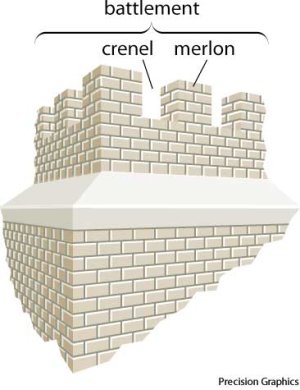
Addendum: I could not think of the word at the time I was posting. I wanted to use “crenelated”. See image below. I just learned that the high points on the castles are “Merlons”. So posting on FOG is culturally educational as well as woodworking educational.

Addendum: I have hand saws (back saws, coping saws, fret saws and pull saws included). I have a band saw, a radial arm saw, a table saw, a scroll saw and a jewelers saw. I also have mortising machine.

But in the end, I think all the pieces will be made on the talble saw. It would be the fastest and most repeatable and cleanest result.

1771083605229.jpg
 
Last edited:
I always heard the term Parapet, as the low wall around the walkway. However, your definition seems more accurate, or at least an older term?
 
I always heard the term Parapet, as the low wall around the walkway. However, your definition seems more accurate, or at least an older term?
I’ve never heard of a “Merlon” and it probably isn’t a good word for general communication.

If I added enough context “crenelated” would be understood.

“The building was crenelated much like the top of a rook chess piece”.
 
I believe "parapet" or "battlement" would describe the entire low wall construct. EX- it is a "crenelated parapet". You could have a non-crenelated parapet as well.

For the chess piece in that set ...................................... just cut some "slots" in the "top" ;) :)

Seth
 
I believe "parapet" or "battlement" would describe the entire low wall construct. EX- it is a "crenelated parapet". You could have a non-crenelated parapet as well.

For the chess piece in that set ...................................... just cut some "slots" in the "top" ;) :)

Seth
I agree. But I think I will simply copy the original as it is considered a “classic” of mid-century design.
 
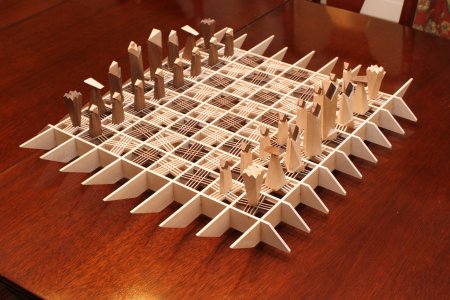
Here's a chess set I made from a class at Marc Adams School of Woodworking in 2013. It was taught by John Economaki (bridge city tools founder) and we used the Jointmaker Pro for all the pieces, a couple of planes and finished with paste wax. Fun project... I think I had over 200 hours in the set by the time it was completed.
IMG_2381.jpeg
Neil
 
Here's a chess set I made from a class at Marc Adams School of Woodworking in 2013. It was taught by John Economaki (bridge city tools founder) and we used the Jointmaker Pro for all the pieces, a couple of planes and finished with paste wax. Fun project... I think I had over 200 hours in the set by the time it was completed.
View attachment 381159
Neil
Well, I’m not going to try something that ambitious. It looks great (but a bit fragile). The Lanier Graham set looks deceptively easy. I suspect I will run into some hiccups along the way.

Pain in my back limits me to very short stints in the workshop if I have to stand. Seated work allows longer work sessions. So I have been looking for work that does not require hauling sheets of plywood and cutting it to size.
 
Back
Top