Considering switching from track saws/MFT to a panel saw.

Not knowing a whole lot about the BenchDog system I took a look and found out he has addressed the inadequacy of squares for the MFT with a couple of posts that screw into his big triangle. I’d like them to be taller though.

Also looked at his Quad MFT? rig. I still think the DashBoard system is better, mainly because the shoulders that guide the part that slides up and down are longer. I watched his (BenchDog) quick intro to the thing and he simply put the parts together and tested with his square and pronounced it good. I watched Peter Millard’s video of the pre-production model and the same thing happened. I consider both results minor miracles, especially in Peter’s case as it appeared he kinda eyeballed where to put the front mounting holes. Neither addressed the problem of adjustment if the grid pattern isn’t perfectly perfect. Maybe that is the difficulty sarno is having?

I really don’t know how to adjust that BenchDog setup. How in the world do you do the 4 cut method with stuff that is locked into holes? Maybe there is some play where the rail joins the hinge? I guess that would be possible but awkward. I’d be lost without a simple pivoting fence on top of the table.
The Benchdogs hinge has pre-drilled holes for each rail type. You put a stopper in the relevant hole for your rail then drop the rail into it. This locks your rail in and you can't adjust it so your fence must be square or adjustable. To get around this, you can choose to use the slotted cut out on the hinge instead of the pre-drilled holes. This allows the stopper to move left or right to get the rail square to your fence. You then tighten down the stopper once you're happy.
 
I am sure Peter Parfitt’s angles are all perfect. 🙂

Benchdogs UK sells CNC-milled tabletops made to measure. Metabo sells a cheap replacement tabletop for their MFT knock-off. But a crosscut station can be built more simply without a full grid. I wouldn’t bother drilling 100 holes by hand for this purpose.
Thinking about how to do this without using dog holes/MFTs... I have a t-slot track running along the face of my bench so if I add a second to the backside I could mount a Dashboard hinge there. Or even make my own bracket both sides where I could place a dog hole. At least then I can slide them around until they're square to the fence.
 
Maybe you need someone who has experience using the equipment to give some advice. I used a Festool track saw when they first came out and it was a disappointing experience and I have never attempted to repeat it but in those days none of the accessories were available so instead I bought a Hammer slider and love it. MFT tables don't look like a rigid device at all but then I want a bench that is suitable for hand work with planes, chisels etc and is rigid enough for that purpose. One advantage of a slider is that it can if you want it can replace a mitre saw with no disadvantages at all.
 
The Benchdogs hinge has pre-drilled holes for each rail type. You put a stopper in the relevant hole for your rail then drop the rail into it. This locks your rail in and you can't adjust it so your fence must be square or adjustable. To get around this, you can choose to use the slotted cut out on the hinge instead of the pre-drilled holes. This allows the stopper to move left or right to get the rail square to your fence. You then tighten down the stopper once you're happy.
Sounds like it’s only awkwardly adjustable, hence you haven’t been satisfied so far.

I’d probably lock the rail in place and get a different fence. Being me, I’d get an original Festool MFT fence because they’re simple and so many people have thrown them over for something fancy, so it would be cheap too. I don’t think a fence needs to be fancy, although sliding stops are nice (and the old Fes MFT fence has them), but with all the holes in the table it’s simple to clamp a stop wherever it’s needed.
 
Thinking about how to do this without using dog holes/MFTs... I have a t-slot track running along the face of my bench so if I add a second to the backside I could mount a Dashboard hinge there. Or even make my own bracket both sides where I could place a dog hole. At least then I can slide them around until they're square to the fence.

Yeah, that setup still feels a bit cumbersome to wrangle for my taste. I’d chase something simpler—less fiddling with adjustments, more rock-solid dependability to keep life easy.

I inherited an ancient family heirloom workbench and mostly parked it in the shop as decoration. But when big jobs ate up our space, we’d drag it out as an extra crosscut station. No way was I risking saw scars on that beauty, so we slapped on a quick MFT-style top for a dead-simple Benchdogs setup: a pair of them in the back as the fence, one to the right with spacers as a stop block, and two tall dogs to lock in the guide rail.

It took a minute to dial in, plus some trial-and-error saw handling to kill any rail wobble. But once humming, we could slice through MDF and plywood very reliably for about a hundred mid-size drawer panels.

With too much adjustability, I’d worry it’d drift over time from sheet bumps. Give me boring reliability any day!

To keep things even simpler, I’d skip the dog-hole pattern, fix the fence permanently to the back, and bolt something on where the guide rail registers at a perfect 90° angle—maybe a hinge or just stop blocks. Once that’s set, I’d think about repeatable fence stops for crosscuts; that could be anything simple, like a clamped wood scrap, or something fancier—whatever works.

The workflow would be like this:

• Clean up factory edge.
• Rip cuts with parallel guides.
• Use the MFT crosscut station or a rail square to square it up.
• Then register with the square edge to the fence stop and cut stuff to size.
 
Yeah, that setup still feels a bit cumbersome to wrangle for my taste. I’d chase something simpler—less fiddling with adjustments, more rock-solid dependability to keep life easy.
This should be the basic standard for all the main processes in your workshop whether you do it for a living or as a hobby unless you don't mind sloppy results or spending most of your time on setting up things than on real woodworking.

In fact, I'd argue (at the risk of unintentionally offending some ones) that that's the difference between an efficient woodworker and an inefficient one.
 
My simple portable right angle cutting station is an old MFT 800 top mounted to a Dewalt miter saw stand. The cutting table is on the right end of the stand and another pair of brackets support a movable stop setup. I this case I used tall dogs to secure the rail (with spring clips made for the purpose) and the fence is fixed to the mdf with screws after making the small adjustments needed.

In the rare cases when I needed to cut other angles on that rig I just clamped an auxiliary fence to the table.
 
Perhaps you can pick up a few techniques from Guido Henn on how he makes crosscuts on the MFT table.

Guido only uses the dog holes for clamping — not for alignment.

He uses a Stop on the Fence, and he also uses a 2nd Stop on the bellybutton end of the track.


If you cannot wait, fast-forward to the 6-minutes mark.


WOW! This is so cool. Can't wait to try this.

@sarno Sounds to me like you might’ve overcomplicated things a bit. 🙂

It’s tough to give solid advice here — you seem a bit frustrated with your setup. Do you feel like you’re in the right headspace to give the MFT another shot? It really does work, and it’s an excellent tool for clean, repeatable crosscuts once it’s dialed in.

Panel saws do have their perks, but they don’t magically fix every accuracy issue, especially when you’re wrestling with big sheets.

Here’s a method I usually point people to when students at the local community workshop get stuck with the MFT/3 setup:


We use MFTs with bench dogs for this, but not because it’s required — it’s just handy. No fancy stops or accessories needed. You’ll get super-precise, repeatable crosscuts this way. It’s all math, not accessories.

Since you said you’re already pretty happy with your rip accuracy, you’ve got most of the heavy lifting done. Just take your time to cut one perfect piece the way you want it, then use that as your template to knock out the rest
 
That video uses my idea of using a distance stick instead of a tape measure. Using two of those set one to the measurement required and set the second using the first stick so if cutting a large sheet the track can be set exactly parallel to the factory edge by using two sticks at once and no tape measure required.
 
My take on the comparison between a track saw and a panel saw.

1. I have found that being very careful with measurements, my track saw could be as accurate as a table saw, and generally makes cleaner cuts. However, if I am making several identical cuts, I prefer to make the track saw cuts over-sized and make the finish cut against the fence on my table saw.

2. My experience with panel saws resides entirely with big box store panel cuts. Very often the cuts are very rough looking. But that might be from dull blades or excessive feed rates. Also, I never count on accuracy better than +/- 1/8” when the operator is being careful; +/- 3/16” is a more reliable tolerance.

3. A panel saw cannot be used in conjunction with a router to make dadoes.

But the big difference (for me) is the track saw can go where I go, whereas the panel saw is as portable as a cabinet saw. (A contractors’ saw can travel, but I have not seen on on the bed of a pick up for several years).
 
But the big difference (for me) is the track saw can go where I go, whereas the panel saw is as portable as a cabinet saw. (A contractors’ saw can travel, but I have not seen on on the bed of a pick up for several years).
Yes, I have always seen the track saw as a carpenter's site tool and not as an accurate cabinetry type saw and I am sure that was the original thinking that Festool used when developing the concept. It then morphed into what it has become today helped by a huge aftermarket of tools to try and make it easier and more accurate to use for us hobbyists and the lower end cabinetry trade that does not need repetitive output. My early attempts to use one and the difficulties I encountered were proven to exist by the huge aftermarket tooling now available. I await the avalanche of posts that refute this idea entirely.
 
Yes, I have always seen the track saw as a carpenter's site tool and not as an accurate cabinetry type saw and I am sure that was the original thinking that Festool used when developing the concept. It then morphed into what it has become today helped by a huge aftermarket of tools to try and make it easier and more accurate to use for us hobbyists and the lower end cabinetry trade that does not need repetitive output. My early attempts to use one and the difficulties I encountered were proven to exist by the huge aftermarket tooling now available. I await the avalanche of posts that refute this idea entirely.
They can refute all they want, but that doesn't deny the fact that the track saw is never designed to replace the table saw, nor is the table saw built to cover everything that a track saw can do (the table saw can't). As you rightly observed, the amount of money or effort some track saw users spent on after-market accessories and gadgets or shop-made jigs, just trying to make the "system" more precise or achieve square cuts was mind-boggling to me.
 
Last edited:
I bought my track saw to breakdown sheet goods, and make final cuts on the table saw. Before that, I let the lumber yard break down sheet goods and I made the final cuts on the table saw.

I found that for making items like bathroom vanities, kitchen cabinets, etc. I could make my final cuts on the track saw.

But if I were doing an entire kitchen of new cabinets, making the final cuts on the table saw gave faster and more repeatable results.

But making accurate cuts with a panel saw seems even more challenging than on a track saw, though admittedly my experience is based on hacks working at lumber yards.

My issue is carrying 4 x 8 sheets down to my basement. So a panel saw would do me no service.

If Kreg had come out with their saw guide a few years earlier, I probably would not have gotten a track saw at all.

I do agree that some people spend extravagant amounts of money to get their track saw to do what comes to a table saw naturally.

Sort of like teaching a race horse how to run on his rear legs only. It would be a remarkable feat, but he wouldn’t win many races.
 
Last edited:
I have never understood the rational behind assuming that using a pedestrian MFT bench top and pedestrian MFT dogs will produce perfect 90º cuts...just do the math and it becomes very obvious, very quickly, it's pretty damn near impossible.

The MFT was conceived as an assembly table not as a precision cutting table. Over the years, others have valiantly tried to morph the MFT into a precision cutting/indexing instrument which it is not. The MFT is a convenient cutting table that produces good results but it is never and has never been a precision cutting instrument.
 
If starting out today with four blank walls I think I would make a vertical panel saw on one wall. I reckon one could be built for not a lot of money but it is sort of a one trick pony. There are plenty of examples on YT and in past magazine articles.
 
Before spending any more money on this, I'm hoping someone tells me I’m doing something fundamentally wrong.

I’ve been getting more serious about hobby woodworking over the last two years and everything’s been going great except for my rip/crosscut situation. I absolutely dread having to get the track saw out when I need something accurate and repeatable. I’ve thrown a frankly stupid amount of money at trying to make it work, Benchdogs, TSO, Festool, UJK, pretty much every jig you can imagine. A good portion of that also went toward shipping to Australia. I don’t even want to tally up what I’ve spent, but it would comfortably exceed the price of a panel saw. I feel like it’s one of those experiences you have to go through before you realise what the right solution might be.

I’m at a crossroads now where I either cut my losses and buy a panel saw or sink more money into refining the track saw/MFT setup. I think I’ve mostly got rip cuts under control, but even then I still cross my fingers every time I make a cut that needs to be straight and parallel. I’ve been using TSO parallel guides on the rail (up to 3000 mm when needed), and I alternate between the TSO track square with the extended aluminium contact attachment and the Festool adjustable guide rail angle stop, which I find more reliable. The biggest improvement came from clamping the rail and avoiding sideways pressure on the saw as I cut, as the rail can flex left to right, but I still don't have confidence in repeatability.

Crosscuts have been the real problem. I don’t think I’ve ever managed to get consistently square cuts or repeatable widths across multiple pieces. I’m using a custom MFT built with the UJK Parf Guide, along with the Benchdogs hinge, fence, and their latest micro-adjust flip stop. The holes are *not* square — that became clear when aligning the track using the Festool pin slot in the hinge. The hinge’s adjustability helped get things square initially, but I still feel like things drift. I find myself constantly checking alignment because the hinge pin can move slightly. The fence and flip stop also seem capable of flex if I push the workpiece firmly against them, and I suspect there may be some movement or flex in the track/fence during the cut itself.

I suspect many of my issues stem from the number of components and variables involved so I want to reduce that. I’ve considered getting a CNC-machined MFT top and simplifying the setup by ditching the hinge and using hinge dogs or Stanton dog locks instead. I’ve also thought about drilling my own top, though I’m concerned about introducing inaccuracy that can’t be corrected afterward. Using the LR32 system is another possibility, but I’ve watched videos on that and I'm not confident I could get it right. I'd drill holes along one side of the workbench then move the rail to do the other side and hope the spacing is the same for every hole (then just turn the track perpendicular and drill the holes between). I’ve also had suggestions to leave the hinge attached but let a track square and parallel guide self-reference against the fence rather than fixing the rail position before the cut.

At this stage I’m honestly leaning toward abandoning the whole setup and buying a panel saw, as I should be able to fit a 1600 mm unit (possibly larger) in my garage. That said, I’m very open to suggestions, even if it means moving away from the MFT approach entirely. What I really need is a reliable reference for aligning the rail and a fence solution that stays square and repeatable. I’d appreciate any thoughts!

Sarno, I've been a serious amateur woodworker for 30 years ... or at least 30 years building serious furniture. There have been many upgrades over the years, and now I look back and can offer my thoughts on what I would and would not part with.

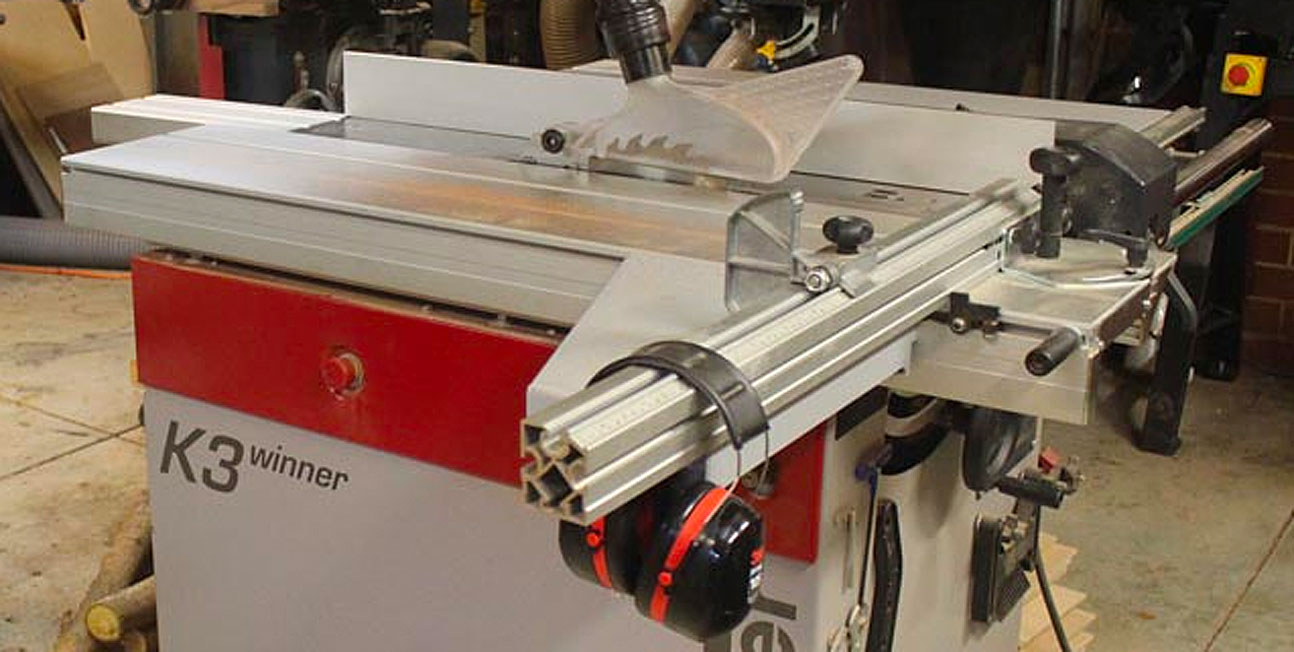
I would like to say that my hand tools remain the cornerstone of my workshop, but this is untrue. I am a dyed-in-the-wool hand plane user, but the cornerstone of preparing and building furniture are two Hammer machines, a shortstop K3 sliding saw and a A3-31 combination jointer-thicknesser.


I do have a MFT with Festool saw and track, but these are toys alongside the K3. Rips and, especially, crosscuts are second nature. And they are repeatable. The crosscut fence has a micro adjuster, and this permits instant adjustments of fractions of a millimetre, as I was doing today in fitting drawer front into a case.

I am not suggesting that you get a K3. They can be a serious outlay for many. But there are less costly versions, such as my previous tablesaw, which had an add-on crosscut slider.

Regards from Perth

Derek
 
Last edited:
Thinking about how to do this without using dog holes/MFTs... I have a t-slot track running along the face of my bench so if I add a second to the backside I could mount a Dashboard hinge there. Or even make my own bracket both sides where I could place a dog hole. At least then I can slide them around until they're square to the fence.
Samo,

What fundamental issue are you trying to address by getting a panel saw?
 
My early attempts to use one and the difficulties I encountered were proven to exist by the huge aftermarket tooling now available. I await the avalanche of posts that refute this idea entirely.
As someone who successfully builds cabinets for my own use without a table saw, I hate to disappoint you, because I am not going to try to refute this idea entirely. But I am going to try to soften it a little.

I started with a track saw, wanted to be able to work a little faster so I got a guide rail square. Then my cuts still weren't coming out as square as I wanted, and people here told me what I needed was parallel guides, so I got a pair of 30" ones. And guess what? I am happy now, and don't look at tools anymore. OK, that was a lie, but when it comes to turning a sheet of plywood into a bunch of panels ready for assembly, I don't feel like I'm missing out on anything.

Building cabinet boxes is something I do maybe once every 2-3 months, and rarely am I making more than one of a piece at a time. My shop gets used for a LOT of different projects, so flexibility of the space and its setup is worth far more to me than the extra efficiency a table saw would add. If you build a lot of cabinets and have the space and budget, then buy a good cabinet saw and be happy like me, because your tools work for you in the way you want them to.

It is hard because as an amateur who maybe didn't have the benefit of learning in school, at work, or in your dad's shop, you often have to buy the wrong tool first in order to develop a really good understanding of what you actually need and should want from your tools.
 
Back
Top