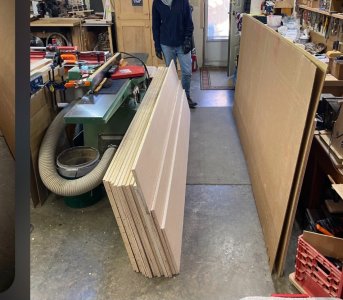
Honestly, I've come to dread stepping into my garage and trying to cut something to the measurements I want, repeatedly and consistently. It always takes 10 times longer as I mess around with all these accessories I've waste my money on only to be disappointed in the results. Always seems to be something different messing up too.
<snip>
For reference, my dad was a cabinet maker his whole life. When he ran his own business I'd frequently help. We only ever cut up sheet goods on the panel saw. Admittedly, it was an enormous Altendorf with the digital fence adjuster and all those bells and whistles. I just miss being able to enter the measurement on the digital control, have the fence move and the saw actually cut to the dimensions I want! I know I won't have that level at home but as close as possible would be great.
A few thoughts:
1. I've been where you are before, fed up with my latest tool purchase that was supposed to make everything just work effortlessly, and didn't. It's extremely frustrating. Sometimes, the best first thing to do is to put that thing down for a little while, forget about it, clean up the shop, mess with a different project that you can make progress on, have a beer or two, and wait a few days to bang your head against the wall again. For me, that feeling of "nothing is working" is the cue to shift gears.
2. Some other type of saw might be a right answer for you, so I'm not here to talk you out of that. However, sometimes it is useful to "slay the dragon," so to speak, and prove to yourself that you *can* get the tool to work, even if not as easily as you want. If I was in your shoes, when I had a clear head and a light heart, here is what I'd try. Forgive me if you've done this a hundred times already!
- Take a scrap or slightly oversized panel
- Find a clean edge or make one straightening cut, if none are present. Trim just a bit off--1/8"/3mm or so
- Get your square and strike a line perpendicular to that edge, placed to trim a similarly small amount off that end of the panel
- Lay your track down so that it splits the line you just drew. When I say "splits," I mean to divide the penciled line in half, along its length. It may help to draw the line a little hard, but don't go nuts, it should be fine pencil line not a crayon mark.
- Now, if you can, use clamps and lock your track down. You don't need to bear down on it, just give it a little extra grip. This takes one big potential variable out of the equation.
- Place the saw onto the track, and slide it back and forth with as little pressure as possible. You want to feel that it's seated properly. Make sure your cords and hoses are lined up so they won't snag anything.
- Start the saw, plunge it carefully (take 3-5 seconds to do so), and then begin pushing it forward while also keeping enough pressure to hold the saw in the down position. There should be some, but not a lot of resistance. Nothing should feel like you need to try very hard and your pressure should be roughly even between holding the saw down and pushing it forward. If you are putting your back into any part of this, that might be too hard.
- If you can't clamp the track down, then pause after the first 6-12" and look to see if your track is still splitting the line along its length. While you can reliably make good cuts with a track without clamps or guides or anything else, there is a *little* technique and feel to it and if you don't have that feel yet then it's not that hard to knock the track a little off course. Too much or too little pressure in the wrong direction can do it.
- Once the cut is done, take the panel and inspect it. If your pencil line is thick enough and you split it just right, you might be able to pick up bits of it along the cut edge. Present your square to the corner you just made and check it.
- Now, take out your tape measure, and pick an edge to reference off--either of your two clean edges are fine. Lay down two marks at an easy-to-measure distance (e.g. 12" or 350mm, not 11-3/32 or 336) to define an edge parallel to that. Then, using your track as a straightedge, lay it down so it splits those two marks, use a pencil to strike a line, and then pick up the track. Use your tape measure and check the distance at several points along the line. Is it the same? Use your square to reference off your other clean edge, and check if it is square to that. In general, your cuts are only as good as your measurements.
- If your line is good, put your track back down, splitting it as before, and cut it as before. You should now have at least two square corners on your panel, and two parallel edges. If you do, then you can lay down one more square edge as before, and finish the panel.
OK - that is a wall of text, go watch a video instead. It sounds worse than it is, but I am trying to make no assumptions about what you do or don't know what to do. If you try this, check at each stage, and if you get to some point and the result isn't good, then you know that your problem is close to that step. If the cause isn't obvious, share everything here, we can try to step through it. I'd come over and help but it is a long flight from Boston, USA.
For my part, when I $#@! this up, the most common causes are measurement errors (I measure 339 instead of 337 or, sometimes--eek--307) and "bump" errors where I nudge the track at the very start or even before I start the cut. Either of these will guarantee a bad result. Similarly, parallel guides make both kinds of mistake much easier to prevent, which is why I got them and am happy with the results. But, that is just my preference.
If on the other hand you do this and end up with a panel that is pretty darn square, you have now proven to yourself that you can do this. If you then think, "boy that's a pain in the...," you can decide what you want to do next knowing
3. As a general observation, if your primary experience of dicing up sheets of plywood is using a fairly high-end commercial production machine, two things are possibly true:
- Almost anything short of a more serious machine than most serious amateurs have will feel like something of a letdown by comparison
- You may possibly not have had the opportunity or need to develop your skills of measurement and setup, which are important when you can't rely on the tool to do that.