Cordless trim routers - DeWalt vs Bosch

derekcohen

Member
Joined
Jun 22, 2008
Messages
1,010
Yesterday, as my wife and I wandered through lines of power tools at the store where I was collecting sanding disks, she reminded me that I have a birthday coming up and should get something I would enjoy using. She is a keeper. :)

I really have all the power tools I need but would like to upgrade the corded Makita trim router. That it is corded is not the issue - but having one less cord to connect up would be pleasant. I discovered this recently with a small cordless Makita angle grinder and a Festool ROS. I use power tools in short bursts, with preference going to non-power hand tools.

One of the issues in the above paragraph is acquiring another battery system. I have tried hard to avoid to avoid this, and stuck with Festool drills, and recently a Festool ETSC-2 ROS. But Festool do not offer a trim router, cordless or otherwise.

There are four features i seek in a trim router:

1. A light, balanced machine capable of being used comfortbly in one hand.

2. Ease of height adjustment. This is the bane of my life with regards the Makita trim router. Too coarse for my liking, too much hunt-and-seek. A dedicated fine adjuster is preferred.

3. A plunge base to convert from fixed format. Prior to the Makita some 5 years ago, my experience was only with plunge routers, and I have come to value this feature when starting and ending a cut, where needed.

4. It would be ideal if trim routers came with a 1/2" shank facility, but that will never happen (as it would create a potentially dangerous machine), but 8mm shanks are pretty good for smoothing vibration and strength, and preferred to 1/4". There are an increasing number of 8mm options coming to the market - I think that manufacturers are recognising this factor. Anyway, I have both sizes, but would prefer a trim router with a 8mm collet as well as 1/4". My Makita has this.

My research tells me that the DeWalt and Bosch trim routers are the ones to beat. The DeWalt appears to have the better height adjustment, but the Bosch is more compact and slimmer in the hand. They have similar power, but I am not fussed by the amount of power, oer se. Can one get small batteries for these routers to reduce weight up high? I use only 3.0 in my Festool drills, preferring to have two and keep the extra charged. I am sure I have seen both 1/4" and 8mm collets available for the DeWalt, but it gets sold with one or the other, not both (depends on the country). Is there an 8mm available for the Bosch? What are the respective plunge bases like for each of these routers?

Your input - experience even if only having used one or the other - is valued.

Best wishes for the festive season.

Regards from Perth

Derek
 
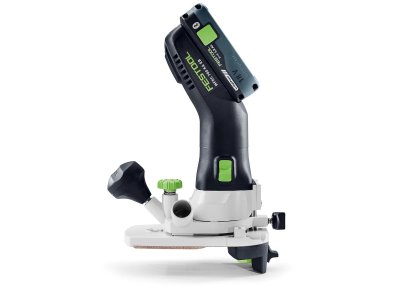
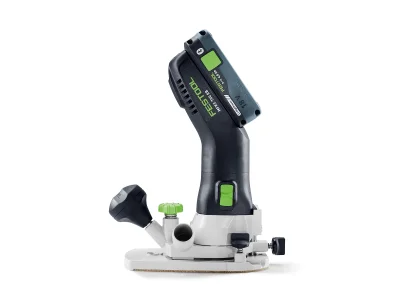
The MFKC 700 KA EB has been recently released in the UK, Germany & the Netherlands, you may want to keep your eyes open for that. I'd assume it'll be available in Australia sooner than in the States. :mad:
That would certainly tick most if not all of the boxes. :)
 

Attachments

  • MFKC 700 KA EB.jpg
    MFKC 700 KA EB.jpg
    171.6 KB · Views: 14
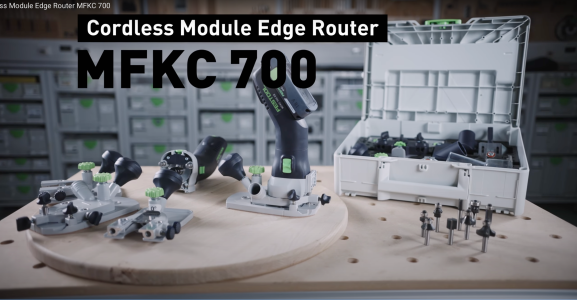
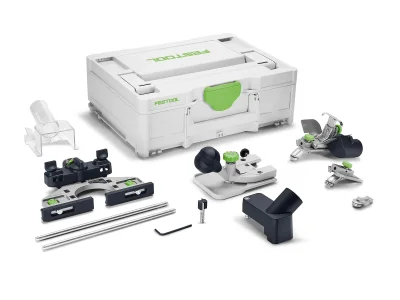
Well here's the new MFKC 700 EB. It appears to fit in all of the available bases.
 

Attachments

  • MFKC 700 EB.webp
    MFKC 700 EB.webp
    54.6 KB · Views: 10
  • MFKC 700_1.png
    MFKC 700_1.png
    3.4 MB · Views: 7
  • MFKC 700_4.png
    MFKC 700_4.png
    2.1 MB · Views: 7
  • MFKC 700_5.png
    MFKC 700_5.png
    2.1 MB · Views: 7
  • ZS-MFK 700.webp
    ZS-MFK 700.webp
    72.2 KB · Views: 7
Last edited:
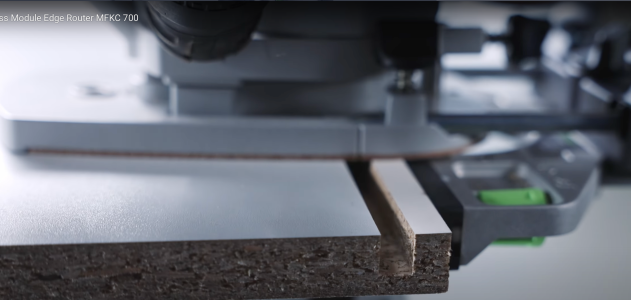
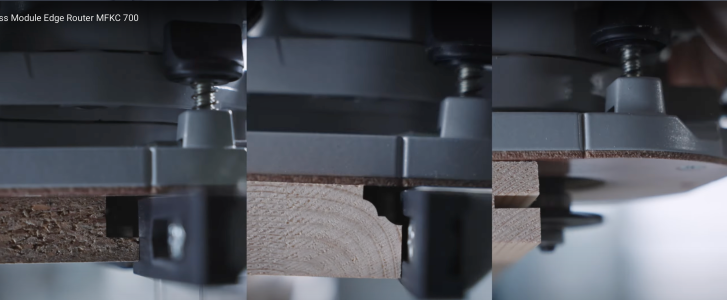
Unfortunately, the Trimmer Router MFKC 700 is an edge router only. that, it can only work close to the edge of a board.

Regards from Perth

Derek
 
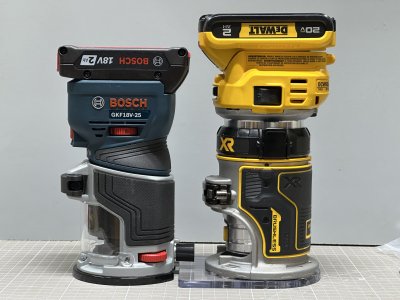
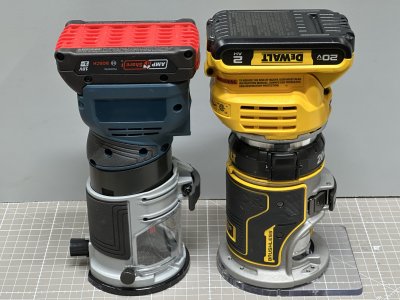
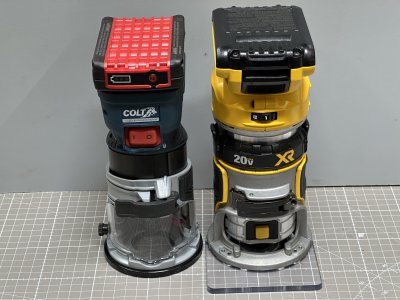
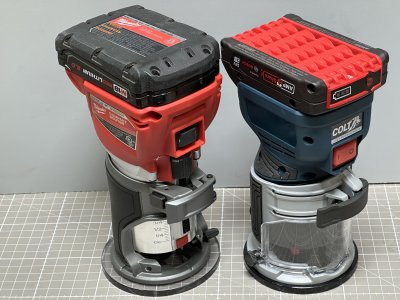
The above pic shows both routers parked at their lowest position each with a 2amp battery.

Girth Dewalt max 29cm, mid 28cm, min 27.5cm

Girth Bosch max 27.3cm, min 23.3cm. The min girth is higher up, possibly above comfortable range, if a longer bit is being used for a surface cut or shallow rabbet.

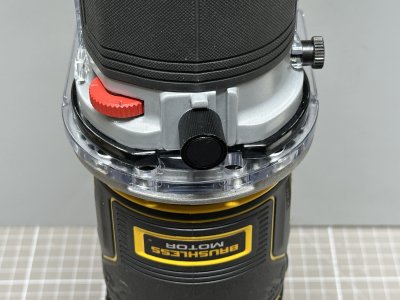
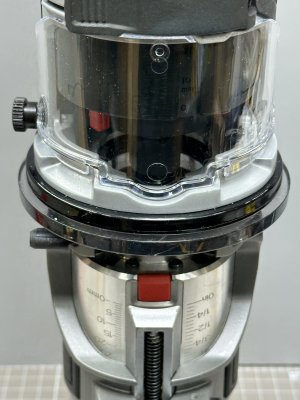
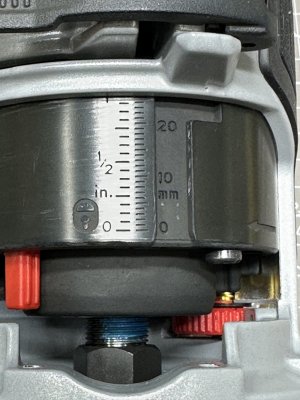
Both have fine depth adjustment but if you prefer to “read” the relative bit depth rather than measure, and expect to change bits frequently, then the Dewalt has the advantage. The Bosch adjustment wheel is the small red disk near the base. It turns a 1mm pitch screw. It has four hash marks so you can “read” 1/4mm increments directly but the marks are far enough apart that you can further subdivide the wheel for finer adjustment.

One important note is that my US purchased Dewalt did not include any kind of dust collection chute. The Bosch included two or three.
 

Attachments

  • IMG_6447.jpeg
    IMG_6447.jpeg
    1.9 MB · Views: 4
  • IMG_6445.jpeg
    IMG_6445.jpeg
    2.3 MB · Views: 4
  • IMG_6444.jpeg
    IMG_6444.jpeg
    2.4 MB · Views: 5
Derek, you are absolutely right about the depth adjustment on the fixed-base Makita. The corded and cordless are physically identical otherwise, so the alternate bases all interchange. The plunge base is very nice, easily adjustable, and solid. I had one of the corded models, for quite some time, before the cordless became available. For the work I needed them to do, cordless was way better. That was already my battery platform, so it was greatly appreciated.
I use them for edge treatment/flush-trimming most of the time, leaving them as "set ups." Most of them are not critical, depth-wise, so it doesn't matter. When it does matter, leaving it "set up" makes the adjustment hassle way less important. I know I'm an anomaly, but it works for me.
If it's more than a simple trim, I go to OF1010, one of those is set up with a bushing and 1/4" up spiral bit. The other is "free", though I usually leave whatever bit was there last. That can save time too, maybe not every time, but often enough.
As far as alternatives; I have used quite a few of them. I don't like that extra diameter of the DeWalt, it is just too wide. The depth adjuster is indeed better, but holding it is more important to me.
If I didn't already have a platform commitment, or didn't mind adding another, Milwaukee would get my vote.
The fit to the hands is good, the depth adjustment is more like the Bosch, and they have additional bases.
 
3. A plunge base to convert from fixed format. Prior to the Makita some 5 years ago, my experience was only with plunge routers, and I have come to value this feature when starting and ending a cut, where needed.
Do you not already have the plunge base for the Makita?

I agree with you that the Makita fixed base height adjustment is crude, but the plunge base is just dandy - and everything fits both the corded and cordless. Plus, Makita is a very good battery system to get into. I can never keep track of which 18v DeWalt battery is which - Milwaukee isn't much better.

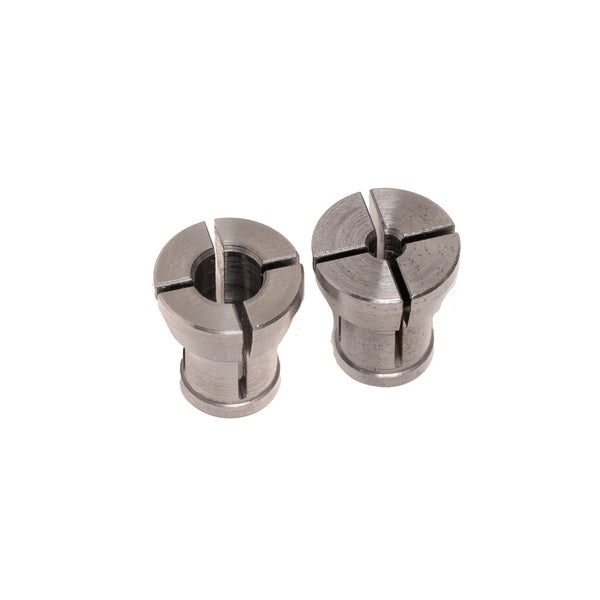
You might want to also consider getting precision collets for whatever router you run. These tend to grip better and are dynamically balanced. Here's a source:

For the Makita, a cheaper source ($25 for both) for ⅛" and ¼" precision collets is:
 
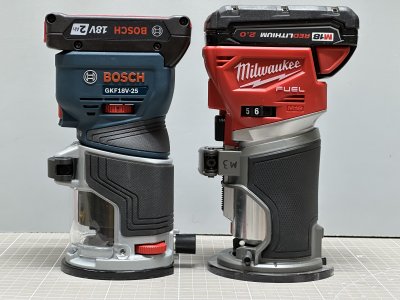
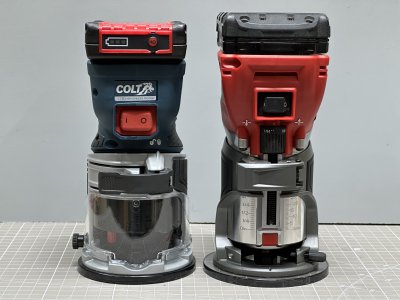
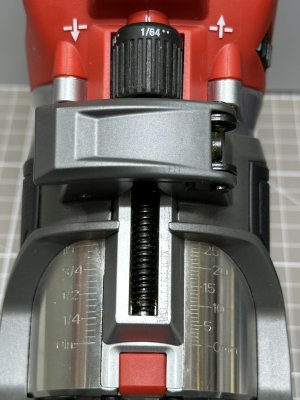
The Bosch and Milwaukee are most similar with depth adjustment via a rotating screw and a simple clamp fixing the depth.
The M18 router does include one dust chute.

Depth adjustment is better on the Bosch as the Milwaukee screw has about 1/32” of uncontrolled lash.
The lesser amount of lash in the Bosch is managed with a spring washer so it is predictable.

The collar/base of the Milwaukee is removable but the Bosch is not so extreme depth adjustments on the Bosch can take some time turning the screw from one end to the other.

Girth of the Milwaukee, max 25.2cm, min 24.5cm.

The Bosch weighs the least. From memory I think the M18 and Dewalt are about the same but those stats can be looked up.

Maybe the most trivial note, the battery locks firmly in place on the Bosch while on the other two the battery wiggles.
 

Attachments

  • IMG_6450.jpeg
    IMG_6450.jpeg
    2.2 MB · Views: 3
  • IMG_6458.jpeg
    IMG_6458.jpeg
    2.4 MB · Views: 3
  • IMG_6455.jpeg
    IMG_6455.jpeg
    1.2 MB · Views: 3
  • IMG_6457.jpeg
    IMG_6457.jpeg
    1.2 MB · Views: 3
  • IMG_6456.jpeg
    IMG_6456.jpeg
    1.1 MB · Views: 4
Dewalt chargers seem to have a very poor reliability record and I am trying to fix one right now. The main issues seem to be dry solder joints on the charging pins but there may be others as well so I would take that into account when buying. Has anyone here had any problems with Dewalt chargers? The attached link goes into the dry joint issues and a lot of comments on the video talk about the same problem. Mine starts to charge then about 30 seconds later it stops and goes to the solid red light he speaks of in the video.

 
Different router, but I recently bought the DeWalt DW620 cordless 2.25 HP (claimed) plunge (only) router. So far, it seems pretty decent, but getting spare collet/nut assemblies is a challenge. I'm running it with a Makita battery adapter. When the Makita battery gets under half full, the router literally blinks its LED, so I think it's complaining about the battery at that SOC, but otherwise the combo works fine.
 
I am coming to accept that a plunge facility is not needed. I already have a couple of small plunge routers, both Elus. I do have the plunge base for my corded Makita, which I rarely use as it feels flimsy compared with the (three) Elu routers I have. So it can be a fixed base, and this does place a premium on the height adjuster. the Makita's rack-and-pinion is sloppy ... just plain horrible.

My like for the Bosch is its size, and that it is slimmer (in the hand) than the DeWalt. A third option presents in the form of a Flex trim router, which is almost a clone of the DeWalt, but slimmer in the body. Same design but 24v and an improved on-off switch. This is made in Germany and similar in quality to Festool. Both DeWalt and Flex can be made lighter with the use of 2.0 or 2.4 batteries, which is fine for the short duration of use.

I have made enquiries to Flex in Australia to find out if they can supply an 8mm collet. They do one in German but locally it is sold with a 1/4". I believe 1/4" shanks are dinasaurs and will be replaced by 8mm in the future as they are much stronger. I will not purchase a trim router which does not offer 8mm (my Makita has both).

Regards from Perth

Derek
 
Dewalt chargers seem to have a very poor reliability record and I am trying to fix one right now. The main issues seem to be dry solder joints on the charging pins but there may be others as well so I would take that into account when buying. Has anyone here had any problems with Dewalt chargers? The attached link goes into the dry joint issues and a lot of comments on the video talk about the same problem. Mine starts to charge then about 30 seconds later it stops and goes to the solid red light he speaks of in the video.


I have 5 of these chargers and have never experienced or heard of this issue. Most of my guys (we are a custom automation house) use the dewalt 20v system and I’ve not heard this complaint from them either. Appreciate the link in case it ever crops up!
 
I believe 1/4" shanks are dinasaurs and will be replaced by 8mm in the future as they are much stronger.
I can guarantee you that in the US at least, ¼" bits will continue to not just be available, but made and new bits offered with that shank size. And, don't forget bits with ⅛" shanks...
 
I can guarantee you that in the US at least, ¼" bits will continue to not just be available, but made and new bits offered with that shank size. And, don't forget bits with ⅛" shanks...
1/4" is also good physical limiter as to the size bits that can be used, which is especially important with trimmers which are generally fairly gutless compared to larger routers.
 
1/4" is also good physical limiter as to the size bits that can be used, which is especially important with trimmers which are generally fairly gutless compared to larger routers.

LMT, from what I have read about the Flex 24v trim router, it could change your attitude about the power available in a small tool. They also have "stacked" batteries now, which appear to double the longevity in the same size case.

Regards from Perth

Derek
 
Back
Top