Cross lap joint shelving advice

ear3

Member
Joined
Jul 24, 2014
Messages
4,281
Location
New York, NY
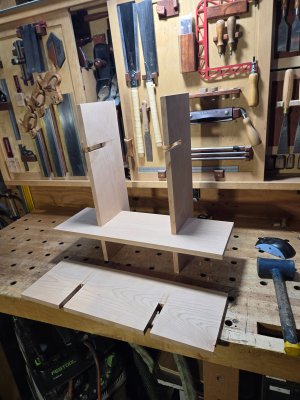
I'm designing a wall mounted bookcase for some folks where, because of the space, it can't be enclosed with an outer frame/case, and has to be assembled on site. I thought a good solution would be to make it via cross lap joints. I've done mini versions of cross lapping for boxes and drawers, but never something of this scale (assembled shelving unit would be around 6 or 7ft tall, 5.5ft wide with an 8 or 9" depth, which I'm thinking could be done via three uprights and 6 horizontal shelves). Anyway, was wondering if there are any best practices (other than dead flat boards) on sizing the boards to the groove, which leaves enough play for ease of assembly without making it too wobbly. Like if I'm working with 3/4" stock and use a .75 router bit to cut the grooves, should the boards be .73 thickness? .72? Etc.

Just did a test piece where I got the boards to around .74, but found the fit to be too tight.
 

Attachments

  • 20260108_193556.jpg
    20260108_193556.jpg
    1.6 MB · Views: 32
I’d make the cuts with a tracksaw on an MFT. Finish with a jig saw and a chisel.

Will this bookcase have a back? I hope so, mounting three uprights on a random wall precisely enough to insert a half dozen shelves would be an extraordinary feat. Although if you can get the top and bottom shelves in you’re pretty much home free.
 
I’d make the cuts with a tracksaw on an MFT. Finish with a jig saw and a chisel.

Will this bookcase have a back? I hope so, mounting three uprights on a random wall precisely enough to insert a half dozen shelves would be an extraordinary feat. Although if you can get the top and bottom shelves in you’re pretty much home free.
No back. But the uprights will extend to the floor, and i will be affixing it to the wall. I figure I will start by getting a single upright completely plumb and level, then attach that to the wall for a stable reference. Whatever looseness is built in to ease assembly can be stabilized by wall anchoring. At least that's the plan...
 
I also think assembly will be difficult and dry-fit and disassembly will be too, especially with a new finish.

In a similar situation, I considered the Domino system with both Dominoes and the Domino connector. It was a too-large investment to accomplish the one-time project.

Instead I used the Hafale spreading connectors along with 8mm dowels. It worked fine.

The video seems to assume that the connectors have some structural purpose (they do not). They are simply clamping. So the video project, from my experience, has far too few actual dowels that perform the actual structural aspect of the assembly.

You can use the connectors as an assembly and knock down device or you can use it as a clamp plus glue on the dowels. A nice system. It requires a (low cost) jig.

The hardest part of the project was remembering how many “f”s and how many “l”s are in Hafale. 😁

I got mine from https://www.homedecorhardware.com/?...MIk4T5h9qDkgMVZUX_AR2n4wrjEAAYASAAEgLWkPD_BwE

 
No back. But the uprights will extend to the floor, and i will be affixing it to the wall. I figure I will start by getting a single upright completely plumb and level, then attach that to the wall for a stable reference. Whatever looseness is built in to ease assembly can be stabilized by wall anchoring. At least that's the plan...
Another question, will the ends of the shelves fit between walls or be free range?

The uprights not only need to be plumb and level (slots) but also the same height. Which means the bottoms of the uprights will need to be scribed to the floor. Which means the slots will not be the same heights if pre-made.

How will these deep but narrow uprights be anchored to the wall? Side mounted cleats or hardware? Is it necessary or even possible to anchor into studs?

I think it will be easier and more successful (if only because everything else I can think of is even harder) to scribe, fit, and temporarily install (tape etc.) each upright, then use a laser level to mark the shelf cuts, then take out the uprights and make the cuts. If the uprights are reinstalled in exactly the same places and the slots are sufficiently accommodating then the shelves should go in nicely. Also, the fronts of the scribed uprights will also need to be rip/trimed to restore them to plumb.

But how to keep it all from falling forward? If the uprights are well scribed to the floor gravity will take care of a stable load but what if a kid climbs on the shelves? I haven’t thought of a secure way to anchor the uprights that isn’t unsightly except to put very long screws through the back of the slots into…what? Would be fine if the wall is made of wood.

The best I’ve thought of is to capture the tops of the uprights with a slotted cleat that spans the width of the installation (and a couple inches longer to lap both sides of the flanking uprights) which is screwed/anchored to the ceiling (oops, I’m assuming they reach the ceiling, minus the half inch or so removed to scribe the bottom to the floor). It should be easy to make a secure connection to the ceiling and from there down gravity is sufficient. Just add a discrete fastener at the bottom of each upright to keep it from moving until some weight is added to the shelves.

 
If the sides of the shelving unit (outside) are hidden from view, then Confirmat screws are strong and easy to apply. No special equipment required except for a special tapered drill bit and a drill-driver.

Faster and stronger than dowels, and may well be faster and stronger than Dominoes, the Confirmats only drawbacks are that they are visible, and they are not particularly cheap.

The short video shows it in use. The speaker states it was created for melamine panels, but works equally well for MDF, particle board, plywood, etc.

I buy mine from McFeely’s. They sell a starter kit, including the special drill bit, the screws and plastic plugs to hide the holes. The 7mm screws cost about $0.14 each. There is also a.5mm diameter version. I’ve only used the 7mm version. Note: The screws require Pozi-drive bits (similar to Phillips head bits, but won’t cam out).


Last edited:
Dowels for the win. Lots of them. The full shebang.
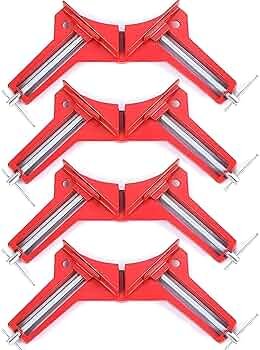
And if it does not have to be knocked down at a later time, add bar clamps and glue. I would also use picture frames corner clamps (8, as a minimum) to keep the whole thing nice and square. The corner clamps on both edges and on all 4 corners will keep the assembly square and eliminate the need for a diagonal bar clamp to square things up. But note: The corner clamps are not a substitute for the bar clamps; you will need both.

Corner clamps (usually under $4.00 each):

1768231981331.jpg


Sequence for clamping:

First glue and apply bar clamps to squeeze the dowels into place.

Then add one corner clamp to each corner on the front edges.

Then add one corner clamp to each corner on the rear edges.

Measure diagonals, but I predict that they will indicate the assembly is square.

Allow sufficient time for the glue to dry (I let glue dry for 8 to 12 hours before moving assemblies.)
 
I’ve only used that type of construction for drawer dividers, where it works really well.

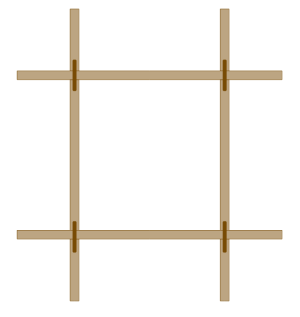
I saw the image, and I assumed that this would be a “start-over” project.

Unless the materials are costly, starting over might be faster and simpler.

The shelves look fairly deep. If it is for a room-divider where there is access from both sides, that is not an issue.

If it gets placed against a wall, access to the rear of the shelf will be compromised, and stuff will inevitably be falling off the truncated shelves at the rear.

If there is going to be doors on this cabinet, then the simplest, and most efficient resolution would be pull-outs. A couple of drawer glides and a pull-out shelf and you are done.

If there are no doors, then I would make a right vertical and a left vertical and attach shelves between them using dowels.

In any case, the design as shown would seem only suitable for a room divider or similar application.

Sorry for not having a more time-efficient answer.
 
I would (and have many times) do it as @mino showed. This was the reason for the first time I made my own Dominos. The 6 x 40 are just too short, to go through 18 or 19 mm material and into the other elements deep enough to matter. IIRC, I made them 60mm or so, enough to go 20mm into the vertical members. This makes a far stronger shelf, since it is full width, rather than cut in half, for the half lap.
It is also easy to deliver and assemble on site. Finishing also has no effect on the fit at that time.
Dowels would work too, but I already have a DF500, MFT holes, and dogs.
 
Back
Top