The main reason for using the TB III is its longer working time. In regular projects with no clamping/gluing complexities, it offers no advantages (except thumb and index finger exercise).

You are using an out of date browser. It may not display this or other websites correctly.
You should upgrade or use an alternative browser.
You should upgrade or use an alternative browser.
Glue Bottles - What you Love or Hate
- Thread starter ChuckS
- Start date
Why didn’t the AI flag that as an offensive or inappropriate image?
Renia TS-Boy Glue Pot
Optimize your adhesive applications with the Renia TS-Boy Glue Pot. Designed for ease and efficiency, this auto feeder pot ensures a clean and precise glue flow. Its sealed lock mechanism maintains adhesive freshness and minimizes waste by preventing drying. The integrated cap offers convenient...drodeatelier.com

Pretty smart AI perhaps?

onocoffee
Member
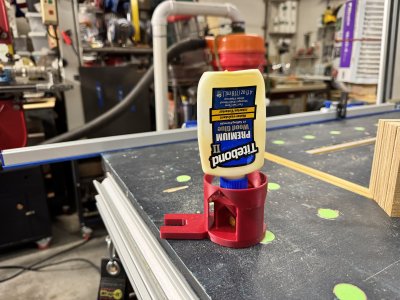
Recently, I printed this stand for Titebond 16z bottles but figured it would work with the 4z bottles since the nozzles are the same. After a week of glue-ups, I’m really liking it. It closes the cap and will catch drips. It’s not designed to reopen the cap when pulling it but that has happened a couple of times.
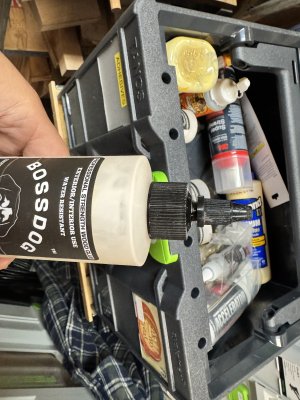
But since the summer, I’ve been using Bossdog glues that come in a twist cap that’s similar to food service bottles. I like those a lot but they don’t seat as securely in the titebond stand.
But since the summer, I’ve been using Bossdog glues that come in a twist cap that’s similar to food service bottles. I like those a lot but they don’t seat as securely in the titebond stand.
Attachments

luvmytoolz
Member
I wish they'd come up with one that has an even longer work time, maybe twice as much, large panel glue-ups are always a mad rush to get it all joined and clamped before the glue skins over.The main reason for using the TB III is its longer working time. In regular projects with no clamping/gluing complexities, it offers no advantages (except thumb and index finger exercise).
I'd happily pay extra for that.
After watching this video, I decided the bottle design wouldn't suit me:
Why didn’t the AI flag that as an offensive or inappropriate image?
Pretty smart AI perhap
Michael Kellough
Member
Can’t remember his name but one of the old timers who used to be covered by Fine Woodworking magazine was said to use plain old Elmers white glue, because it had less solids and he could get tighter joints.I hate the Titebond bottle I am sometimes forced to use in another workshop and I buy the cheapest glue I can find in Bunnings and nothing ever breaks so I don't see the point of paying a premium for Titebond when there is no advantage in the finished project.
For furniture making with hardwood/softwood, Old Brown glue (or any hide glue) gives up to 30 mins of open time. Lepage white glue is my next choice -- 20 to 25 mins of working time for complex jobs. All other regular jobs, TB original or Lee Valley cabinetmaker's wood glue.I wish they'd come up with one that has an even longer work time, maybe twice as much, large panel glue-ups are always a mad rush to get it all joined and clamped before the glue skins over.
I'd happily pay extra for that.
*TB original in one gallon
Last edited:
luvmytoolz
Member
I'll have to check out that Lepage thanks, looks like it's available from an Oz supplier!For furniture making with hardwood/softwood, Old Brown glue (or any hide glue) gives up to 30 mins of open time. Lepage white glue is my next choice -- 20 to 25 mins of working time for complex jobs. All other regular jobs, TB original or Lee Valley cabinetmaker's wood glue.

West System 105 epoxy has the longest open time, usually available at marine supply shops. There's also Titebond Extend PVA which gives you about 15 minutes. https://www.titebond.com/product/glues/d7c6f86b-93cc-4400-99ed-79f8a75a2e95I wish they'd come up with one that has an even longer work time, maybe twice as much, large panel glue-ups are always a mad rush to get it all joined and clamped before the glue skins over.
I'd happily pay extra for that.
luvmytoolz
Member
West System 105 is great but for general woodwork cleanup and inadvertent spills are messy, I like the Titebond Extend, haven't seen that one as it seems difficult to get here. I've found one local'ish supplier that only stocks the 20L drums. I'll look around a bit more.West System 105 epoxy has the longest open time, usually available at marine supply shops. There's also Titebond Extend PVA which gives you about 15 minutes. https://www.titebond.com/product/glues/d7c6f86b-93cc-4400-99ed-79f8a75a2e95
I remember two different youtube presenters who studied glue strength by brand.Can’t remember his name but one of the old timers who used to be covered by Fine Woodworking magazine was said to use plain old Elmers white glue, because it had less solids and he could get tighter joints.
Project Farm was one. He concluded the Weldbond (Frank Ross & Sons) is the strongest and best. Can’t recall which variety of Gorilla he tested in that exercise.
The other study could have been done by Stumpy Nubs or Mattias Wandel. But I am pretty sure Weldbond scored at the top there as well.
Anyone else seem any of those “scientific” style tests?
Mini Me
Member
Call me sceptical but I have always thought Titebond was a very successful marketing exercise and somewhat of a scam but that maybe too strong of a word. In 50 years of gluing stuff together I can't recall any adhesion problems with simple white wood glue. Yes, it definitely is not good in wet areas but then other alternatives including joint design have always been available. Thomas Johnson uses brown glue exclusively and he knows a lot more than me about sticking stuff together.
Mini Me
Member
After watching this video, I decided the bottle design wouldn't suit me:
Actually, I like that.

hdv
Member
I can't say whether it is "better" or stronger than Titebond, but I have always been using plain white glue (either Ponal, Bindan or Frencken, but any well-known brand would do) and to me that has been good enough. I never had a joint break on me, apart from a few cases where I had made a mistake myself. If I need especially long open times I switch to cascamite (now that it is dependable again) or a type epoxy that is made for this.
luvmytoolz
Member
1-2 hours working time, that's fantastic!If I need especially long open times I switch to cascamite (now that it is dependable again) or a type epoxy that is made for this.
Someone must like it, otherwise, the asking prices wouldn't be that high. I always prefer a simple set-up, and that means I just want to open a glue bottle and use it. I don't want something that adds extra work like a glue dish or a wedge to open the nozzle cap.Actually, I like that.
One exception is the OBG, which needs to be kept warm during its use.
As for epoxy glue, which is expensive, it has its place in woodworking, but I haven't known any furniture maker -- full-time or amateur -- in my neck of wood who uses it as their go-to glue. It's messy and hard to clean up like PVA or hide glue.
Last edited:
Packard
Member
I use TiteBond 3 exactly for that reason.The main reason for using the TB III is its longer working time. In regular projects with no clamping/gluing complexities, it offers no advantages (except thumb and index finger exercise).
I do keep some CornerWeld glue in the shop. It was designed for picture framing and it has an extravagantly short open time that is sometimes handy. It was marketed as a “high strength glue formulated for end grain to end grain joints”. And compared to the white glue (Elmers) that we were using back then, it was a huge advance.
About 10 years ago, I did a home brewed test comparing the strength of Titebond III to Cornerweld for end grain to end grain joints. There appeared to be no meaningful difference in the strength of the joint.
But I could apply Cornerweld glue to two pieces of wood, rub the pieces back and forth a few times and it would start to set. 30 seconds max.
Both are PVA glues. TiteBond III has the longest open time I could fine and it makes glue ups more leisurely.
Michael Kellough
Member
Good point about end grain. Higher solids glue is more efficient for end grain. With ordinary white glue you need to apply to both ends, wait, apply again and wait some more, and maybe once more.I use TiteBond 3 exactly for that reason.
I do keep some CornerWeld glue in the shop. It was designed for picture framing and it has an extravagantly short open time that is sometimes handy. It was marketed as a “high strength glue formulated for end grain to end grain joints”. And compared to the white glue (Elmers) that we were using back then, it was a huge advance.
About 10 years ago, I did a home brewed test comparing the strength of Titebond III to Cornerweld for end grain to end grain joints. There appeared to be no meaningful difference in the strength of the joint.
But I could apply Cornerweld glue to two pieces of wood, rub the pieces back and forth a few times and it would start to set. 30 seconds max.
Both are PVA glues. TiteBond III has the longest open time I could fine and it makes glue ups more leisurely.
Packard
Member
Corner Weld (by Framica) was formulated for miters, which is essentially end grain to end grain. But with an open time of one minute or less, not useful for most woodwork.Good point about end grain. Higher solids glue is more efficient for end grain. With ordinary white glue you need to apply to both ends, wait, apply again and wait some more, and maybe once more.
Framers, however, apply glue to one surface, put the two pieces in an underpinner and step on the pedal. Done. 10 minutes later the frame can be loaded with glass, art and backer. You could not do that with any of the Titebond products.
Fast forward to 0:50 to see how quickly miters are joined with an underpinner. Underpinned joints need glue though. Some Cinese imported picture frames try to get by with the V-nails only. It is not really acceptable. The underpinner I had was entirely manual, with the foot pedal providing all the pressure.
The Gupto Glueminator, will defenitely be picking one up myself. https://bookbindingaustralia.com.au/product/glue-potActually, I like that.
Similar threads
- Replies
- 6
- Views
- 51K
- Replies
- 14
- Views
- 12K


- Replies
- 66
- Views
- 19K
- Replies
- 1
- Views
- 624