Spraying out the doors was easy on my bench. But brushing the boxes with Advance involved a significant learning curve, as Advance is quite low in viscosity and was prone to runs on vertical surfaces. When I finally figured it out, it was easy and worked fine.
Allow yourself adequate practice brushing out the finish.
Masking the already installed boxes seemed way too much work, and overspray still seemed a worry.
I believe I can usually spot re-painted cabinets for one of the following reasons:
1. Painted cabinets of a style that is typically done in stained wood.
2. Fresh-looking painted cabinets with very old hinge hardware.
3. Small overlay with plenty of face frame showing.
4. Overspray inside the cabinets. (Especially egregious and insulting cases where the hinges are covered with overspray.)
I had to make frequent adjustments, but basically, I went from a 1/2” overlay to a 1” overlay. The doors were all made taller to cover most of the face frames. Had to make adjustments where the hinge side was flush up against a wall. (I don’t remember how I made that adjustment—special overlay hinges, or reduced door size? Not sure anymore. But workable solutions were found.)
I would note that I painted with B-M Advance, Satin, Black. The black (and other dark colors of Advance) had noticeably softer surface than semi-gloss whites that I had used earlier. I’ve been told that this phenomenon is not unusual and extends to other manufacturers and paint-types. In any case, I believe that whites will result in tougher finishes (though would get soiled more frequently.
I would also note that many of my old cabinets had hand smudges on the doors. That was largely because the handles were placed in aesthetically pleasing, but ergonomically challenging locations. I used the locations of those smudges as a consideration on where to locate the handles.
I would also note that the handle style I used is great for horizontal use in upper cabinets, but are best avoided for the same application for lower cabinets as they tend to hook onto loose clothing (a nuisance).
In retrospect, the horizontal handle placement is superior to the original, but since I used wider handles, I think they would have worked as well centered at the bottom of each door rather than bunched together near where the doors met. In any case, I seem always to use the handle to close the doors, where in the past, I would often close the doors by touching the door frame instead. So, I think an analysis of the smudge marks is a worthwhile enterprise.
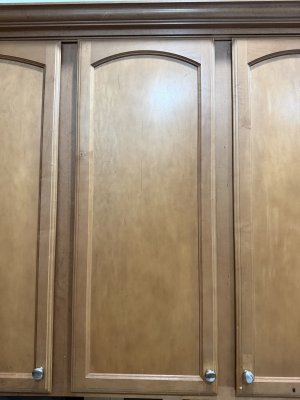
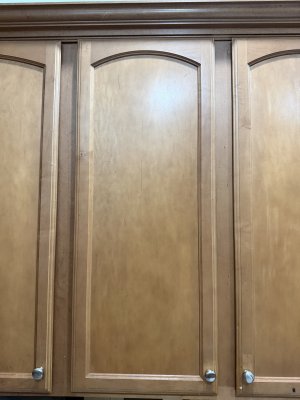
Note the upper cabinets with the horizontal handles. That location was dictated by the smudge marks. Note also the small gaps between the doors. I duplicated the earlier image for side by side comparison.


 ... Which one should I get?