Help with Blum cup hinges

bobtskutter

Member
Joined
Jun 5, 2021
Messages
421
Location
UK, England, Humberside.
Hello FOG,
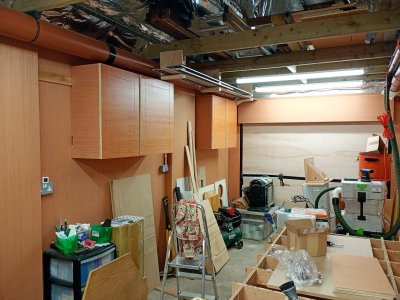
I've been making wall cabinets for my workshop.
The material is 18mm plywood.
I've used Blum 75T1550 hinges with 173L8100 mounting plates.
I planned for a 17mm overlay, to have a 1mm gap all round the door and the cabinet.
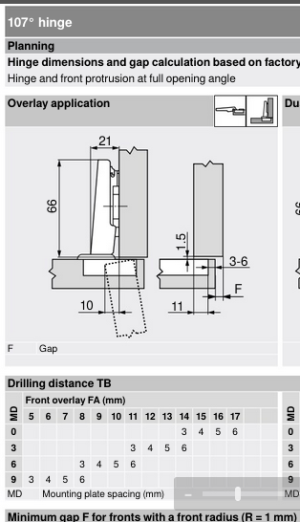
According to page 79 of the Blum manual, I need a 6mm offset when drilling the hinge cup. That means 35/2+6 = 23.5mm.

The hinge cup is drilled 23.5mm from edge of door to center line.
The plate mounting holes are set back 37mm. (I drilled through the cabinet sides because I plan to use the holes to mount shelves between cabinet boxes).

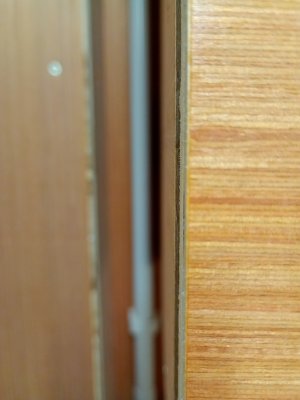
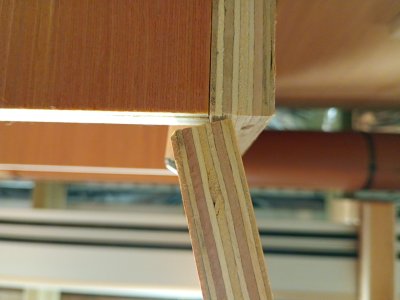
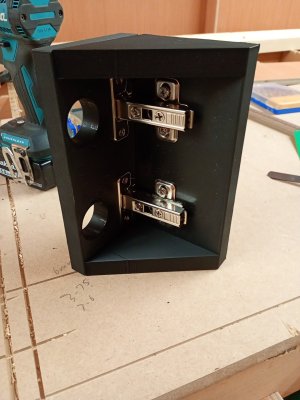
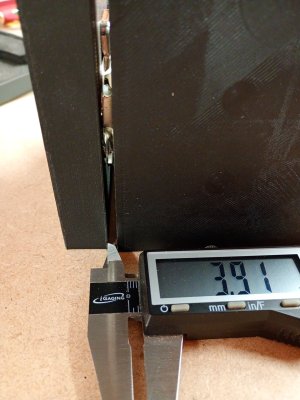
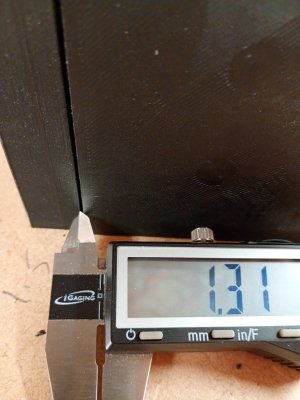
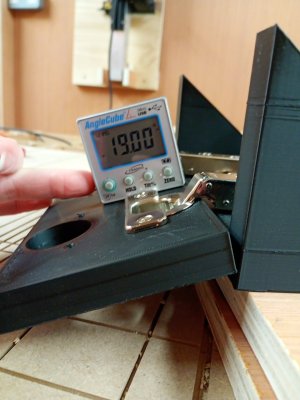
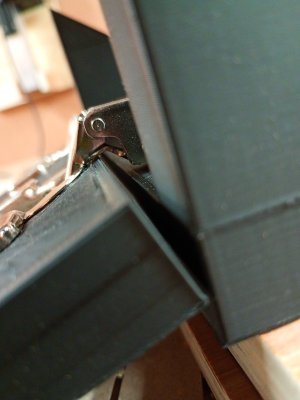
I end up with a 4mm gap to get the door to open otherwise the front edge of the door catches the cabinet side.
Is this right? The 4mm looks "wrong" and I need to adjust the hinge all the way out to get the 4mm gap!
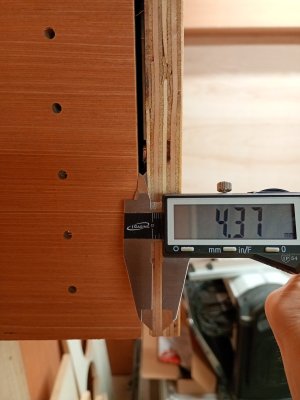
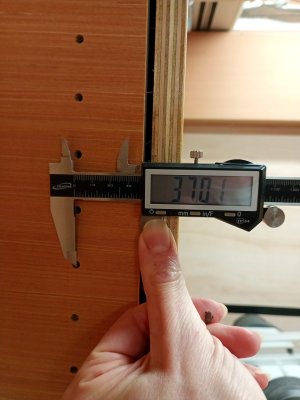
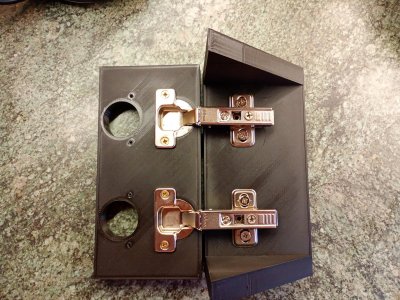
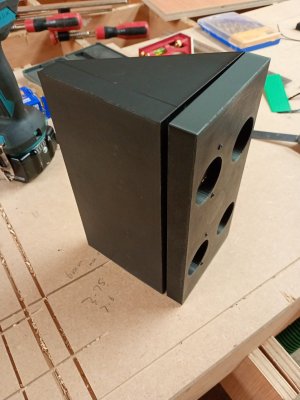
IMG_20251221_184507.jpgIMG_20251221_184605.jpgIMG_20251221_184630.jpgIMG_20251221_184728.jpg

blumcat78.pngIMG_20251221_164017.jpg

Thanks
Bob
 
Blum requires a 1mm radius on the edge of the door.

The farther the boring distance the larger the gap between the back of the door and the case needs to be. There are various thicfkness bumpers to allow the door to close on plane.

Tom
 
I normally drill the centre line of the 35mm cup @ 22.5mm from the door edge and make the doors 3 to 4mm narrower than the cabinet.
These measurements have always worked for me for many years using Blum hinges and backplates.
 
I was aiming for a 1mm gap all round with overlay doors, the doors being 2mm narrower than the cabinet. That would create a 2mm gap when two cabinets were butted up against each other. I was testing myself to see how good I was at building boxes. I was surprised at how much of a gap there was between the back of the door and the surface of the cabinet frame. 4mm looks like a lot, but as Tom pointed out I'd forgotten about the needing a small radius on the front edge of the door.

What do others do when creating slab doors and narrow gaps between doors?
Do all hinge manufactures require a big gap between the back of the door and the surface of the cabinet?

Bob
 
I was aiming for a 1mm gap all round with overlay doors, the doors being 2mm narrower than the cabinet. That would create a 2mm gap when two cabinets were butted up against each other. I was testing myself to see how good I was at building boxes. I was surprised at how much of a gap there was between the back of the door and the surface of the cabinet frame. 4mm looks like a lot, but as Tom pointed out I'd forgotten about the needing a small radius on the front edge of the door.

What do others do when creating slab doors and narrow gaps between doors?
Do all hinge manufactures require a big gap between the back of the door and the surface of the cabinet?

Bob
I think you will find that 2mm gap is not enough. In any place where two hinged panels are together, they will hit each other, even worse if you open both at once. You will be better off with 2mm.
The point of the gap has to do with where the actual pivot point hits. With most of them, because of the multiple links, the pivot is somewhat "floating".
If you look closely from above, like in that one pic, you will see the outside corner of the door move outward initially. Then it starts to roll in as the pivot point changes. After that, it moves back toward the box. This is exaggerated even more with hinges of greater opening capacity. Those doors actually push outward as they open and swing totally out of the way of the interior sides.
This is also how inset type hinges work. The door moves away from the side, as it swings inward.
 
Thanks CRG. I really don't follow what's going on with these hinges. According to the blum catalogue, they should be OK.
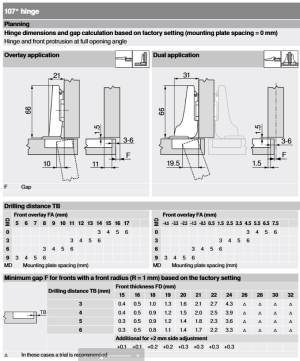
The hinges are 107' opening, overlay type. 75T1550.
This is page 78 from https://publications.blum.com/2022/catalogue/en/78/
1766476935983.png
The bottom table says the hinges are OK for 15mm to 24mm material, mines 18mm.
The hinge plate style is "zero spacing", it's a 17mm overlay so 6mm drilling distance.
The bottom table says the min gap "F" is 0.8mm to allow opening - which it is, and the doors do open OK.
The top left picture also shows a 1.5mm gap between the back of the door and the front of the cabinet - this is quite clearly wrong, that gap is more like 4mm to allow the door to open fully.
I even made a test piece with a 6mm round over on the front edge of the door, and that still required a 4mm gap.

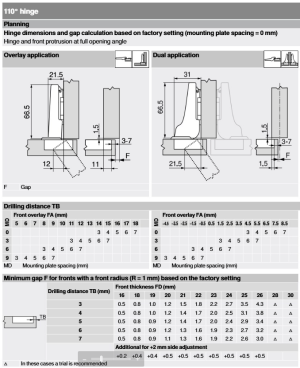
If I change to 110' degree 71T3550
1766477354851.png
The bottom table says the hinges are OK for 16mm to 26mm material - 2mm thicker than the 107' style hinge.
With a "zero spacing" mounting plate and 17mm overlay the drilling distance is 6mm, the same as the 107' style hinge.
The bottom table says the min gap "F" is 0.8mm to allow opening.
It appears as though the 110' and 107' hinges have exactly the same drilling positions and clearances to allow full opening.
But the picture top left shows the front edge of the door comes to rest in a different location - which it would do because the hinge is opening to 110'.

It really seems as though I'm missing something here.
The diagram clearly show a 1.5mm gap between the back of the door and the edge of the cabinet
The hinges are good for 18mm material.
But the door doesn't fully open with a 1.5mm gap, it needs to be bigger.

I'm probably overthinking this....

Bob
 
Hi Bob,

If you think of it in terms of a kitchen cabinet, for example.....

A 500mm wide kitchen cabinet will have a door width of 495 or 496 or 497, depending on the manufacturer. ( The European manufacturers tend to have narrower doors @ 495 with a 2.5mm gap at each side)

Aesthetically, the wider the door, the better it looks when 2 or more cabinets are fitted together, but the measurements I've quoted above have been recognised and accepted in the industry for many decades.

A 4mm gap between the back of the door and the face of the cabinet when the door is closed, does not sound right to me at all....?? A 1mm or 2mm gap would be the norm, which would be the thickness of a bump stop on the non hinged side of the door.

Try and do a mock up based upon the measurements I've mentioned in my Post#4 above, and I'm confident that you will get that hinge and mounting plate to work correctly.

Tim.
 
There is a dizzying array of hinges and plate combinations. The "zero" plate, that they are basing the standards on, is the thinnest one. Pretty much all of the offsets are made to work with it, but there are variants, essentially in 3mm increments. These thicker plates move the door and its pivot point, while keeping the same hinge. That allows you to use a full overlay hinge in a dual-door application, using the right plate. (based on the thickness of the partition panel)
Personally, I'm not a fan of kitchen cabinet doors over 18" (450mm), especially with cup hinges. Wider doors do look "clean"/ less busy, but functionally, they are not as friendly. The leverage gets to be a bit much, so you end up adjusting so sag out of them. This is especially bad with odd cabinets, like the short ones above a refrigerator or microwave. More than a few times, I have seen these where they are wider than they are tall. That is always a problem.
 
The garage cabinet build was really me practicing building cabinet boxes. It's probably simple stuff for the pros, but being a hobby work worker it was a great test of my planning and building "skills". Cutting everything oversize to account for the plywood bowing, then resizing with the table saw and trimming to length with the track saw was a good skill to practice. I drew out all the domino positions on a cabinet box (stole that idea from FOG ;) ), it made life so much easier. Everything went together really well. Even the door sizing turned out OK (they have a 1mm reveal all round the cabinet, but they are a little too big).

But the hinges are almost witchcraft!!
I need to build some test pieces and experiment with different hinges, but that's not an easy thing for a hobbyist since I only buy them when I need them. Probably need to plan a specific project to test hinges.

Regards
Bob
 
Back
Top