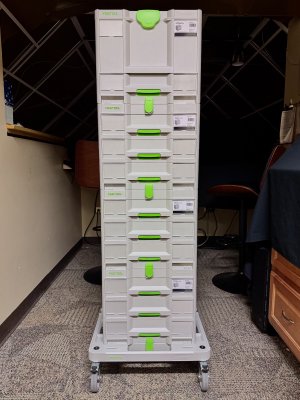
How are you Organizing Your Festool and Systainers?

It's been a long time since I looked, but I seem to remember heat pump/mini splits that had an electric resistance coil for times when the heat pump was inefficient.
That doesn't make them more efficient..
It's also rather hard on the grid. Some local governments here require the resistive elements not be connected // disabled for new housing. That sometimes results in the heatpump being chosen 1 step bigger, but then running at higher efficiency.
 
It's been a long time since I looked, but I seem to remember heat pump/mini splits that had an electric resistance coil for times when the heat pump was inefficient.
Traditional heat pumps tend to have some form of auxiliary heat. I haven't seen much evidence of that on more current generations of Mini Splits as they are more efficient than regular heat pumps, but it's certainly a possibility that some might have it. (Our heat pump here in the house uses oil for auxiliary heat when outside temps drop below about 30ºF...last month was darn expensive!)
 
It's been a long time since I looked, but I seem to remember heat pump/mini splits that had an electric resistance coil for times when the heat pump was inefficient.
They can, but not all of them are so equipped. It's an added expense, additional power, etc.

When it gets down around zero, mine can't satisfy the thermostat. It runs, doesn't shut off, and it froze up once.
 
Unless you plan to resign yourself to not going out there much in the winter I wouldn’t give up the warm floor. So, get both, or just the boiler and an AC.
This.

The best of both worlds is to run the floor at a comfortable but low temperature, think 20C or so, so it does not raise dust, while heating the air/walls with the split.

That doesn't make them more efficient..
It's also rather hard on the grid. Some local governments here require the resistive elements not be connected // disabled for new housing. That sometimes results in the heatpump being chosen 1 step bigger, but then running at higher efficiency.
Actually, it does as the compressor life is not being wasted. The argument it being "hard on the grid" is ridiculous and technically wrong, assuming the pump is configured correctly. A pump running at too low a temp can absolutely see the compressor take more power than the amount of heat it can transfer. All depends on the unit.

IMO the reason this is being discourages in NL is twofold:
Firstly it is about having an under-sized power generation for winter, with an overextended grid, cutting off even few percent of consumption, however inefficient, when done during the critical winter period is worth it. Even running a heat pump at 110% efficiency to eke-out those last 10% of paper efficiency at the cost of an early death may be the better option when it helps avoid a whole grid collapse. But this is a uniquely Western EU mess from broken grids and too little backup generation capacity.
Secondly, I cannot imagine this being much of a concern in Netherlands of all places. I mean, when was the last time you had a week of continuous -15C as the high temp during day ... if ever. So this rule kinda makes sense in your mild-ish climate. But not in general/for all climates.

 
Last edited:
Systainers do not enjoy too varying of a temperature. Keeping them cozy is absolutely relevant.
Honestly, this is also true of the tools. Yes, they can tolerate big temp swings but like anything, "moderation" is a good situation. I condition the shop, not just for me, but also to avoid condensation related pains with cast iron surfaces, for example. And if the space is comfortable, it means I can go out there and admire the Systainer storage without bundling up so much or stripping down to nearly nothing. :) :D :P

BTW, on the comments about in-floor radiant, for folks who live in a geography that has a definite and long cold season, it's absolutely worth it. Radiant isn't good for areas where there's a lot of up and down because it needs to be turned on once in the late fall and left to run until it's no longer needed. Radient is heating the mass of the floor which in turn heats the air...and it's not "quick to adapt".
 
Wish I had radiant but now it's too cost prohibitive to install. However, the garage concrete slab usually hovers around 40F most of the winter - except for those few weeks when we really dipped into the teens. Then the slab was around 32. At 40F, I use a propane heater and it gets to be pleasant enough.

Summers here - once the slab warms up and we get to the dregs of late July, I just wait until nightfall. Or September.
 
Back
Top