
I need some elegant door stops

I bought 3M’s Bumpons, also by the thousands. They were self-adhesive and have a flat face. I used two at the bottom corners of every picture frame I produced.

I have plenty in stock, so naturally I used them for doors. On frequently used doors, they are fine. But if left resting against a smooth surface they would adhere.

I have a glass topped coffee table. I will probably have to use a razor blade to separate the glass from the bump on. In any event, I don’t use them for that purpose anymore.

I used to be able to find black rubber versions, but they seem to have disappeared fro the market.
As I mentioned we don’t do many overlay cabinets. These are the bumpers we use now, they have a small contact area, never had a complaint of them sticking. Biggest issue is they fall off the sheets moving them. My supplier will send me one sheet when I need them.
The girls in the shop call them nipple bumpers……..


Black bumpers are still available.


Tom
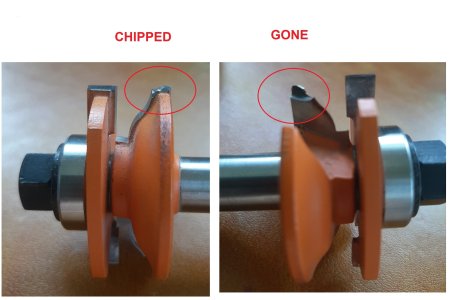
 
But I'm gonna have to check my cutter set --- on these doors, the stiles really wanted to roll a bit, with the outside edge wanting to roll towards the back of the door.

Ouch.
The one side of the stile cutter is chipped, and the other side of the cutter is totally gone.
No wonder I had to hand work every joint.
Pau Ferro Janka hardness of 1960 is hard, but shouldn't be breaking carbide.
That set was expensive. I don't recall seeing cutters being sold separately, but will enquire.
 

Attachments

  • Stile Cutter.jpg
    Stile Cutter.jpg
    325.2 KB · Views: 9
Ouch.
The one side of the stile cutter is chipped, and the other side of the cutter is totally gone.
No wonder I had to hand work every joint.
Pau Ferro Janka hardness of 1960 is hard, but shouldn't be breaking carbide.
That set was expensive. I don't recall seeing cutters being sold separately, but will enquire.
I have several CMT bits and I have always considered them to be top quality. So I was surprised about the damage. Some Internet research revealed a probable cause, shown below in bold face, red.

Silica, of course is “sand” and is perfectly capable of damaging metal, or even carbide, parts. (And is why you should never bring a film camera to the beach—a few errant grains of sand can turn your old Nikon into a paperweight.)

Bubinga (often called African Rosewood) is a highly desirable wood, but it presents several specific challenges during machining due to its extreme hardness, density, and, at times, high silica content. Common problems include rapid dulling of tools, severe tear-out in figured pieces, and burning. FineWoodworking +4
Here are the main problems and challenges associated with machining bubinga:

  • Rapid Tool Dulling: Bubinga is very hard and dense, and some pieces contain embedded silica (grit), which is a common cause for rapid dulling of saw blades, planer knives, and jointer knives.
  • Tear-Out on Figured Grain: While straight-grained, flatsawn boards are easy to work, boards with interlocked or "rowed" grain are prone to severe tear-out during planing.
  • Burning: Due to its density, bubinga can burn easily when being cut or sanded, particularly when using slow feed rates or dull blades on a router or tablesaw.
  • Sanding Difficulties: The natural oils in the wood can cause sandpaper to clog ("gum up") quickly, rendering belts and discs useless rapidly.
  • Glue Failure: The high density and natural, waxy oils in the wood can impede glue, making strong adhesion difficult if the surfaces are not properly prepared.
  • High Resistance to Cutting: Because of its hardness, it is challenging to carve with traditional hand tools, requiring high-speed steel or carbide-tipped tools instead.
 
It was a 3 piece CMT set. I just got a reply from the vendor --- I don't have to buy the 3-piece set, but I would have to buy the rail/stile bits as a set. Oh well, still half the price of the 3 piece set.

The rail and stiles were Pau Ferro (AKA Marado, aka Bolivian rosewood), not Bubinga. Hard, but not as hard as Bubinga. However, the raised panel on those doors was bubinga, but that cutter survived. Many light passes.

I remember first time I used bubinga. First, I had to resaw some 8/4 in two. My carbide tipped bandsaw blade was going all over the place.
Then I put in my planer to clean up that horrible cut. Could only take a few thousanths off per pass. I got out my phone to check what the hardness of bubinga was --- "oh, 2500 pounds, no wonder"
By the way, when resawing very hard wood, first rip a slot on top and bottom on table saw -- the bandsaw will then follow inside of the rip cuts. (did that second time resawing bubinga)
 
That's really weird, I use Bolivian Rosewood quite a lot with my CMT panel set, and also machining on the CNC with $2 two flute straight and cove cutters I buy in bulk from Temu, and have never had chipping like that at any point as a result.

Teak and Blackwood (Acacia) are also very high silica content timbers I do a massive amount of machining with, with the only result being that they only dull the edge after a while, but never chip.

In fact I've never had a chipped cutter like that except for cases where it's hit the hold downs while machining.

I really think there has to be something else at play here. Maybe a fault with the grain on the TCT?
 
Last edited:
Back
Top