MFT/3 table leg clamps

kwakefield

Member
Joined
Jun 6, 2022
Messages
14
I’m brainstorming a way to hold long pieces of plywood vertically against the side of the MFT/3 table so that I can iron on edge banding. The plywood will be longer than the table so using the top t-track and clamps from the side is not a viable option. I’m envisioning supporting the piece from underneath with a clamp or two to keep it from falling away from the table.

Two paths come to mind.
1) build a couple pieces that connect to the table via the t-track and hang down far enough I can clamp the bottom of the wood.
2) clamp a cross piece between two of the table legs that can support the plywood and clamp to.

If I go with option 2, what kind of clamps should I be looking for that I can then attached to the cross piece?

Any other suggestions for long vertical support on an MFT/3?

Thanks!
 
Make a panel that attaches to the t-track. Put a rail on the bottom of the panel to support the workpiece. If mainly using one thickness of material, you could add another rail, forming a 'U' shape to capture the workpiece.
 
To ask the obvious question, why not lay the plywood flat on a table, and then apply the edge banding to the “awkward sides”?

The old fashioned Handscrew Clamps serve nicely for holding the panels in a vertical position. Of course, the panel’s height cannot be too tall.

I used the Fastcap holders before learning about the Handscrew Clamp method.

 
Make a panel that attaches to the t-track. Put a rail on the bottom of the panel to support the workpiece. If mainly using one thickness of material, you could add another rail, forming a 'U' shape to capture the workpiece.
I think I'd use the vertical panel as suggested, but first drill the vertical panel with 20mm holes using the LR 32 in 96mm increments rather than bother with a fixed rail. I'd use quick clamps through the 20mm holes to get the height right for the workpiece. :)
 
If you have a photo or two of a similar solution, that can help to tickle our brains.

Recently @builditnotes had a video for unique clamping solutions with the MFT table.

Perhaps you and he can brainstorm on a few ideas.

 
I like the approach but I wonder if he really needs that jig to hold everything. I wonder if it might be simpler to use a Hongdui (or TSO) planing stop to hold both the flat workpiece as well as the bird's mouth jig. Of course, you'd have to widen the bird's mouth jig to span across three MFT holes to center it with the middle line of holes for the SP clamp.

 
If you have a photo or two of a similar solution, that can help to tickle our brains.

Recently @builditnotes had a video for unique clamping solutions with the MFT table.

Perhaps you and he can brainstorm on a few ideas.


That is me :) I am trying to make a few jigs that will help ... in between orders and deliverables of course.
 
I like the approach but I wonder if he really needs that jig to hold everything. I wonder if it might be simpler to use a Hongdui (or TSO) planing stop to hold both the flat workpiece as well as the bird's mouth jig. Of course, you'd have to widen the bird's mouth jig to span across three MFT holes to center it with the middle line of holes for the SP clamp.

Thanks for the link to the planing stop. I didn't know that product existed. I would like this even more if it were wood and thus it would not damage my hand plane blade if there was accidental contact Also, this gave me another idea of something to try.
 
Thanks for the link to the planing stop. I didn't know that product existed. I would like this even more if it were wood and thus it would not damage my hand plane blade if there was accidental contact Also, this gave me another idea of something to try.
I have seen a video where someone made a plane stop such as this from wood. So, be sure to post a pic once you're done!
 
I use a 5 gallon bucket or stacked Syatainers, again, I’m just a lazy guy……..

Tom
Perhaps a workpiece supporting device corollary to the workshop law of hammers rule that states that "any tool within reach can be converted to use as a hammer"
 
IMG_2093.jpeg
IMG_2092.jpeg
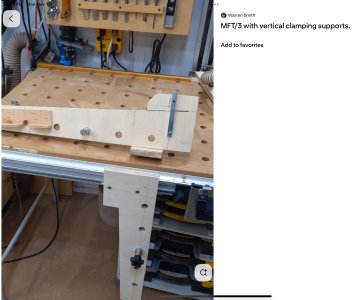
Thanks for all the replies and suggestions! This is what I’m after. I am making progress with option 1 (the vertical board that attach via the t-track in the side extrusion). Rather than cut a rail joining bar in half I modeled up and 3d printed a t-track slider. The important part is that I’ll be able to support the plywood panel from underneath as they will frequently be longer than the MFT/3 so clamping using the t-track directly is not possible.
 
#1 looks like a good solution provided the MFT is locked down someway …by its self it will move all over the place when planing
*edit-sorry you are most likely well aware of that….and if just edge banding maybe you’re fine
 
#1 looks like a good solution provided the MFT is locked down someway …by its self it will move all over the place when planing
*edit-sorry you are most likely well aware of that….and if just edge banding maybe you’re fine
No planing, just iron-on edge banding. The last batch I did sitting on the concrete floor of the carport. That was too awkward to ever want to repeat.
 
View attachment 379452
View attachment 379453
Thanks for all the replies and suggestions! This is what I’m after. I am making progress with option 1 (the vertical board that attach via the t-track in the side extrusion). Rather than cut a rail joining bar in half I modeled up and 3d printed a t-track slider. The important part is that I’ll be able to support the plywood panel from underneath as they will frequently be longer than the MFT/3 so clamping using the t-track directly is not possible.
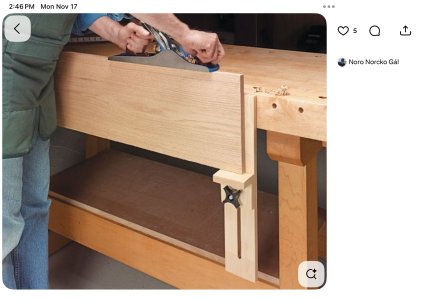
This is nice. There must be a hidden (by the persons body) support that pulls the board towards the table.
 
Back
Top