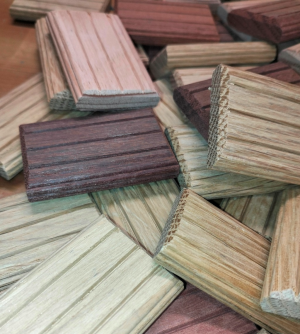
Safe way to make Domino tenons

Just my two cents...I don't usually think the sides of a domino offer much. I'll just cut a wider domino with the machine, and then rip the domino square sided. Occasionally I'll take a few passes with a low angle block plane and give the sides a rough chamfer. It's nice to have some extra wiggle room on the sides when gluing up a large number of dominoes, and extra width also gives space for any extra glue. The top and the bottom of a domino are structurally enough for most of my work, small and big—unless I really want perfect alignment—and even then, that's usually just a matter of adjusting while clamping.

I fret the near perfect thickness of the domino. To my mind that's the important factor. In softwoods, I'll do a test, and sometimes leave them just a fraction of a hair thicker for snug alignment. Especially in larger thickness dominoes from the XL.

 
Where added structural strength is desired, for example, in a butt joint, or where precise alignments are needed in a narrow to narrow mortise setting, full-width tenons are better than squared-off ones. Three-way miters are another joinery example where squared-off tenons may not be ideal.
 
I know some don't believe in even glueing the tenons in, let alone rounding the edges, but I like maximising the glue contact surface as much as possible and I love being able to use wider tenons, so I use the side profile cutters from findbuytools.com to machine the edge grooves easily and safely, and then use a pattern bit to do the grooves on the faces in one pass.
 

Attachments

  • Domino.Tenons.png
    Domino.Tenons.png
    2.3 MB · Views: 10
Last edited:
+1. Grooved/fluted dowels are better than dowels for dowel joints and the same goes for dominoes.
 
For making long strips of Domino tenons, this happy fella has a simple 5-minute holder to safely use the router table.
Nice video.

I did something similar when making some white oak domino through tenons, but I used a setup of four feather boards on my router table. That worked fine.

I suppose making a permanent jig would be good if one needed to make a large amount of tenons repeatedly over time.

Bob
 
I employed the feather board approach, too, one time when I needed to make my own. More than one permanent jig will be needed to make all the sizes if they are used.
 
Back
Top