Speaker building

This weekend I got the chance to work on the speakers. I machine all the mortise on the speaker panels. I glued them too.
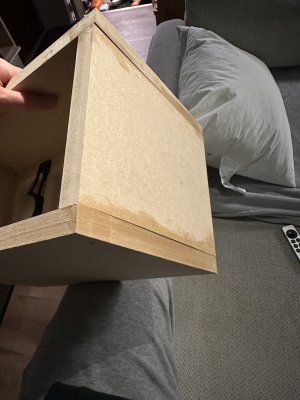
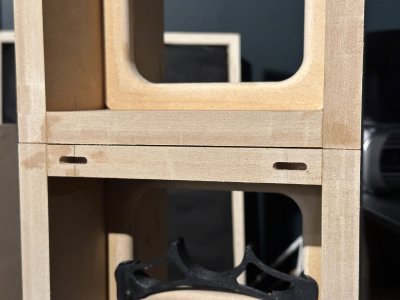
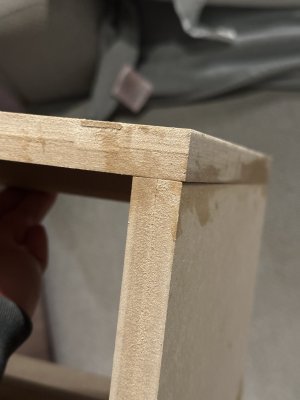
There’s a small mid alignment that occurred.
Any idea on Why it’s happening?
I’m sur my setup was sub optimal, but the first enclosure I did came out perfect.


IMG_8154.jpegIMG_8155.jpegIMG_8156.jpegIMG_8157.jpegIMG_8158.jpegIMG_8159.jpegIMG_8160.jpegIMG_8163.jpeg

Next step would be to machine all the groove/reveal between the the sides and top/bottoms and baffle and back panels.
 
Looks like you might have fallen victim to placing the mortise almost exactly in the middle of the stock, then placed one workpiece piece upside down?

Especially with such indistinguishable stock like mdf, mark the hell out of every piece before you cut mortises to make it clear what’s what.
 
Looks like you might have fallen victim to placing the mortise almost exactly in the middle of the stock, then placed one workpiece piece upside down?

Especially with such indistinguishable stock like mdf, mark the hell out of every piece before you cut mortises to make it clear what’s what.
Best advice ever :)
I'm about two weeks into my learning curve with my new domino and I have done a 180 flip on somethings I thought before I got it. For example, the project I am working on has really highlighted for me the benefit of off-centre/offset mortises to help keep track of things! And all the parts are a mass of blue tape with notes, numbers and orientations :ROFLMAO:
 
Looks like you might have fallen victim to placing the mortise almost exactly in the middle of the stock, then placed one workpiece piece upside down?

Especially with such indistinguishable stock like mdf, mark the hell out of every piece before you cut mortises to make it clear what’s what
I thought of that, but there a rabbet in all on my pannel. Maybe I’d flip one of two, but I thought having the rabbet on the pannel would make it obvious.

I’ll take extra care next time.
Great job on the speakers.
It's really impressive to see your broad skill set all coming together in one piece - love it! 👏👏👏
Thank you so much! Love doing it with nice tool!
 
I just saw theee pictures on a desktop computer, they're HUGE! sorry about that!

I'm scared my question got lost in the previous post.

I'm not sure how the finishing would go. I'm wondering how to proceed when it comes to glue sand and paint.
Knowing its mdf, and when I will coat with primer, the mdf will fuzz. I'm using zinser white shellac primer. I'm scared about sanding the 3/16 groove when the mdf fuzz after the primer.
I was thinking of doing:
  • masking all surface that would have glue in the glue-up,
  • painting the first coat of primer.
  • sand the primer.
  • glue
  • glue clean up
  • spot fill and sand using timbermate woodfiller
  • second coat of primer
  • sand
  • and paint using a matte/flat ultra washable paint, like benjamin moore scuff-x or sherwin william Scuff tuff.
I also seen online that some people like using a mixture of 50/50 of timbermate woodfiller and water to seal the MDF edges.


What would you guys do ? what do you think about my workflow ?
For ultra-flat paint, I would suggest General Finishes’ “milk paint” which is actually a modern exterior grade acrylic finish meant to replicate the appearance of milk paint.

They claim no primer is required. I used SealCoat dewaxed shellac for improved adhesion and to prevent raising the “grain”, which with MDF looks like 80 grit sandpaper.

Applied with the recommended foam brush or the not recommended bristle brush, it yields a perfectly flat and smooth surface finish with no hint of brush strokes. It brushes on better than any other finish I have tried. But water-based and the MDF must be sealed before applying the paint. US SealCoat or BIN pigmented shellac for that purpose. I find that the SealCoat is less likely to leave brush strokes on the finish.

I used grain filler (intended for open grain wood floors) applied with a rag like shoe polish, then lightly sanded. Once dry, the grain filler sands easily and cleanly. Then the shellac, then the GF “milk paint”.

But note that matte finish can show scuff marks rather easily. A clear coat will protect the finish. But note that a semi-gloss or matte finish clear will make the black finish look like dark gray. I found that using gloss finish and then hand rubbing with 0000 steel wool used with wax, yields a better result. The wax and sanding leaves a silky feel and feels rich to me. But they also sell “wool-oil” if you don’t want to use wax. The steel wool knocks down the glossy finish. Using 000 will result in a lower gloss, but I have not tried that. Make tests for whatever finish you want. Matte finish black offers some difficulties.

I made a table top with two layers of MDF and the edge finished with grain filler, seal coat + gold sign paint. The seam is entirely invisible. I will post an image when I get home.

ADDENDUM:

Below is an image of a table top made from laminating two layers of 3/4” thick MDF. The edges were prepped as described above, and finished with 1-Shot sign painters’ paint in gold. I will add a detail shot shortly.

The detail will reveal some brushstrokes, but will not reveal the seam between layers of MDF. The grain filler took care of that.

Note: This was made from older MDF stock with glass-smooth calendared flat surfaces that did not need to be grain filled or sealed. The stuff I can find does not have that glass-smooth flat surfaces, and likely will need sanding and filling to get a really nice finish.


 
Last edited:
MDF sands down quickly. You can probably simply sand it to alignment. It looks as though those surfaces mate and are hidden from view. Sanding might be the easiest way to get things to seat.

I’m not a big fan of shims, but that might be another alternative. But shims might be needed if you want to keep the sides aligned. Since shimming is reversible, I would make a test using shims.

Card stock is a quick and easy way to test this. Cut pieces of file cards to make the shims. You’ll want something more dimensionally stable for the final assembly, but it would make a quick test. Iron on veneer would be a more stable product and still easy to use. You can stack it for greater depth.

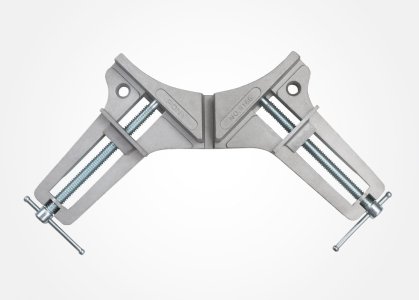
I use picture framers corner clamps (8 to a box). Since using them, all my boxes have been coming out perfectly square. I never have to corner to corner clamp.

Even the cheapest ones seem to be accurate enough for this purpose. I believe I spent under $2.00 each for mine.

Addendum: I see that they are now four for $15.00 on Amazon. I did not check Harbor Freight.

This is the clamp I was speaking of. Eight are required for a box.

1764188624475.jpg
 
Last edited:
Just a quick update. havent taken any pics in a while, but I' m done machining all the domino in the baffle, back, and boxes. I primed and filled most of the little hole and what not.
I'm waiting on my router bit for the groove/reveal in the enclosure. My router table is really not up to code for this operation. I got this router bit :

I tried using aluminium extrusion as a fence, but needed to align both side of router bit and with the vibration cause by the router, the fence moved ever so slightly and cause the rabette/groove/reveal to be off by a mm or 2.
I think with the bearing it'll be a lot easier.

once that operation is done, ill prime a second coat, and then paint. Once in painted, I'll install the crossover in the enclsure, glue the back pannel, install the port (inside portion). Glue the baffle, install the driver, and I think we'll be good to go!
 
I’ve used an edge banded ready-made shelf as a straight edge for trimming with a router. I bought a white laminated shelf from Lowes for that. Grab two and press the edge-banded edges together. If there are no gaps in the mating of the two shelves, then they are straight. Most are. Then just buy the one(s) you need for the job.

I don’t have my shelf anymore, so I think I must have used it for a project I did in for my garage.

In any case, it is cost-effective and readily available. Nice wide surface for clamping. I think I bought the 12” (nominal, 11.7” actual) width. They also make a 15.7” wide shelf.

The 12” x 6’ costs $20.00 and is edgebanded on one edge only. The banding makes for a very smooth bearing surface for your router bit’s bearing or your router’s bushing.
 
I’ve used an edge banded ready-made shelf as a straight edge for trimming with a router. I bought a white laminated shelf from Lowes for that. Grab two and press the edge-banded edges together. If there are no gaps in the mating of the two shelves, then they are straight. Most are. Then just buy the one(s) you need for the job.
Melamine makes a great straight edge, you can barely see daylight between two sheets butted up usually! I was using one just last night to trim some shelves for an overhead cupboard!
 
that a good idea! I just would have needed to drill a little hole for the router bit, or even just raise the router so the bit cut the shelf.

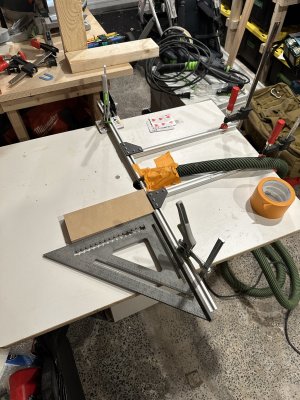
heres my ghetto setup:
Using a square to push a sacrificial mdf piece not to blow out the speaker enclosure. taped hose for dust collecting. Melamine sheet for a table top, on a ikea cabinet hahaha.
20251030_160236044_iOS.jpg
 
Back
Top