
You are using an out of date browser. It may not display this or other websites correctly.
You should upgrade or use an alternative browser.
You should upgrade or use an alternative browser.
Using Hardwood Oak Flooring to Make Panels
- Thread starter onocoffee
- Start date
Thx for the file share. How stable is the setup? I've seen some wooden versions that the bottle and stand can still be knocked down easily.@Michael Kellough Typically (and for this first panel), I used 6mm dominos - but if it's really just for alignment, I could use 4 or 5mm, right?
@jeffinsgf - I just came across that stand and printed it the other day. This is the first time using it and I really like it. This version holds the bottle upright and will close the nozzle. Fantastic. It does not re-open it when pulling it out - just closes. Printed in PLA on Bambu P1S.
Wait. There're more stable options: https://makerworld.com/en/models/943238-titebond-glue-bottle-holder-upside-down#profileId-2462690
This also looks interesting: https://makerworld.com/en/models/12...le-opener-stand?from=search#profileId-1304281
Last edited:
Michael Kellough
Member
With nice flat nominal 3/4” stock I use 5mm Dominos. If the stock isn’t nicely flat and a little torque will/might make it flatter (requiring less sanding) I’ll use 6mm tenons in the area that needs help.

onocoffee
Member
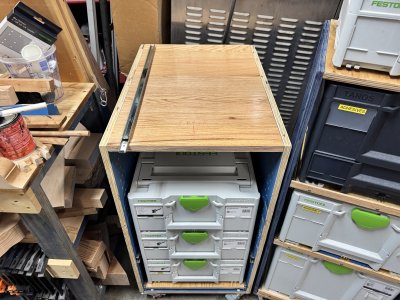
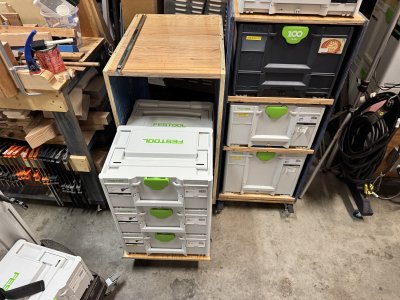
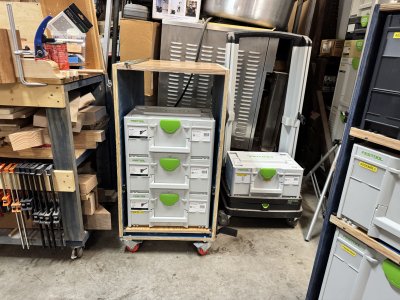
I’ve assembled the first of four (maybe six, eventually) cabinets using the hardwood flooring. The idea is that the overall height is 920mm (36”) and they will, eventually, gang together to make a unified miter saw station (presuming I ever get a Kapex).
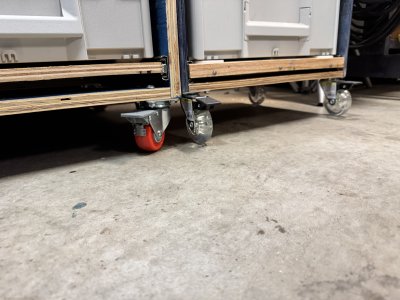
For the most part, they’re meant to sit in one place for a long time. They are on casters so they can move as I reconfigure the garage but mostly stationary. My one question is if I’m going overboard on the casters. The orange ones are WoodRiver Double-Locking coasters that I’ve used for tool cart builds and they are excellent.
For other cart builds, I’ve used poly skate locking casters from Harbor Frieght. They’re about half the price and work well enough. The locks are so-so but the carts I use them for either sit in one position for a long time (kinda like the intent for these sys cabinets)) or I don’t really need to lock them down significantly for any operation. Should I drop the WoodRiver and go with the Harbor Freight? The WoodRiver are on sale this month so they’re at a good price.
And lastly, the more I build these cabinets either using SYS-RAILS or SYS AZ or making my own slides, it’s a bit irritating to see how much vertical space I lose. In the cabinet, I could stack another M187 but with the slides there will only be enough room for three with some extra space that won’t squeeze an M112.
At least they’re double-depth.
For the most part, they’re meant to sit in one place for a long time. They are on casters so they can move as I reconfigure the garage but mostly stationary. My one question is if I’m going overboard on the casters. The orange ones are WoodRiver Double-Locking coasters that I’ve used for tool cart builds and they are excellent.
For other cart builds, I’ve used poly skate locking casters from Harbor Frieght. They’re about half the price and work well enough. The locks are so-so but the carts I use them for either sit in one position for a long time (kinda like the intent for these sys cabinets)) or I don’t really need to lock them down significantly for any operation. Should I drop the WoodRiver and go with the Harbor Freight? The WoodRiver are on sale this month so they’re at a good price.
And lastly, the more I build these cabinets either using SYS-RAILS or SYS AZ or making my own slides, it’s a bit irritating to see how much vertical space I lose. In the cabinet, I could stack another M187 but with the slides there will only be enough room for three with some extra space that won’t squeeze an M112.
At least they’re double-depth.
Attachments

luvmytoolz
Member
Nice cabinets, I love good organisation like that, should do it myself one day! ;-)
I'm a sucker for the PU wheels as I tend to overload the weight by a large margin at times, and they're the only wheels I've found that don't deform from weight, or from sitting too long in the one position.
Even if they're more expensive, I think they're worth it as they last so well, and move much easier than softer wheels.
I'm a sucker for the PU wheels as I tend to overload the weight by a large margin at times, and they're the only wheels I've found that don't deform from weight, or from sitting too long in the one position.
Even if they're more expensive, I think they're worth it as they last so well, and move much easier than softer wheels.
Michael Kellough
Member
This is not a criticism of your cabinets but a question for whoever way back when decided the sides should overlap the top and bottom.
Just bringing it up here because your photos clearly illustrate the plan, which is the one most often seen.
Since the bottom has to carry the weight of the entire cabinet and contents why isn’t it the full area of the cabinet?
Especially when the weight is carried by casters so most of the support (from the caster) is not even under the side panel.
Similarly, the top has to carry the load placed on it, which could be considerable.
All the load from top to bottom is carried by whatever screws or pins connect the sides to the top/bottom panels.
At least in kitchen base cabinets the countertop overlaps the sides so the top fasteners aren’t over stressed.
To me the only logical way to construct a cabinet is to have the top/bottom overlap the sides.
Just bringing it up here because your photos clearly illustrate the plan, which is the one most often seen.
Since the bottom has to carry the weight of the entire cabinet and contents why isn’t it the full area of the cabinet?
Especially when the weight is carried by casters so most of the support (from the caster) is not even under the side panel.
Similarly, the top has to carry the load placed on it, which could be considerable.
All the load from top to bottom is carried by whatever screws or pins connect the sides to the top/bottom panels.
At least in kitchen base cabinets the countertop overlaps the sides so the top fasteners aren’t over stressed.
To me the only logical way to construct a cabinet is to have the top/bottom overlap the sides.
Last edited:
onocoffee
Member
Thank you. I'm not a cabinet maker, so I don't really know much of the difference in the way they are assembled. Many years ago, when I made cabinets from plywood (for a 19" rack cabinet), I made them in the manner you mentioned (tops and bottoms overlap the walls). This past year, I've seen cabinet makers make them in this manner and have been following that. Thinking about it now, it makes sense since those cabinets would have a countertop mounted to them.This is not a criticism of your cabinets but a question for whoever way back when decided the sides should overlap the top and bottom.
Just bringing it up here because your photos clearly illustrate the plan, which is the one most often seen.
Since the bottom has to carry the weight of the entire cabinet and contents why isn’t it the full area of the cabinet?
Especially when the weight is carried by casters so most of the support (from the caster) is not even under the side panel.
Similarly, the top has to carry the load placed on it, which could be considerable.
All the load from top to bottom is carried by whatever screws or pins connect the sides to the top/bottom panels.
At least in kitchen base cabinets the countertop overlaps the sides so the top fasteners aren’t over stressed.
To me the only logical way to construct a cabinet is to have the top/bottom oVerla’s the sides.
In this case, the casters are carriage bolted through two of the mounts into the bottom stretcher with the other two lag screwed into the verticals. My understanding is that this way they share the load?
Michael Kellough
Member
I think (just my opinion) it’s unfortunate that you inset your nice oak panel between the sides but I’m sure the cabinets will function well as Systainer cabinets since Systainers are usually about half filled with air. The inset top/bottom design might be a problem if the cabinets were used for general storage in a shop where a guy with packrat tendencies (cough cough) would put a LOT more weight in them. In that case it would be better for the construction to follow the plan you used in the old 2x4 table to the left in the last photo.
To answer my own question/complaint I’m sure this design came from the 32mm System and is the result of a serious engineering efficiency study. Remember the glass half full joke? To an engineer the glass is “twice as tall as it needs to be”. From that point of view a benefit of this design is that the cabinets will always be the same height even if the material thickness is not uniform.
To answer my own question/complaint I’m sure this design came from the 32mm System and is the result of a serious engineering efficiency study. Remember the glass half full joke? To an engineer the glass is “twice as tall as it needs to be”. From that point of view a benefit of this design is that the cabinets will always be the same height even if the material thickness is not uniform.

MacBoy
Member
a question for whoever way back when decided the sides should overlap the top and bottom
Peter Millard has a popular cabinet video that explains the reason.
If done as you said, then my memory is this:
For upper kitchen cabinets, a heavy load of dishes will cause the screws to strip out and the bottom will fall out.
For floor cabinets, lifting by the top will cause the screws to strip out and the top will pull off the carcass.
Last edited:
Michael Kellough
Member
Peter Millard has a popular cabinet video that explains the reason.
If done as you said, then my memory is this:
For upper kitchen cabinets, a heavy load of dishes will cause the screws to strip out and the bottom will fall out.
For floor cabinets, lifting by the top will cause the screws to strip out and the top will pull off the carcass.
Good point! I only had lower cabinets in mind.
Picking loaded cabinets up by the top isn’t done frequently is it?
MacBoy
Member
Good point! I only had lower cabinets in mind.
Picking loaded cabinets up by the top isn’t done frequently is it?
I have done it at least 20 times in 30 years.
Either with someone assisting me, or solo by putting a shoulder into the cavity of the carcass and hoisting it up.
The point being “don’t make me think on how to be cautious” while moving things around.
Packard
Member
Could the wood flooring have been reasonably assembled in a herringbone pattern? Just curious.
I imagine there would be more waste that way. What about assembled strength? It would entail a significant amount of face grain to end grain joints.
I imagine there would be more waste that way. What about assembled strength? It would entail a significant amount of face grain to end grain joints.
onocoffee
Member
Herringbone???Could the wood flooring have been reasonably assembled in a herringbone pattern? Just curious.
I imagine there would be more waste that way. What about assembled strength? It would entail a significant amount of face grain to end grain joints.
While I appreciate that you think my capabilities are that of such a woodworker…
When I build cabinets, apart from structural and functional considerations (which are the most important), I also pay attention to how I want the endgrain to be seen -- or not seen (i.e. the top covers the endgrain edges). For a wall-mounted cabinet, no one is gonna try to raise their feet to look down and see the endgrain, and they will be seeing only the front and sides of the unit.
Last edited:
Packard
Member
That is exactly the reason I used mitered corners on Shaker rails and stiles. No matter what I did with my painted cabinets, the stub tenon and end grain looked different than the face grain. I ended up using miters and two dowels per corner. All face grain. I think my choice of color (black) emphasized the difference in appearance.When I build cabinets, apart from structural and functional considerations (which are the most important), I also pay attention to how I want the endgrain to be seen -- or not seen (i.e. the top covers the endgrain edges). For a wall-mounted cabinet, no one is gonna try to raise their feet to look down and see the endgrain, and they will be seeing only the front and sides of the unit.
luvmytoolz
Member
After having done about 50m2 of herringbone, I can well attest to the waste factor, I ended up with cartons of off-cuts that were all just that "too little" to be able to use, or were the wrong tongue/groove orientation for the grain.Could the wood flooring have been reasonably assembled in a herringbone pattern? Just curious.
I imagine there would be more waste that way. What about assembled strength? It would entail a significant amount of face grain to end grain joints.
I live in hope though so I still have them saved for the next job!
onocoffee
Member
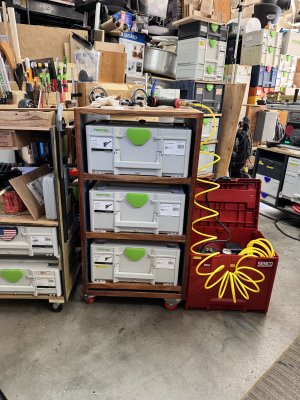
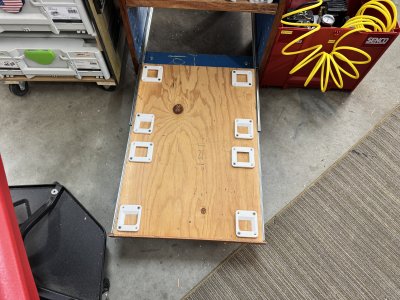
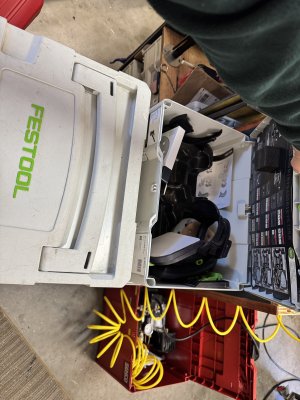
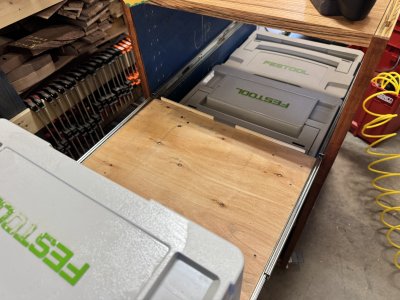
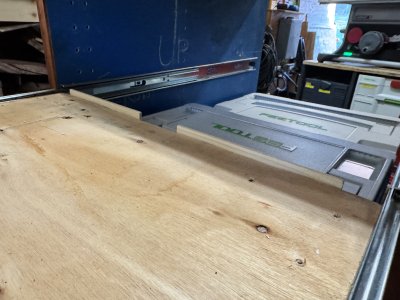
I wrapped up the first cabinet today (I think). Trimmed it out with Hawaiian Koa and tung oil for the finish. Installed cleats to seat the Systainers. Both Systainers will fit with the cleats and when the rear systainer cleared and opened completely, I thought I was a brilliant genius woodworker - on the level of Krenov and Sellers. Then I went to open the front Systainer. Too darned close and the front one wouldn't open. More like the idiot trying to make a birdhouse with a butter knife!
Pulled out the cleats and just tacked on some stops on the back end of the shelf to keep the rear systainer from sliding off. Now it works well.
Pulled out the cleats and just tacked on some stops on the back end of the shelf to keep the rear systainer from sliding off. Now it works well.
Attachments
luvmytoolz
Member
So long as it looks pretty, that's what counts! ;-)I wrapped up the first cabinet today (I think). Trimmed it out with Hawaiian Koa and tung oil for the finish. Installed cleats to seat the Systainers. Both Systainers will fit with the cleats and when the rear systainer cleared and opened completely, I thought I was a brilliant genius woodworker - on the level of Krenov and Sellers. Then I went to open the front Systainer. Too darned close and the front one wouldn't open. More like the idiot trying to make a birdhouse with a butter knife!
Pulled out the cleats and just tacked on some stops on the back end of the shelf to keep the rear systainer from sliding off. Now it works well.
Similar threads

- Replies
- 11
- Views
- 2K
- Replies
- 8
- Views
- 4K

