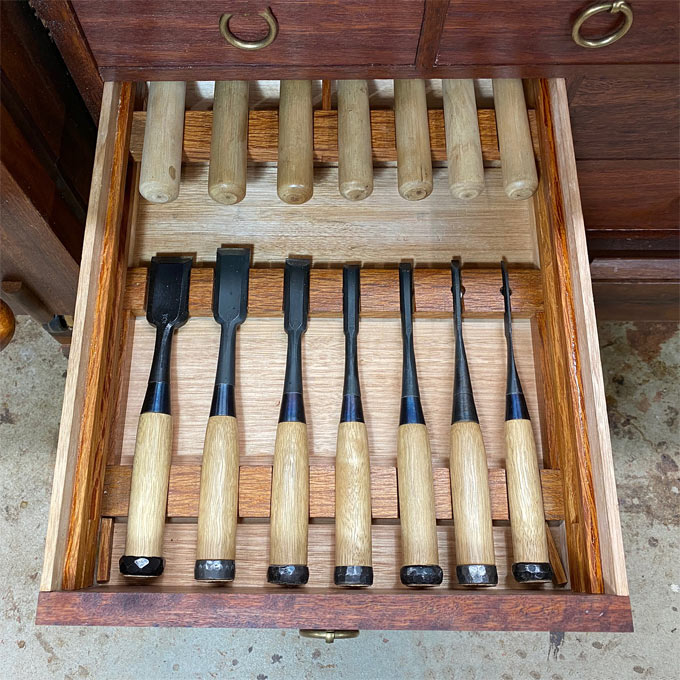
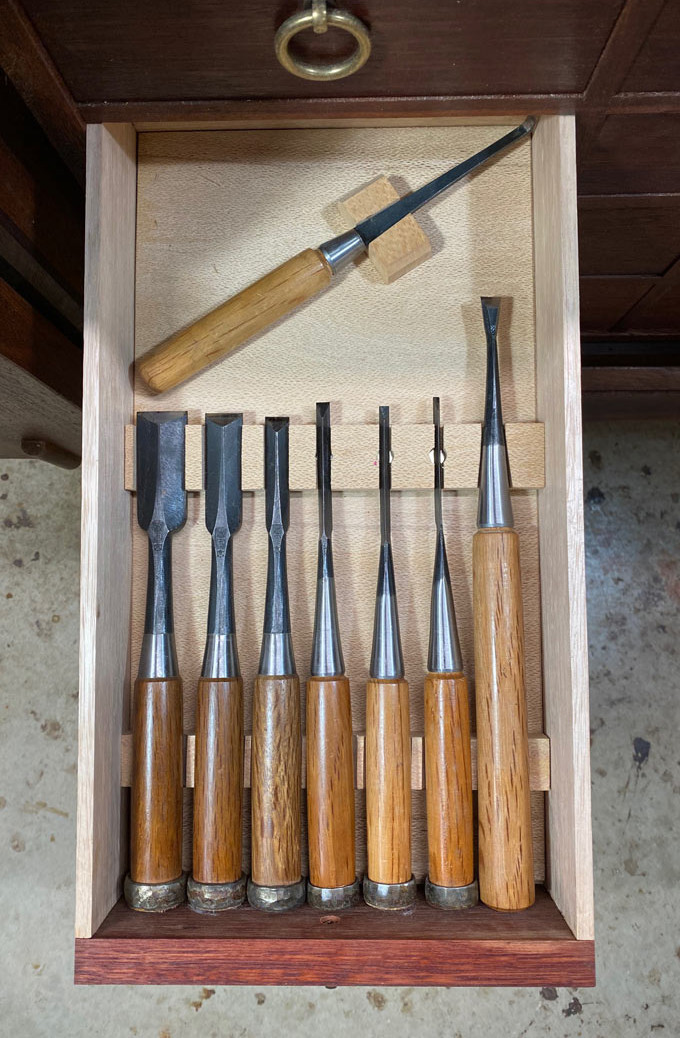
woodworking chisels

I'm suspecting that the 'resin' is more like the thin type use in wood hardeners. This would very easily be taken up by most woods under vacuum.
These hardness are variously described by their manufacturers as resins/polymers/polyurethane/epoxy
 
Since we had some discussion on mallets here, specifically the Blue Spruce, I've been thinking about them a little since. How difficult is it to replicate the resin impregnation of a wood mallet?

I'm thinking about a rectangular mallet head made from white oak, and I remembered there's a vac chamber sitting in a pile in the garage - if I get a vacuum pump (like the Pittsburgh or even Icon from Harbor Freight), could I impregnate the white oak? I've never worked with epoxy before (I'm presuming it would be epoxy), so is it a matter of putting the mallet head in a smaller container, filling it with epoxy, putting it in the chamber, sucking the vacuum and waiting three days? Does the epoxy solidify around the mallet?
As AstroKeith mentioned, normal resin is too highly viscous to impregnate deep into oak, I use Cactus Juice which is closer to a mineral oil in viscosity, maybe even less.

I hook up the pump and leave it run till the bubbles completely stop, usually several days, opening the valve a little every so often to let it draw into the timber, then I turn the pump off and leave it under vacuum for at least a few more days, more usually a week or two. It's always very gratifying when you release the vacuum and you see the resin go down an inch or two. Then it's taken out, wrapped in aluminium foil and baked in an oven for an hour.

A lot of people think resin stabilising timber is a just matter of applying a quick vacuum, soak a day and then done, far from it, denser timbers like oak really need a much longer process to get any decent sort of penetration.
 
+1 on Cactus Juice. I was donating a ton of kitchen stuff to friends after remodeling the kitchen, but kept the toaster oven so it could be the Cactus-Juice oven.
 
This has been my chisel solution for years, the Stanley chisels which were the first set I purchased, are made in the US and have steel caps. They're used for all sorts of rough construction tasks and have been routinely hammered on with an Estwing claw hammer. If they needed to be sharpened in the field, a RA grinder with 120 grit came to the rescue.

The Pfeil are Swiss made and only used on the bench by hand or with a light tap of a mallet. They are only sharpened on proper bench stones with a proper guide.
My Stanley chisels (purchased about 30 years ago) were made in England. I don’t know if that makes any difference in quality, but mine take a really sharp edge and hold it for a decent amount of time. I use mine for mortising mostly.

I also use them for trimming the ends of iron on veneer edge banding, though I now have a 2-1/2” wide chisel that I use for trimming the flat edges. I find the chisel faster and easier to use than the dedicated edge trimmers.

I use a double sided hammer with a rubber head on one side and a yellow plastic head on the other. I’m pretty sure I got it from Harbor Freight. I don’t see how an expensive hammer/mallet is going to improve the quality of my mortises. I’m sure I paid less that $10.00.

Addendum: I just checked, and H-F shows a very similar hammer for $7.99. Though my recollection is that mine has a solid steel handle, and this image is showing a tubular handle.

 
Back
Top