Glue Bottles - What you Love or Hate

You wrote: :White glue is for gluing paper and cardboard, or if nothing, absolutely nothing else is available.

The white glue you refer to above has to be school white glue because a lot of other white glue is PVA glue and PVA glue is not just for paper and cardboard.
That was not the case.

The original Elmer’s Glue was made from casein, a byproduct of milk production. Some time in the 1960s, they (Borden) transitioned to a synthetic version of casein. Apparently the changeover was gradual. They never re-labeled the product.

I could not find a definitive date when all of the Elmers had switched to PVA. The parent company is Borden, a dairy company. They may have been reluctant to give up the use of a “free” byproduct, and purchase the replacement (PVA).

School Glue is an entirely different product developed because parents were complaining that the glue would get on children’s clothing and would not wash out. It is a less viscous glue and it is always clearly labeled “School Glue”.

In any case, the early versions of Elmers was not a particularly strong adhesive.

I did find this notation from Google A.I.:

Both Elmer's white glue (PVA) and Woodworkers II
(a yellow aliphatic resin PVA) create bonds stronger than the wood itself, but Woodworkers II is superior for structural joints due to faster curing, higher strength, and better heat/moisture resistance. Elmer's is best for crafts, while Woodworkers II is better for furniture.
 
Exactly. It's you who said white glue was for paper and cardboard, and some of us are trying to tell you (unless it's school white glue), white glue that is PVA is perfectly fine for woodworking. We're just hoping to correct your misconception.

As I pointed out, LePage white glue is PVA and widely used by carpenters as well. It isn't the name or brand but the content that determines if it is for school work or furniture projects.
 
Last edited:
`````
Exactly. It's you who said white glue was for paper and cardboard, and some of us are trying to tell you (unless it's school white glue), white glue that is PVA is perfectly fine for woodworking. We're just hoping to correct your misconception.

As I pointed out, LePage white glue is PVA and widely used by carpenters as well. It isn't the name or brand but the content that determines if it is for school work or furniture projects.
OK.

I do recall my father repairing our dining room table with Elmers. It was about a 1” wide x 12” long “splinter” that narrowed to a point that had broken off. He applied Elmers and taped it back in place.

Clearly face grain to face grain, and clearly a perfect fit—no planing or sanding required.

The following day he removed the tape. It never broke off. About 10 years later, Mom re-furnished the dining room and the repaired table left the house.

I still don’t think Elmers is nearly as strong as Woodworkers III, my go-to glue. Nor as strong as Corner Weld (from Framica) for end grain to end grain glue ups (with a notably short open time).

But I did use it at work to glue down some Formica that had lifted in one corner and it never lifted again.

(My spell checker just replaced “lifted” which was not misspelled with “Justin”, and I simply cannot follow the A.I. logic. Other than both having 6 letters, what?)
 
After you've mixed a batch of Cascamite up have you found it can be stored for a while for later projects, or it needs to be fully used at the time?

I my experience you can't really keep it after mixing a batch. I haven't heard of anyone else doing that either. But I have to be honest, I don't know for sure it can't be done. I never tried, because I just felt it wouldn't work or would be too much of a bother. It would require some method to keep it in an environment that is completely moisture (and thus also air) free. If even a little moisture is available it will keep on curing. Ah, while writing this I caught myself thinking "If it is already mixed, then there will be water anyway". So, no, I don't think you can keep it after mixing. Sorry for the long-winding answer.

Talking about moisture: make sure you store it as dry as you can. But also be aware it degrades quickly when it gets too hot. It doesn't like it when it gets frozen either. For me that's no problem as my shop is air conditioned, but it might be something to consider in your shop. When I buy a tub I pour the powder in stop-loss-bags with a larger opening using a funnel (actually, a cheaper alternative from a food store). I squeeze out as much of the air as I can before closing the bags. And then I put as many of the bags as will fit back in the tub and close the lid again. Then I write the date I opened the tub on the lid. That way there won't be new air (and thus moisture) in contact with the powder every time I open the tub. Doing this allows me to keep the powder for at least 2 years, although Polyvine mentions a shelf life of 12 months.

One of the advantages I really like over Titebond and other PVA glues (apart from the aforementioned longer open time) is how easy it cleans up. I use an old tooth- or nailbrush with a small jar of water and use plenty of water to brush it off. Then I wipe the water off. That way I don't have any trouble with blotches where there was squeeze-out when finishing. I have found that with PVA glues it is much harder to prevent this from happening, even when properly wiping the excess.

[Edit] Another thing to be aware of is that it dries up really hard, meaning there will be no flexibility after curing (unlike PVA glues). I wouldn't use it for joints that are exposed to dynamic forces. I have never tried my hand a making chairs, but I wouldn't it for that.
 
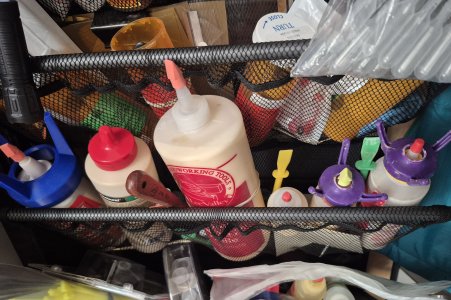
Sneaking in here to derail the glue discussion and add my glue bottle experience. Like others, I'm not overly fond of the Titebond caps. Great when they're clean; terrible when they clog. I tried the Gluebot and while it works great for application, the fiddly gasket is, well, fiddly. I switched to the Milescraft 5222 Glue Mate and those are fantastic. No gasket, just a wedge seal. Tighten until you can't hear any air escaping when you squeeze the bottle and you're good to go.
 
I always considered cleaning the glue caps as just the cost of doing business.

The most useful tool for cleaning Titebond caps is a pair of pliers.

1. If the glue is dry, use the pliers to gently squeeze the cap so that the opening “smiles”. That will break the hard glue free from the cap. Use the tip of the plies to tear any of the glue away. That is what I encounter most often.

2. If the glue has not been used for while and the cap is completely clogged, then I use the pliers to pull the outer sliding piece entirely off the cap. At that point I find a piece of wood (usually I break up a tongue depressor for that) to poke out any partially dried glue. Hardened glue gets broken up by a squeeze of the pliers.

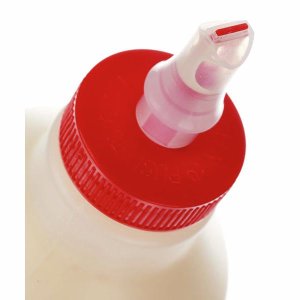
This is the best image of the cap I could find. The clear part is the part I generally squeeze into a “smiles”. It is also the part I yank off and clear out with a stick. The screw cap rarely has issue. There is a horizontal hole in the “tongue” that pokes out of the clear part, and that sometimes gets clogged too. Yanking off the clear part is the only way to access that.

When the caps are new, they rarely clog. For that reason, I don’t buy large jugs of glue and pour down into the bottles.

And this guy replaces the original cap with one pilfered from a bottle of French’s mustard. The nice part about that is that you can soak the factory cap in hot water while keeping the bottle sealed with the French’s Mustard cap. I have a bottle of French’s in the fridge. When it is used up, I will save the cap.


1775242574203.jpg
 
Sneaking in here to derail the glue discussion and add my glue bottle experience. Like others, I'm not overly fond of the Titebond caps. Great when they're clean; terrible when they clog. I tried the Gluebot and while it works great for application, the fiddly gasket is, well, fiddly. I switched to the Milescraft 5222 Glue Mate and those are fantastic. No gasket, just a wedge seal. Tighten until you can't hear any air escaping when you squeeze the bottle and you're good to go.


Aah, didn't know that existed. I thought GlueBot was the only one designed that way. Same application set up but no gasket. Sounds like a win!

Seth
 
Sneaking in here to derail the glue discussion and add my glue bottle experience. Like others, I'm not overly fond of the Titebond caps. Great when they're clean; terrible when they clog. I tried the Gluebot and while it works great for application, the fiddly gasket is, well, fiddly. I switched to the Milescraft 5222 Glue Mate and those are fantastic. No gasket, just a wedge seal. Tighten until you can't hear any air escaping when you squeeze the bottle and you're good to go.
Funny thing about Miles Craft products: They all look and feel cheap, and they all seem to work perfectly. I will have to get one of their bottles.

 
Hmm, that might be, but I haven't noticed it being particularly worse than other glues. Almost all glues are harder than wood (unless you live down under ;) ), so they will always be a bit hard on edge tools. It might help that I try to remove squeeze out when it is rubbery, or with a scraper after it has set. Anyway, I think I'll trust my own experience over Google...
I have only used Cascamite a few times, mostly as a test, but it worked fine. Either way, I always find it better to remove as much squeeze out as possible.
I have posted previously that I am a Glu-Bot fan. I know some don't like them, but personally I can't imagine a better glue bottle.

Seth
I like them too, especially for dowels, Dominos, edges, etc. but they don't do "volume" very well. That's why I keep the condiment bottle type too, with the tips cut to different sizes. Gravity works far better than constantly squeezing/re-squeezing a Glubot.

The gasket issue can be overcome with the same cutting board wax/oil blend.
 
Back
Top