Installing a Vise in the Workbench - Some Qs?

onocoffee

Member
Joined
Sep 23, 2024
Messages
1,447
Location
Baltimore, Maryland, USA
I decided to revisit my front vise install for my workbench after attempting it in the fall, failing and walking away from it. Now that the weather may be getting pleasant (despite the snow), I feel able to try again.

The workbench is made of 2x4 lumber with double layer of 3/4" plywood for the top. I originally built it back in 1998 so I don't recall if I glued the top together or if it's just screwed. The worktop has about a 1.5" overhang of the 2x4 frame.

The vise is a 10" cast iron from Woodcraft. I would like the top of the vise to sit flush with the top of the workbench so I can utilize the built-in dog. I also plan on putting wood in the vise for its jaws.

Back in the fall, I started out by cutting a piece out of the frame to let the vise sit flush. I made a support piece to mount behind the frame and another piece to mount in front of the frame to give the vise places to screw into and support. Installation did not go well. The vise is heavy and difficult to lift and hold into position. Then, I realized that the support in the back was insufficient and needs to be extended. Part of the front support broke off and I have reglued it but it in not (at the moment) installed.

I figured I would ask for your thoughts on how I should be approaching this? Part of me thinks I should just unload the entire bench and flip the thing over (it is a Beast) and install the vise upside down? That could even make it easier to cut the rabbets for the MFT/3 rails I'd like to install.

Any thoughts will be appreciated. Thanks!
 
If it means making it easier to guarantee it'll be aligned perfectly, I'd go with flipping it!

Sometimes the little extra effort option is actually the easier path.

I'd want to set it on fire if I struggled along and it ended up out of alignment! ;-)
 
You answered your own question just the instant I decided to reply with what you should do. Bite the bullet. Get some saw horses. Flip the bench over and do it right. Been there. Done that. Didn't want the tee shirt. I put a monstrous old Record quick release in my main workbench. I had lugged the thing around in its original box for 20 years. When I set my shop up here in Ohio I built a big workbench/assembly table and decided to put the Record in it. It was a giant PIA, and that was on a bench that was under construction, so I feel your pain, but can assure you a solid installation will reward you for years to come.
 
I'd flip the top to give you space to accurately inset it. I had a vise like that on a bench that I ended up giving to my son about five years ago. I'd measure from the top edge to the bottom top of the undercarriage and cut rabbets with a track saw or a router to give you a stable and consistent inset for attaching the vise. From your description, you might be cutting a fair amount into the 2x4 frame so I'd consider adding a piece of ply beyond the base frame to give you extra stability.

Here's the vise and top I had... IMG_0194.jpeg
 
I would clamp a piece of timber in the vice jaws and clamp that to the bench to ensure the jaws are flush with the bench top and that will hold the vice in position allowing you to fasten it with no hassles. just a plain piece with another bit of timber fastened to it to go into the vise jaws.
 
Well, you guys are right. After hemming and hawing, I just bit the bullet, stripped the bench down, removed as many panels as I could to lighten and flipped it over. I like the idea of working on the saw horses, but even stripped down, it's too heavy for me to maneuver in that manner.

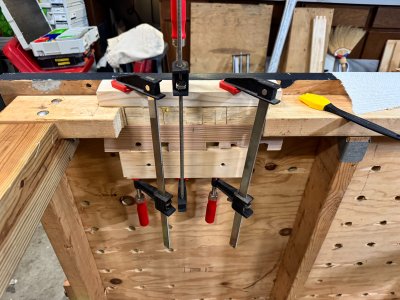
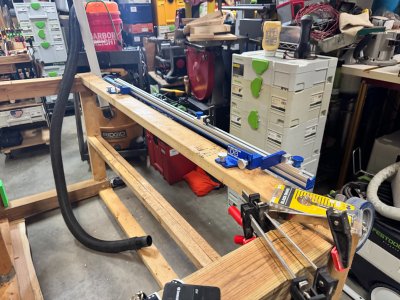
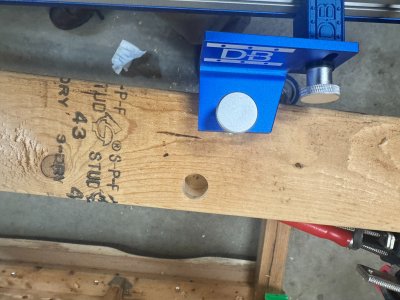
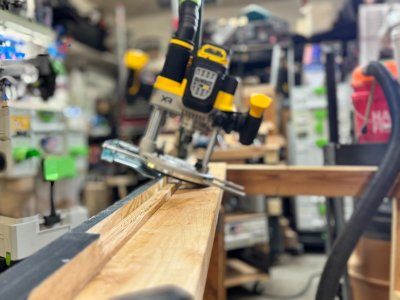
Cut, glued, screwed and clamped the blocking for the vise. You might be able to see the block I installed originally in November that split out. I think it will sandwich in and secure the carriage bolt - though I have been thinking about countersinking a bolt from the top side for greater holding. Routed out a channel to fit the MFT/3 rail. Tomorrow I'll cut the backing for the rail so it can be mounted at the correct orientation. I also bored a couple 20mm holes in the lower support as a storage spot for the DashBoard F2 Fence. Tomorrow, I'll start to mount the vise and I'm also going to see if I can find a new set of double-locking casters. The bench was originally designed to sit against a wall, so I only put two locking casters way back when. Now that it's a free-standing workbench, having only two locking casters is a bit of a drag (literally).
 

Attachments

  • IMG_1290.JPG
    IMG_1290.JPG
    3.3 MB · Views: 40
  • IMG_1294.JPG
    IMG_1294.JPG
    3 MB · Views: 31
  • IMG_1297.JPG
    IMG_1297.JPG
    1.6 MB · Views: 29
  • IMG_1302.jpg
    IMG_1302.jpg
    1.4 MB · Views: 33
Seeing as you've already got it upside down, I venture that it might be worth changing to flip down castor wheels so you have a lot more rigidity from the bench sitting on the floor?

Even locking wheels will still allow lots of movement, especially under heavy use.
 
Seeing as you've already got it upside down, I venture that it might be worth changing to flip down castor wheels so you have a lot more rigidity from the bench sitting on the floor?

Even locking wheels will still allow lots of movement, especially under heavy use.
I was thinking about that but then the bench drops by six inches, so that might not be ideal. But I will be going to the woodcraft tomorrow to see what they have.
 
I was thinking about that but then the bench drops by six inches, so that might not be ideal. But I will be going to the woodcraft tomorrow to see what they have.
Could always build the legs up, it'd be worth it I reckon. I fitted a set to my combo planer and absolutely love it, makes life so much easier.
 
I decided to revisit my front vise install for my workbench after attempting it in the fall, failing and walking away from it. Now that the weather may be getting pleasant (despite the snow), I feel able to try again.

The workbench is made of 2x4 lumber with double layer of 3/4" plywood for the top. I originally built it back in 1998 so I don't recall if I glued the top together or if it's just screwed. The worktop has about a 1.5" overhang of the 2x4 frame.

The vise is a 10" cast iron from Woodcraft. I would like the top of the vise to sit flush with the top of the workbench so I can utilize the built-in dog. I also plan on putting wood in the vise for its jaws.

Back in the fall, I started out by cutting a piece out of the frame to let the vise sit flush. I made a support piece to mount behind the frame and another piece to mount in front of the frame to give the vise places to screw into and support. Installation did not go well. The vise is heavy and difficult to lift and hold into position. Then, I realized that the support in the back was insufficient and needs to be extended. Part of the front support broke off and I have reglued it but it in not (at the moment) installed.

I figured I would ask for your thoughts on how I should be approaching this? Part of me thinks I should just unload the entire bench and flip the thing over (it is a Beast) and install the vise upside down? That could even make it easier to cut the rabbets for the MFT/3 rails I'd like to install.

Any thoughts will be appreciated. Thanks!
Ask chat
I decided to revisit my front vise install for my workbench after attempting it in the fall, failing and walking away from it. Now that the weather may be getting pleasant (despite the snow), I feel able to try again.

The workbench is made of 2x4 lumber with double layer of 3/4" plywood for the top. I originally built it back in 1998 so I don't recall if I glued the top together or if it's just screwed. The worktop has about a 1.5" overhang of the 2x4 frame.

The vise is a 10" cast iron from Woodcraft. I would like the top of the vise to sit flush with the top of the workbench so I can utilize the built-in dog. I also plan on putting wood in the vise for its jaws.

Back in the fall, I started out by cutting a piece out of the frame to let the vise sit flush. I made a support piece to mount behind the frame and another piece to mount in front of the frame to give the vise places to screw into and support. Installation did not go well. The vise is heavy and difficult to lift and hold into position. Then, I realized that the support in the back was insufficient and needs to be extended. Part of the front support broke off and I have reglued it but it in not (at the moment) installed.

I figured I would ask for your thoughts on how I should be approaching this? Part of me thinks I should just unload the entire bench and flip the thing over (it is a Beast) and install the vise upside down? That could even make it easier to cut the rabbets for the MFT/3 rails I'd like to install.

Any thoughts will be appreciated. Thanks!
ask chat…..you know 😉😉😉
 
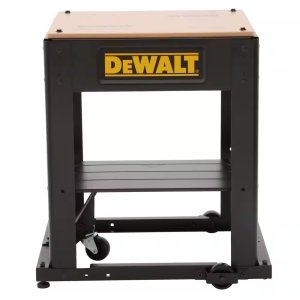
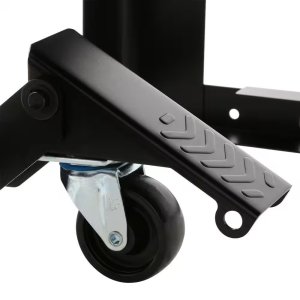
You may want to look at the method Dewalt uses on their planer table/cart. The height of the in-feed table only changes 1/2" from the stationary position to the mobile position. Once the adjuster pedal is released, the Dewalt cart will not move.
 

Attachments

  • Image 2-24-26 at 7.42 AM (1).jpg
    Image 2-24-26 at 7.42 AM (1).jpg
    89.2 KB · Views: 15
  • Image 2-24-26 at 7.45 AM.jpg
    Image 2-24-26 at 7.45 AM.jpg
    97.8 KB · Views: 20
It might be too late to suggest, but for this type of vise, I like to enclose the rear jaw in a piece of wood the length of the workbench, so I can more easily secure long material. I make a wooden front jaw slightly higher than the benchtop, then close it and plane it flush. I also replace the steel dog with one made of a strong hardwood.
 
It might be too late to suggest, but for this type of vise, I like to enclose the rear jaw in a piece of wood the length of the workbench, so I can more easily secure long material. I make a wooden front jaw slightly higher than the benchtop, then close it and plane it flush. I also replace the steel dog with one made of a strong hardwood.
It's never too late. Might you have a pic of your setup? I have been thinking of adding a deadman to accommodate larger pieces.
 
With a quick search of the web, this is the closest I found.
The second to last image represents my idea if that rear wooden jaw was extended the length of the bench.
 
As long as you’re inverted the worktable, why not go all the way and disassemble the vise 🤪

Would make some things easier...

I liked the idea of suspending the vise by tightening it onto some stock that is clamped to the top of the table.
My suggestion would have been to use a big deep throat clamp and a Vee block but you had plenty of good suggestions already.
 

Attachments

  • IMG_0668.jpeg
    IMG_0668.jpeg
    96.8 KB · Views: 15
As long as you’re inverted the worktable, why not go all the way and disassemble the vise 🤪

Would make some things easier...

I liked the idea of suspending the vise by tightening it onto some stock that is clamped to the top of the table.
My suggestion would have been to use a big deep throat clamp and a Vee block but you had plenty of good suggestions already.
Actually, this is similar to how I was thinking of doing the clamp - though I thought the block could be added without having to disassemble the vise. Guess I'll have a closer look tomorrow. Thinking about it a little more, I was thinking of making the chop block wider so while the chop is screwed into the vise jaw, it could also be fastened to the side of the bench as well. Might as well take it as far as I can since it's all broken down anyway.

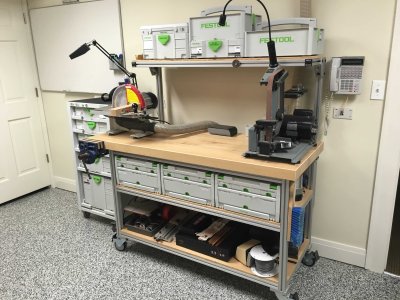
Another thing I'm thinking of adding now is a sliding deadman to work in conjunction with the vise. And then 20mm dog holes in the legs (just in case). In the videos I've seen the bottom of the deadman is a v-groove that seats/slides on a triangular rail that's screwed into the stretcher with a groove along the upper stretcher. Since I've learned that my DW620 router will work with the edge guide from my Skil 10A, those rails will also fit the Festool track guide, I'm thinking of using the two together, on both sides of the router to act as an ad hoc OF-FH Routing Aid.
 
Back
Top