
smorgasbord
Member
My tablesaw is an old Inca 2100. Great saw - 12" blade, big table, overhead guard, blade rises up in a straight line, etc., but one problem I've always struggled with is that the miter slots are a non-standard 20mm wide. Even though that's just under a single millimeter wider than the standard ¾" slots, it's enough that few of the adjustable after-market miter bars sold (at least that I could find) would not fit, and those that would fit (like the MicroJig Zero-Play) were too short for my purposes. I had taken to using the adjustable bars with a strip of HDPE tape on one side to expand the width enough, but I can never get the tape to last/stick more than a few months (weeks under heavy use). And the adjustable bar circles wear out and need constant tweaking with medium/heavy use, too.
Jonathan Katz-Moses just announced his adjustable miter bar, and to my surprise it supports up to 21.26mm (0.837") slot widths. So, I spent $90 plus tax and shipping and ordered one.
It's good, but not perfect.
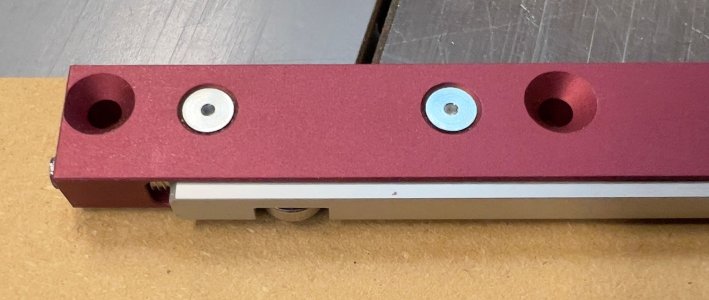
Here are some photos. Basically, the body (in red) has 3 sets of 2 ball-bearings. Then there's a sub-piece (silver) that has 3 ball bearings, each one located in between the set of 2 on the other side of the bar.


There are grub screws at each end of the bar that you adjust (push-pull) that moves the silver bar fore-after in angled slots so the silver bar also moves in/out, thus changing the width.
In his product video (link), he shows his sled sliding really easily on his table. I found that while I could get a no-perceptible wiggle adjustment on my saw or I could get the bar to continue to slide after I stopped pushing it, I couldn't have both - if the bar was adjusted to no wiggle then it was too tight to just keep going. That said, this wasn't my expectation for this anyway, and I found I could tweak the width to get a no-wiggle fit with enough smoothness that pushing it wasn't an issue, and that it was easier to push than the adjustable bars with the circles.
I was a bit concerned that with the adjustment being for the whole bar that my slot might have worn over the decades to be a tad wider in the front than in the back and so there might be some fit/wiggle concerns, but that doesn't appear to be an issue for me so far.
Perhaps the biggest issue, for me anyway, is the shortish length combined with effectively having just 3 points of contact. A bit more than half the bar has to be the slot for any kind of accuracy. So, at a 20" length you need at least 11" of bar in the table, so you've got only about 8" or so of bar beyond the front of your table to your raised blade. For "normal" sized cross-cutting this is probably fine, but this wouldn't be my choice for a wide stock cross-cut sled. That said, he does sell a slightly cheaper 8" long version, and perhaps one could combine two of those in a line, or stack the 8" with the 20". But, that gets expensive and alignment might be tricky.
One really clever aspect is that the bar is fitted with a number of very pointy grub screws (more like tacks) that are threaded into the bar so you can remove them, but they enable you to put the bar in the slot and press down on your sled base to stick/align them. The tacks hold well enough in plywood and MDF that you can then lift the base up with the bar attached, and then screw up/down as desired.
Overall, I give this a thumbs up. It's not cheap, but it appears well made and does what it needs to. Unlike the plastic circle adjustable bars, this shouldn't wear out quickly, and unlike wood runners it won't expand/contract with humidity.
-----
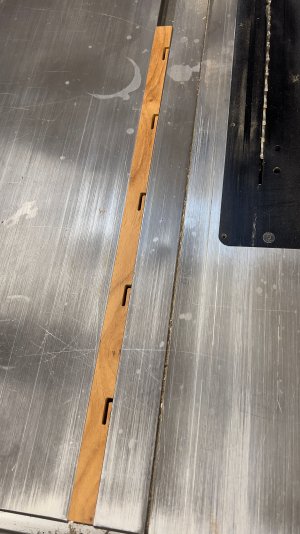
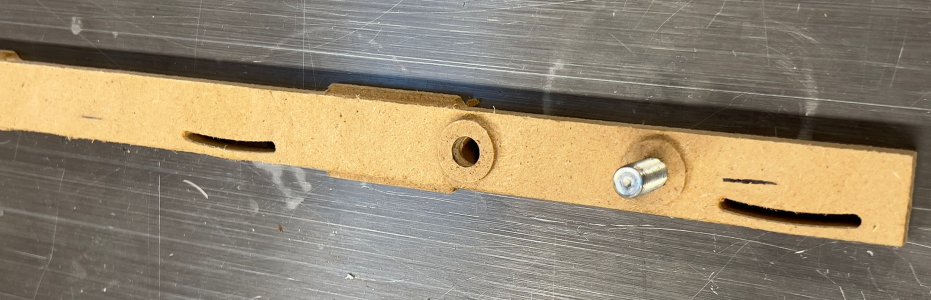
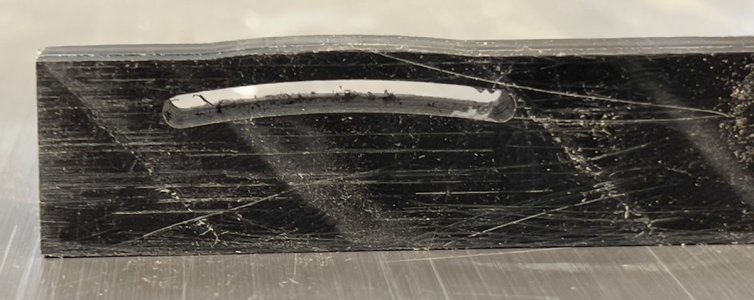
As a side note, I've been spending some of my spare hours in the shop working on a CNC'd miter bar that uses the compressibility/springability of wood/phenolic to self-compensate for wear. This came from my YARSB (Yet Another Router Sub-Base) effort where I made a phenolic attachment to ride in the groove of a track saw track:
https://festoolownersgroup.com/threads/yarsb-yet-another-router-sub-base.76896/#post-741606 , applying the same principle to the miter bar. As I sort that out I'll post on that, too.
Jonathan Katz-Moses just announced his adjustable miter bar, and to my surprise it supports up to 21.26mm (0.837") slot widths. So, I spent $90 plus tax and shipping and ordered one.
It's good, but not perfect.
Here are some photos. Basically, the body (in red) has 3 sets of 2 ball-bearings. Then there's a sub-piece (silver) that has 3 ball bearings, each one located in between the set of 2 on the other side of the bar.
There are grub screws at each end of the bar that you adjust (push-pull) that moves the silver bar fore-after in angled slots so the silver bar also moves in/out, thus changing the width.
In his product video (link), he shows his sled sliding really easily on his table. I found that while I could get a no-perceptible wiggle adjustment on my saw or I could get the bar to continue to slide after I stopped pushing it, I couldn't have both - if the bar was adjusted to no wiggle then it was too tight to just keep going. That said, this wasn't my expectation for this anyway, and I found I could tweak the width to get a no-wiggle fit with enough smoothness that pushing it wasn't an issue, and that it was easier to push than the adjustable bars with the circles.
I was a bit concerned that with the adjustment being for the whole bar that my slot might have worn over the decades to be a tad wider in the front than in the back and so there might be some fit/wiggle concerns, but that doesn't appear to be an issue for me so far.
Perhaps the biggest issue, for me anyway, is the shortish length combined with effectively having just 3 points of contact. A bit more than half the bar has to be the slot for any kind of accuracy. So, at a 20" length you need at least 11" of bar in the table, so you've got only about 8" or so of bar beyond the front of your table to your raised blade. For "normal" sized cross-cutting this is probably fine, but this wouldn't be my choice for a wide stock cross-cut sled. That said, he does sell a slightly cheaper 8" long version, and perhaps one could combine two of those in a line, or stack the 8" with the 20". But, that gets expensive and alignment might be tricky.
One really clever aspect is that the bar is fitted with a number of very pointy grub screws (more like tacks) that are threaded into the bar so you can remove them, but they enable you to put the bar in the slot and press down on your sled base to stick/align them. The tacks hold well enough in plywood and MDF that you can then lift the base up with the bar attached, and then screw up/down as desired.
Overall, I give this a thumbs up. It's not cheap, but it appears well made and does what it needs to. Unlike the plastic circle adjustable bars, this shouldn't wear out quickly, and unlike wood runners it won't expand/contract with humidity.
-----
As a side note, I've been spending some of my spare hours in the shop working on a CNC'd miter bar that uses the compressibility/springability of wood/phenolic to self-compensate for wear. This came from my YARSB (Yet Another Router Sub-Base) effort where I made a phenolic attachment to ride in the groove of a track saw track:
https://festoolownersgroup.com/threads/yarsb-yet-another-router-sub-base.76896/#post-741606 , applying the same principle to the miter bar. As I sort that out I'll post on that, too.
Last edited:



 Not sure when the Dubby first came out.

