New jigsaw model just announced...

Right. You don’t need a cord for every tool and you don’t a battery for every tool either. You certainly don’t need to waste space for a charger in every Sys.
I have said for years that it's a huge waste to have a Plug-it in every Systainer, but apparently, I'm in a minority?
The feedback I got was "everyone is not like you, some guys only have one tool"
My own argument against it is that a lot of people would be offended by the price, having to add more to make the tool function. Of course, this only happens with the first one, after that you already have one.
Retailers probably wouldn't want to deal with it. They would have another sku, but it can't be that bad.

I have obviously put way too much thought into this, but I'm also the guy with a dozen cables in a drawer.....
 
Since this is a PSC-E, I assume the E stands for “easy,” like the T 18-E that was released in the US with a fixed chuck. Maybe this is a base model, 90° cuts only, and they will release another jigsaw with more features that takes all the bases. Just a thought.
 
Since this is a PSC-E, I assume the E stands for “easy,” like the T 18-E that was released in the US with a fixed chuck. Maybe this is a base model, 90° cuts only, and they will release another jigsaw with more features that takes all the bases. Just a thought.
Had this same thought when I saw it. To me it sort of fits into the Try Out Festool category of tools, like the T18-E you mentioned and the ETS 125 (especially when it was priced at $199). NGL, a cheap cordless jigsaw is kind of a genius move since a lot of DIY'ers often look for a jigsaw as one of their first tools. For a lot of people it's their only saw.
 
Festool says it’s designed for "trimming work on furniture, kitchens, for interior fitting, cooping end strips". If it excels at that with its better ergonomics, I think it’s a great addition to the battery platform.

I guess it’s intended to compete with this Bosch,

I’m not sure Festool was really aiming at that Bosch. The model you’ve referenced is the most powerful in Bosch’s lineup, with a cutting capacity of 6 ¹⁄₈ inches in wood, while Festool lists the PSC‑E 18 EB’s capacity at only 1 ⁹⁄₁₆ inches. That’s not even in the same ballpark.

To me it seems Festool had very specific used cases in mind when they specified the parameters for development and design.
 
Last edited:
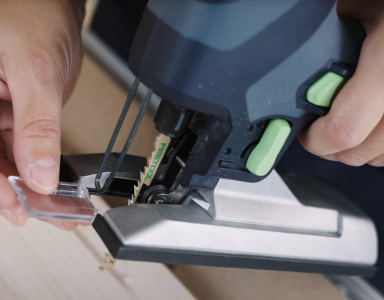
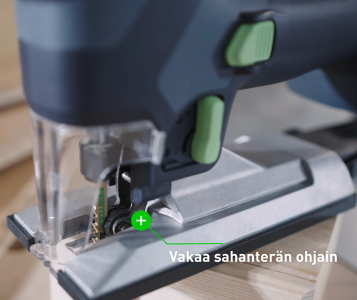
Here's the Finnish video drop that gives a little more insight. Looks like the same bearing pendulum (vs Mafell's internal). It does have a sleeker profile and a light, so maybe it's not as bleak as it seems?

And the jigsaw does lay on its side in the M187.

 
Festool says it’s designed for "trimming work on furniture, kitchens, for interior fitting, cooping end strips". If it excels at that with its better ergonomics, I think it’s a great addition to the battery platform.


I’m not sure Festool was really aiming at that Bosch. The model you’ve referenced is the most powerful in Bosch’s lineup, with a cutting capacity of 6 ¹⁄₈ inches in wood, while Festool lists the PSC‑E 18 EB’s capacity at only 1 ⁹⁄₁₆ inches. That’s not even in the same ballpark.

To me it seems Festool had very specific used cases in mind when they specified the parameters for development and design.
I wouldn’t trust Bosch’s specs. On it’s own website it list the stroke length as that same 6+” length.
 
Here's the Finnish video drop that gives a little more insight. Looks like the same bearing pendulum (vs Mafell's internal). It does have a sleeker profile and a light, so maybe it's not as bleak as it seems?

And the jigsaw does lay on its side in the M187.


Looks like dust collection is pretty good. Lotsa dust flying around when the hose isn’t connected.
 
It seems those nasty carbide blade guides are now absent. 🙏 🙏 🙏

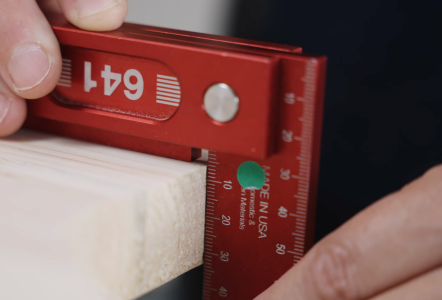
And if so, Festool is now touting the perpendicularity cutting with a Woodpeckers square...gotta love that. Back at you @jeffinsgf

If this new less expensive jigsaw also has LED lighting, it could lead to the ultimate demise of the Carvex. This saw appears to be everything the Carvex is except for the adjustable base plate and that's certainly easy to fix.

The Carvex always seemed to me to be a tool without a country, so to speak. It wasn't the best at what it did but it commanded a premium price and still needed a different base for $150 to achieve full functionality. There's not a lot to love there. :)
 

Attachments

  • PSC-E 18-1.png
    PSC-E 18-1.png
    2.6 MB · Views: 15
  • PSC-E 18-2.png
    PSC-E 18-2.png
    2.3 MB · Views: 15
  • PSC-E 18-5.png
    PSC-E 18-5.png
    2.2 MB · Views: 15
Right. You don’t need a cord for every tool and you don’t a battery for every tool either. You certainly don’t need to waste space for a charger in every Sys.
Completely agree. It would be much better if the 'bare' versions of tools came in a slimmer systainer with some space for key accessories instead of the battery and charger etc.
 
This is a 'premium-hobby' jigsaw first, good-enough light 'pro' jigsaw second.

It is trying to cover a gap in the market - there are literally NO quality-made jigsaws that are not super-expensive and/or heavy, having affluent hobbyists go with the CARVEX /and unhappy with price-value/ or with those non-that-good low-end Makitas of this world.

Put it alongside the CT 15 mentioned, the RTSC 2, the DTSC 200 and possibly some other tools to come (TS 55 K replacement anyone ?) and it becomes obvious it forms a broader "hobby-focused" product line. The only negative may be it will inevitably take some sales from the TRION, which may result in that one being dropped without a replacement.

Also, I get the feeling there is some understanding between Mafell and Festool owner families to not overlap /too/ much in their market targeting. It seems to me like Festool is 'fine' with leaving the king title to the Mafell on the jigsaws front. Mafell is to take the "cost no object" professional customers while Festool is to playing the 'mainstream' pro space plus high end hobby markets + specialties. If you look around the portfolios, Mafell does not really go out the way to challenge Festool on their key tech and Festool does not do so to Mafell either - most of the Mafell-challenging Protool-heritage tools are being dropped gradually. This may not be so obvious to our US colleges who never had the CSP 145/165 monsters, the HK 132, the DR 20, or the BS 105 for that matter, but this is really kinda obvious to a European/230V customer.


Completely agree. It would be much better if the 'bare' versions of tools came in a slimmer systainer with some space for key accessories instead of the battery and charger etc.
Or just cardboard. Like the ETS 125 ships on some markets.

With the SYS3 heights fiasco /as far as some, including me are concerned/ the inclusion of a systainer is a "tax" that is paid twice - first in being forced to buy it, second in being forced to waste time selling it.

That said, with these "hobby" line tools IMO a bigger systainer that can take all possible accessories and the charger is absolutely the right way to go. There will be a WAY higher proportion of customer that have just this one tool and DO NOT have a shop to store its complements in than with the "pro" geared stuff Festool sells
mostly to the trades folks. Besides. The only thing "wasted" is the insert. The systainer is not restricted to be used "as shipped" in any way or form.


/end rant
 
Last edited:
Also, I get the feeling there is some understanding between Mafell and Festool owner families to not overlap /too/ much in their market targeting. It seems to me like Festool is 'fine' with leaving the king title to the Mafell on the jigsaws front. Mafell is to take the "cost no object" professional customers while Festool is to playing the 'mainstream' pro space plus high end hobby markets + specialties. If you look around the portfolios, Mafell does not really go out the way to challenge Festool on their key tech and Festool does not do so to Mafell either - most of the Mafell-challenging Protool-heritage tools are being dropped gradually. This may not be so obvious to our US colleges who never had the CSP 145/165 monsters, the HK 132, the DR 20, or the BS 105 for that matter, but this is really kinda obvious to a European/230V customer.
You may well be right, but I heard another angle that made sense for me as well: That Mafell is more focused on heavier Carpentry-work (like wooden houses etc.) while Festool is more focused on lighter carpentry and then joinery, fitting, painters etc. Of course there is some overlap, but if I look at the Festool-assortment as a whole and how it seems to be moving I think that is fairly accurate. Then you can add market sizes etc. of the respective niches into the mix and I think overall what Festool is doing makes sense, even if it doesn't always work for me as an individual (but hey, I'm just a hobbyist so my opinion isn't important anyway) :D
 
You may well be right, but I heard another angle that made sense for me as well: That Mafell is more focused on heavier Carpentry-work (like wooden houses etc.) while Festool is more focused on lighter carpentry and then joinery, fitting, painters etc. Of course there is some overlap, but if I look at the Festool-assortment as a whole and how it seems to be moving I think that is fairly accurate. Then you can add market sizes etc. of the respective niches into the mix and I think overall what Festool is doing makes sense, even if it doesn't always work for me as an individual (but hey, I'm just a hobbyist so my opinion isn't important anyway) :D
That is actually my point.

TTS owns Festool, Tanos, Shaper, Narex and owned Protool /closing the brand in 2014/. Protool was their "carpentry/building sector" tools arm. Some of the Protool tools were co-branded with Festool originally, some interesting ones were kept under Festool brand even after the Protool brand closure.

My point is there was either implicit or explicit understanding that resulted in the Protool closure. There was just not enough market space to support two wide-spectrum premium carpentry tool makers and Mafell was the one that "won" the stick. A premium jigsaw is more a carpentry tool than a cabinetry tool, so it is logical Mafell is left to reign supreme with no updates to the TRION.

Yes, Trion was a joint Festool/Protool/Narex co-branded design, targeted at carpentry mostly. That is why it is a 700W+ motor "monster" with enough power to cut 4" beams ... as contrasted to the comparatively light-motored CARVEX or the new one.
 
Makes sense. I've only been a "white box collector" for around 5 years now, so I don't know the history going back much earlier than that :cool:
 
This is a 'premium-hobby' jigsaw first, good-enough light 'pro' jigsaw second.

To me, it seems pretty absurd to assume "pro" means one thing. In industrial settings, the professional tool is the tool that is ideal for a specific job, and not the tool that’s the most of everything. Kitchen installers and electricians fixing homes bring a 1.1 ft-lbs SDS drill to work, and not the "better" Hilti TE 30-22 with 2.8 ft-lbs.

As a pro, "money no object" means I can afford a bunch of jigsaws for specific tasks. The most expensive over-engineered tool is not always the best for every situation.

Festool’s video shows someone laying floors. A light, efficient jigsaw with shallow depth of cut is the perfect tool for this application. Festool is notorious for listening to feedback from tradespeople, and then design something specific for what’s sometimes considered a niche. That's the reason the SCS SYS is a cordless tool. Market research showed them back then that about 50 % of users would prefer cordless, and that happened to align better with their goal to build the saw in the size of a systainer.

@Nisbeth You’re right about the perception of Mafell and Festool in their home market. Mafell is the brand for framers, Festool is the brand for woodworking/cabinetry … That was not always the case. Festool’s origins are in heavy framing tools. Festo built chain mortisers, chain saws and gigantic circular saws for framers in the 1930 and 1940s.

Festo/Festool’s innovations since the 1970s happened mainly in the cabinetry area when they moved away from stationary tools: sanding, dust extraction, a very precise jigsaw, the plunge saw with guide rails of course, and routers that work with guide rails in the 1980. Cabinetry became their core competence then and this is where they invested in innovations.

With the rise of battery platforms, manufacturers converge to some extent, to fill in the product range. That's why angle grinder, SDS drill, multitool, reciprocating saw are developed in conjunction with other brands like Flex and Fein. And manufacturers license their competitor's patents all the time if it makes sense. And inventors often encourage that if they’re hoping to set new standards. That’s how SDS-plus, the T-shank and Starlock got adopted over time.

 
Last edited:
Mafell is more focused on heavier Carpentry-work
Heard this a thousand times... Mafell do an edge bander, edge trimmer, plunge saw etc - they are not focused on heavier carpentry work, that was how they started out.

Concerning jigsaws - you either get the Mafell or you get 2nd best. I have the 230v and 18v - they are leagues ahead of the closest competitor.
 
Heard this a thousand times... Mafell do an edge bander, edge trimmer, plunge saw etc - they are not focused on heavier carpentry work, that was how they started out.

Concerning jigsaws - you either get the Mafell or you get 2nd best. I have the 230v and 18v - they are leagues ahead of the closest competitor.
Focusing on a market does not mean being present only in that market.

There is a lot of tool overlap between cabinetry and carpentry. Then there are historical tools. Then there is the fact small tool makers make designs and then manufacture a tool mechanic for decades to amortise the R&D and make spare parts availability manageable.

My DR 20 or the CSP 145 E are TTS/Festool originated carpentry beasts. But they are the past. So is the newer generation HK 132. All those tools could go toe-toe with the best competitors on the European market and they were cheaper than them thanks to Festool scale. Yet they are not made. The market is too small for Festool to compete in it but is still fine for the 10x smaller Mafell to operate in. So makes sense.

As Nirsbeth correctly stated, Festo was a carpentry-tools company as well. It is not anymore. Not because they make sanders or fine drill. Because they have systematically *withdrawn* from many of the building industry markets starting with the closure of Protool in 2014. And this had benefited Mafell greatly, along with other niche German tool makers. And it is absolutely understandable when you understand all those are privately owned companies where their owners know each other well, inter-marry, etc.

---
On topic,

Festool intentionally did not follow up after TRION with another powerful carpentry-capable jigsaw. The TRION was not updated for more than 20(!) years by now. It is easy to forget it came out way before Mafell made their bid with the P1Cc mechanics.

Instead, they made the CARVEX, as cabinetry-focused a jigsaw as it gets. That is a clear indication of their market focus. And is why I fear for the future of a TRION/P1Cc class tool in the Festool line-up moving forward.

Coincidentally, that is also why a new TRION is such a great value to buy today - its tooling is long amortised so Festool can make money on making such a monster jigsaw even at those super-competitive prices it sells today. It should cost 70-80% of P1Cc, yet it sells for slightly above 1/2 its price on the German market.
 
Looks perfect for what 99% of people use a jigsaw for. It better not have blade wobble like the Carvex...
And why does it have such a tall Systainer?
General wasting of space, like with all Sys^3

I hate the carbide guides on my TRION. Either they are too loose to be useful or they rub too much and burn the blade. And they need to be readjusted for every blade of a different type.
Mine got knocked out of center once and it's a PITA to get them back, because they rotate with the screw that is supposed to fix them in place.

Yes, Trion was a joint Festool/Protool/Narex co-branded design, targeted at carpentry mostly. That is why it is a 700W+ motor "monster" with enough power to cut 4" beams ... as contrasted to the comparatively light-motored CARVEX or the new one.

Brushed (Trion) vs brushless (Carvex). Numbers can't be 1:1 compared.

The TRION was not updated for more than 20(!) years by now.
Yeah a strobe light would be nice.
 
Last edited:
@mino The perception that framers go for Mafell while cabinetmakers choose Festool dates back further than TTS’s recent Protool stint. You could even argue Mafell’s stellar reputation played a role in Festool’s challenge to remain—or regain—footing in that segment. Historically, Festool’s pivot away from heavy framing predates their Narex acquisition in the ’90s.

Their focus on integrated systems—dust extraction, accessories, the works—was locked in well before, starting really in the 1960s. That’s where the R&D money went, no coincidence.

Festool hasn’t ditched structural work entirely, but Germany’s home market has firm lines. Zimmermanns (structural carpenters, framers) and Tischlers (joiners/cabinetmakers) are separate trades, each with 3 years of on-the-job training plus school. Starting your own shop? Add a year of full-time master school, or 2–4 years part-time while working.

The Mafell-for-Zimmermanns stereotype has its roots in the 1920s with game-changers like the portable Type A chainsaw (1926)—widely seen as the world’s first specialized portable power tool for framers. Later came the legendary on-site Erika plunge saw (1980). Framer training workshops are still most likely stacked with Mafell gear today, while Tischler shops lean toward Festool—my uni workshop had Altendorf panel saws and Festool tools, for instance. It rubs off on people when they learn their trade for seven years surrounded by specific brands.

Zimmermanns tackle roofs, stairs, and structural timber frames. Tischlers handle doors, windows, furniture—and stairs too. Festool’s larger circular saws could simply support Tischler stair work rather than targeting framers. Drywall installers, painters, and floor layers represent separate trades where Festool has strong footing, but Mafell largely doesn’t compete.
 
Back
Top