This is a 'premium-hobby' jigsaw first, good-enough light 'pro' jigsaw second.
To me, it seems pretty absurd to assume "pro" means one thing. In industrial settings, the professional tool is the tool that is ideal for a specific job, and not the tool that’s the most of everything. Kitchen installers and electricians fixing homes bring a 1.1 ft-lbs SDS drill to work, and not the "better" Hilti TE 30-22 with 2.8 ft-lbs.
As a pro, "money no object" means I can afford a bunch of jigsaws for specific tasks. The most expensive over-engineered tool is not always the best for every situation.
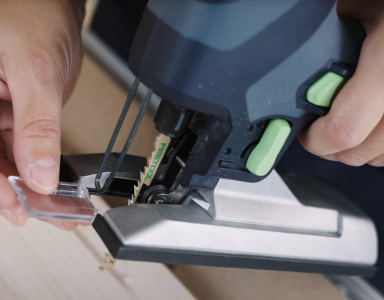
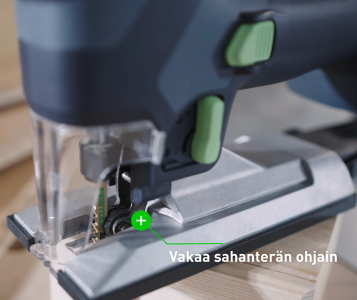
Festool’s video shows someone laying floors. A light, efficient jigsaw with shallow depth of cut is the perfect tool for this application. Festool is notorious for listening to feedback from tradespeople, and then design something specific for what’s sometimes considered a niche. That's the reason the SCS SYS is a cordless tool. Market research showed them back then that about 50 % of users would prefer cordless, and that happened to align better with their goal to build the saw in the size of a systainer.
@Nisbeth You’re right about the perception of Mafell and Festool in their home market. Mafell is
the brand for framers, Festool is
the brand for woodworking/cabinetry … That was not always the case. Festool’s origins are in heavy framing tools. Festo built chain mortisers, chain saws and gigantic circular saws for framers in the 1930 and 1940s.
Festo/Festool’s innovations since the 1970s happened mainly in the cabinetry area when they moved away from stationary tools: sanding, dust extraction, a very precise jigsaw, the plunge saw with guide rails of course, and routers that work with guide rails in the 1980. Cabinetry became their core competence then and this is where they invested in innovations.
With the rise of battery platforms, manufacturers converge to some extent, to fill in the product range. That's why angle grinder, SDS drill, multitool, reciprocating saw are developed in conjunction with other brands like Flex and Fein. And manufacturers license their competitor's patents all the time if it makes sense. And inventors often encourage that if they’re hoping to set new standards. That’s how SDS-plus, the T-shank and Starlock got adopted over time.