Threaded Inserts - Interchangeable?

onocoffee

Member
Joined
Sep 23, 2024
Messages
1,615
Location
Baltimore, Maryland, USA
Was looking at using threaded inserts to attach a table top to a metal base. The top is made of hardwood (walnut, cherry, maple). Was perusing the Woodcraft website and noticed that there are two types (softwood, hardwood). One uses brass inserts, the other uses flanged. Can they be used interchangeably?
 
@onocoffee i use a lot of threaded inserts in my work. Bases are all hardwood. I always use the brass inserts.

The brass inserts have a knife edge on the outside threads which makes it easier to screw into hardwood. Generally the flanged inserts for softwood have a thicker and blunter outside threads which makes them easy for softer wood but more difficult for hardwood IMHO.

EZ LOK is the big name in threaded inserts. They make several sizes and market kits with an insert tool. I made in insert tool by cutting the head of a longer machine screw and using double nuts on the threads.

My process:

I use a drill press to drill the appropriate size hole. It needs to vertical. Remember to make it deep enough to allow for extra space at the end. Using a zero flute countersink I chamfer the hole. I’ll pop my insert tool into the drill press chuck and start the insert. Without changing the set up I’ll use a wrench to continue to sink the insert.

I like to sink the a bit below the surface so I use a socket head screw that has a head slightly smaller than the insert diameter in to screw it in more with a small impact driver.

I buy my inserts in bulk from ZORO (zoro.com) the ZORO select brand is actually EZ LOK inserts in bulk pack.

Ron
 
I find Rampa inserts the best for hard woods. They are steel. Lee Valley or many other places sell them.
Not positive if all the sizes are the same OD, but in the sizes I use, they suggest 10mm pilot drill in softwoods, 10.5mm pilot drill in hardwoods.
I put a small chamfer on the hole and the flange sits below flush.

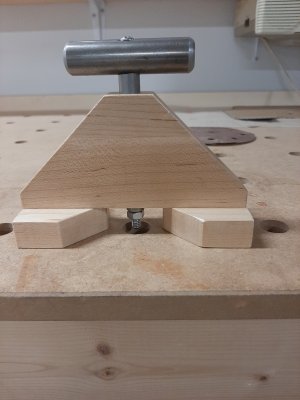
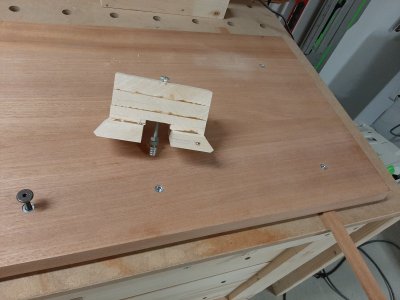
I made a small jig to ensure the insert goes in straight.
You can tell it is made of scrap, but it works. (One day I will make a nice jig)
Some of the Rampa inserts have a 3-start thread, with the idea that it is sitting on 3 points, so tends to go in straight, but I normally use the jig, to guarantee it goes in straight.

Not sure why you would want to mix insert types, but I don't see any problem with that.
 

Attachments

  • Threaded Inserts In Top.jpg
    Threaded Inserts In Top.jpg
    1.6 MB · Views: 43
I've used E-Z Lok inserts in both hardwood & softwood installations, they work well...making sure the guide hole is perpendicular to the surface and properly chamfered is paramount.

I've also "cut" threads into hardwood if the stress levels are low in the final application. For those installations, I'll use a pilot drill that's a smaller diameter than normal and the fastener threads in very snugly. I liken the process as similar to using Threadfloer taps in metal.

 
I rarely use threaded inserts in wood. Mostly if the screw has to be removed and replaced frequently. The last time I used them was to make a height adjustment for my router insert in a shop made router table.
 
I made a small jig to ensure the insert goes in straight.
You can tell it is made of scrap, but it works. (One day I will make a nice jig)

I felt a little embarrassed after posting that, so I made a new, nice insertion tool.
It is open in the center because sometimes the threaded mandrel will break free of the insert when I reverse direction after installation, but often I will need to put an open end wrench in there to break the hex nut free.
 

Attachments

  • Threaded Insert Inserter.jpg
    Threaded Insert Inserter.jpg
    1.4 MB · Views: 16
I have used several different models of inserts, flanged, un-flanged, different threads, etc. The most important thing seems to be the hole that you pre-drill. Straight, and on-size, are critical. Too tight splits the grain too loose and they can back out when removing the machine screw.
 
I have used several different models of inserts, flanged, un-flanged, different threads, etc. The most important thing seems to be the hole that you pre-drill. Straight, and on-size, are critical. Too tight splits the grain too loose and they can back out when removing the machine screw.
Yeah, drilling square is still a bit of a challenge.
For me, inserts commonly go into pieces too big for drill press.

I don't have a Festool drill. I have an old, piece of crap Sears Craftsman drill, but it has a bubble level on top. The bubble level seems to be a rare feature on drills today, and I can't bring myself to get rid of it.
 
Yeah, drilling square is still a bit of a challenge.
For me, inserts commonly go into pieces too big for drill press.

I don't have a Festool drill. I have an old, piece of crap Sears Craftsman drill, but it has a bubble level on top. The bubble level seems to be a rare feature on drills today, and I can't bring myself to get rid of it.
Drill blocks are made for that application.

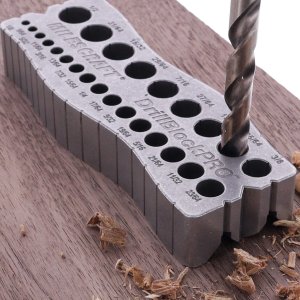
While Big Gator is the acknowledged gold standard in that field, Kreg, Milescraft and others make serviceable versions. My preference is Milescraft. All their fixtures look and feel cheap, but all seem to work perfectly. Walmart sells them for $8.00 online. Milescraft also makes a “Pro” version made entirely out of hardened steel for about $25.00. Any one of those will make perpendicular holes, and will aid in precise placement of the holes.

The video does not explain why they made the jig with a wavy shape. Aesthetics?

 
Last edited:
Just to be fancy, I should think.

I have the Milescraft with the wavy shape. At the store, they nest together in the display.
I agree, it is probably some marketing thing.

I did google the drill guide and the metal insert is hardened steel. And since it is cast of all one piece, I would expect them all to be square and accurate.

I also have a no-name drill guide that has interchangeable bushings. The bushings are a very loose fit and I suspect if I was to use it frequently, some of the bushings would wander off. Instead, I use the Millecraft version.
 
Yeah, drilling square is still a bit of a challenge.
For me, inserts commonly go into pieces too big for drill press.

I don't have a Festool drill. I have an old, piece of crap Sears Craftsman drill, but it has a bubble level on top. The bubble level seems to be a rare feature on drills today, and I can't bring myself to get rid of it.
If you’re working with hand tools and don’t have a drill block like Packard discussed then longer sight line are very helpful. I find it’s worth it to use an extension shank and a hex shank drill bit when I want the hole to more than sorta perpendicular.
 
If it was available when I bought my drill block, I probably would have bought the Drill Block Pro. It is probably comparable to the Big Gator. (Still, with the wavy design.)

1776367353330.jpeg

 
Trouble with those drill blocks is you need a different bushing for every drill size.
The recommended pilot drill for the Rampa inserts I use is 10.5mm for hardwoods and 10mm for softwoods and I am normally working with hardwoods.
Milecraft does not make a drill block with a 10.5mm bushing.
Drill Block Pro is a better idea, but seems to only be available in inch right now.
I have made my own guides, on a drill press, in a piece of hard maple, but I generally use the bubble level on my drill.

The Drillmate style of tool is something I have considered, but it seems a waste for how often it would get used. I can't recall a situation where I would have needed the angle adjustment.

 
Trouble with those drill blocks is you need a different bushing for every drill size.
The recommended pilot drill for the Rampa inserts I use is 10.5mm for hardwoods and 10mm for softwoods and I am normally working with hardwoods.
Milecraft does not make a drill block with a 10.5mm bushing.
Drill Block Pro is a better idea, but seems to only be available in inch right now.
I have made my own guides, on a drill press, in a piece of hard maple, but I generally use the bubble level on my drill.

The Drillmate style of tool is something I have considered, but it seems a waste for how often it would get used. I can't recall a situation where I would have needed the angle adjustment.
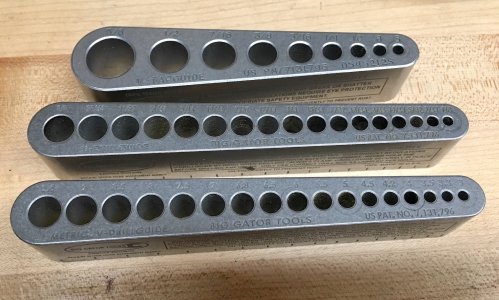
The Big Gator metric (on the bottom) comes in .5mm increments.
 

Attachments

  • 3820 Tap-Drill-Drill.jpg
    3820 Tap-Drill-Drill.jpg
    788.3 KB · Views: 15
0
Trouble with those drill blocks is you need a different bushing for every drill size.
The recommended pilot drill for the Rampa inserts I use is 10.5mm for hardwoods and 10mm for softwoods and I am normally working with hardwoods.
Milecraft does not make a drill block with a 10.5mm bushing.
Drill Block Pro is a better idea, but seems to only be available in inch right now.
I have made my own guides, on a drill press, in a piece of hard maple, but I generally use the bubble level on my drill.

The Drillmate style of tool is something I have considered, but it seems a waste for how often it would get used. I can't recall a situation where I would have needed the angle adjustment.
I have found that if you pre-drill a hole slightly smaller than the hole you need, and then follow with the actual size required, the larger drill will closely follow the angle of the first hole. So just select the next smaller size on the drill block, and follow up with the 10.5mm bit freehand. It would be very much like reeming which is done freehand in a tapping handle.
 
I agree, it is probably some marketing thing.

I did google the drill guide and the metal insert is hardened steel. And since it is cast of all one piece, I would expect them all to be square and accurate.

I also have a no-name drill guide that has interchangeable bushings. The bushings are a very loose fit and I suspect if I was to use it frequently, some of the bushings would wander off. Instead, I use the Millecraft version.
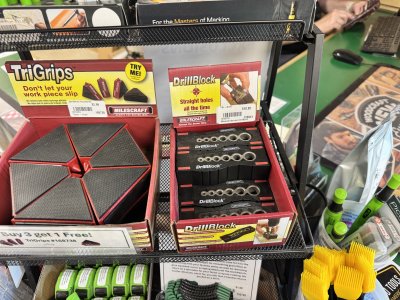
Thought about you today while I was at the Woodcraft.
 

Attachments

  • IMG_3312.jpeg
    IMG_3312.jpeg
    5 MB · Views: 13
Thought about you today while I was at the Woodcraft.
I never saw that display, but the wavy thing looks and feels like a gimmick. That said, every Milescraft device I’ve bought worked as promised. And cheap enough that I could justify the purchase for a single project.

My good friend retired and moved to Florida. So I did not have a second pair of hands to install some crown molding. I got a Milescraft device that replaced the second pair of hands. I used it once, but still a good investment. (I haven’t seen it in ages—I have no idea where it is.)
 
Back
Top