Why is my Festool track saw not cutting straight for the first 50-100mm?

sarno

Member
Joined
May 17, 2024
Messages
12
Location
Melbourne, Australia
Hey all,

I've been at this problem for a while now and it's got me stumped. Not sure when this started happening but I noticed it this week after trying to put a cupboard together and noticing some weird gaps. For what it's worth, this is the TS 60K purchased a year or two ago. It's already died on me once and had to get sent back for repairs. I don't think that has anything to do with my problem though.

I'm trying to cut a sheet of 20mm hardwood veneer about 450mm long and for the first 100mm or so it's cutting too far in compared to the rest of the board. I've tested this by putting multiple straight edges along the cut face and can very easily "rock" the straight edge. If I press it down against the far cut edge I can see a very clear gap where the cut started. Here's a list of things I've tried that hasn't worked:

- Different tracks (800, 1300, 1900)
- Track clamps
- Wait for motor to spin up fully, plunging before the work piece, then cutting
- Going slow
- Going a bit faster
- Cutting 5mm at a time until I reach the depth
- Adjusting cams so there's no movement of the saw on the track
- Even downward pressure on the saw
- Standing directly behind the saw
- More pressure to the left and holding down the saw to the track with my left hand
- Same as above but on the right

I tried cutting a 12mm thick plywood sheet and it seems to cut perfectly fine. I guess it's something with the hardwood? It's from and old wardrobe door from the 50's. They're about 120mm wide lengths joined in some way, then veneered. For what it's worth I've only cross cut it and haven't tried ripping.

Sorry if this is the wrong forum. I don't think this is a saw problem. I'd love to be able to try and different saw to compare but unfortunately I don't have access to one.

Thanks!
 
Couple of things come to mind, you've mentioned cutting in 5mm DOC increments so that rules out blade deflection and not keeping the saw flat on the track at all times, which would be pretty noticeable from burn marks anyway if that was the issue.

You've adjusted the cam so it's a snug ride on the track which is the other most likely issue ruled out then.

You mention trying 3 different tracks, are you extending the front edge of the track a fair way before the start of the cut and clamping at both ends so the saw is fully supported before and after the cut?
 
Could the board be bowing after you've cut it due to tension in the board?
What happens if you push the cut off piece back up to board, is the joint perfect or is there a gap?

I've been ripping plywood and OSB lately and discovered it can bow after being cut. So I rough cut panels about 5mm oversize, and then recut them to the correct size.

Regards
Bob
 
Probably the way you put pressure on the saw. Downwards to insert te saw and then forwards. You need some advance track before hitting the wood where the down position will fit, so that you only use forward pressure while cutting the wood.
After a while you will get a feel for this and be able to do a flowing transition and hit the wood after a shorter run-up.
 
It sounds like technique to me. What would be interesting to see would be if on a large piece of scrap you would leave a much longer part of the track overhanging at the start of the cut and then start up your saw and push technique further away from the plywood edge and see if that mattered.

Peter
 
Typically when there is a defect in the cut occurring only at the beginning or end it’s because the saw base was not fully engaged with the rail.
That may be unlikely since you mentioned adjusting both cams.

Also, as bertv mentioned you need sufficient rail overhang (not literally hanging unsupported) before the saw gets to the work to be sure you’re only pushing the saw forward, no longer plunging as well.

Looks like Peter was posting while I was writing 👍
 
Are you plunge cutting?
Do both cams have contact with the ridge of the rail during the whole cut?
Is the splinterstrip still intact at the ends of the rail?
If putting too much pressure, the rail will bend. In that case support the overhang.
 
Are you using the rail clamps on each end? In theory, the friction strips under the rail should keep the rail from moving. On mission critical cuts I always clamp on both ends of the cut. I never have absolute confidence in the rail staying steady with the clamps.

Ron
 
What Sarno posted was correct in what to do, and what the vast majority of us do without thinking thru lots of use. Multiple rails rule out rails unless you believe that three rails all could have issues at the start end. Having the adjusting gibs adjusted kicks wobble on the rail down the road into the storm sewer. Plunging and have the saw come up to speed prior to entering the workpiece kills the possible jerkiness.

Could toe-in or -out be in play? Maybe toe out?

Peter
 
What Sarno posted was correct in what to do, and what the vast majority of us do without thinking thru lots of use. Multiple rails rule out rails unless you believe that three rails all could have issues at the start end. Having the adjusting gibs adjusted kicks wobble on the rail down the road into the storm sewer. Plunging and have the saw come up to speed prior to entering the workpiece kills the possible jerkiness.

Could toe-in or -out be in play? Maybe toe out?

Peter
The only problem is the OP already ruled out any play in the tracks, and he also tried doing 5mm deep at a time.

That's why I was thinking he maybe didn't have the front end of the track extending far enough out so the saw wasn't fully properly supported.
 
Have you tried different (sharp) blade? The blade choice is essential for cutting solid wood and I don’t like that festool keep reducing the thickness of the blades.
 
Thats a great video. Next time I have the track saw out, I will do this test and see how they are set up relative to one another per this video. I liked the way he expalins things. I have a set of torx wrenches that look like Allen keys with the long and short side bent 90 deg. Will use it for the screw under the dust port. I have never adjusted the 2 saws I have. No idea if they are close to the same or are really different. Certainly can expalin how it cuts and how it can create a difference on the other piece. So looking at that toe on the saw with the back side out a little , his case 0.4mm, that would mean, that the piece being cut against the track will be fine, but the outer side piece being cut if not retained and the saw just goes through the cut width, will leave an area that has 0.3mm or so still not cut through. If you are not re triming this rh side piece, and are using it as cut, but the back of the balde has not gone completly through the cut or the outer section has moved from not being clamped, then I can see that there will be a funny gap.
I have never checked my 2 saws for this toe, but do have extra over hang, and have so far always been in the habit of clamping the rail and clamping both sides of the board unless it is a trim cut removing a small strip etc.
 
Thanks all, got some ideas of what to try next!

Excuse my ignorance around the splinter guard discussion, but would that have an effect on the cut? My splinter guards are in good condition as far as being intact and clean, etc... but they aren't a nice straight line as I botched the first cut on all of them (I did them all when I got the saw and clearly didn't pay enough attention).

I did try a support sheet under the rail where I start the cut but I'm starting to think I didn't give it enough run up. I'll try about 300mm run up or more before I cut into the work piece and see what happens (y)

I just checked toe-in and it's confused me even more now. The front teeth of the blade are always up against the cut face of the work piece along the entire length. I cannot get any feeler gauge between the tooth and cut face. The rear teeth differ to each other depending on where I measure. At the end of the cut where it's a nice straight cut, I have about 0.3 mm gap. But, at the start of the cut the gap is wider, closer to 0.45mm probably larger. To me, that suggests the saw is twisting into the track as the cut is made. I did the same test with an 18mm sheet of mdf and the gap was 0.4mm through the entire cut.

One thing I did notice was loosening the cams has improved the cut significantly. Though now I seem to have a very minor "hump" about 3/4 up the cut line so closer to the end of the cut than the start. It's small enough that's it's not really noticeable though.
 
Have you tried different (sharp) blade? The blade choice is essential for cutting solid wood and I don’t like that festool keep reducing the thickness of the blades.
That's what I was going to try next! The saw hasn't had a lot of use and mainly cut melamine chipboard. It's the standard blade that comes with the TS 60k (42 tooth). I did wash it with my blade cleaner if that helps. What blade is best for cutting this kind of hardware-type material? Or is it more about the blade thickness?
 
That's what I was going to try next! The saw hasn't had a lot of use and mainly cut melamine chipboard. It's the standard blade that comes with the TS 60k (42 tooth). I did wash it with my blade cleaner if that helps. What blade is best for cutting this kind of hardware-type material? Or is it more about the blade thickness?
That blade is most likely dulled by this point. It takes only a few cuts to dull a wood blade with chipboard, even less such cuts will dull it when it is laminated.

The standard 42T blade is definitely NOT suited for melamine, or chipboard for that matter.

Get your existing 42T blade sharpened and use it only for wood/plywood moving forward.

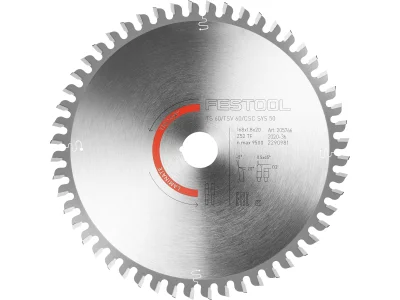
Get a new blade for laminates - this is the /Festool/ blade you want for chipboard, MDF, HDF, etc., laminated or not:

hks_sb168x1,8x20TF52L_205766_z_01a_1600_1200.webp


Get a "universal" blade for rip cuts and related. The 42T blade /and the saw, but mainly the blade/ is unnecessarily taxed when used for rips. This one:

A good video PP did on this, it is focused on wood, but should get you started still:


ADD:
A dulled wood blade may still behave seemingly OK cutting chipboard - it does not cut it but abrades it so slightly dull still works fine. The same blade will face a major challenge with wood as it needs to cut it - abrasion will not work with wood. With a wider blade and a weaker saw - say a TS 55 with a 2.2 mm blade - you notice this immediately as the saw lacks the raw power to compensate for the dulled blade.
 
Last edited:
Back
Top