Considering switching from track saws/MFT to a panel saw.

sarno

Member
Joined
May 17, 2024
Messages
9
Location
Melbourne, Australia
Before spending any more money on this, I'm hoping someone tells me I’m doing something fundamentally wrong.

I’ve been getting more serious about hobby woodworking over the last two years and everything’s been going great except for my rip/crosscut situation. I absolutely dread having to get the track saw out when I need something accurate and repeatable. I’ve thrown a frankly stupid amount of money at trying to make it work, Benchdogs, TSO, Festool, UJK, pretty much every jig you can imagine. A good portion of that also went toward shipping to Australia. I don’t even want to tally up what I’ve spent, but it would comfortably exceed the price of a panel saw. I feel like it’s one of those experiences you have to go through before you realise what the right solution might be.

I’m at a crossroads now where I either cut my losses and buy a panel saw or sink more money into refining the track saw/MFT setup. I think I’ve mostly got rip cuts under control, but even then I still cross my fingers every time I make a cut that needs to be straight and parallel. I’ve been using TSO parallel guides on the rail (up to 3000 mm when needed), and I alternate between the TSO track square with the extended aluminium contact attachment and the Festool adjustable guide rail angle stop, which I find more reliable. The biggest improvement came from clamping the rail and avoiding sideways pressure on the saw as I cut, as the rail can flex left to right, but I still don't have confidence in repeatability.

Crosscuts have been the real problem. I don’t think I’ve ever managed to get consistently square cuts or repeatable widths across multiple pieces. I’m using a custom MFT built with the UJK Parf Guide, along with the Benchdogs hinge, fence, and their latest micro-adjust flip stop. The holes are *not* square — that became clear when aligning the track using the Festool pin slot in the hinge. The hinge’s adjustability helped get things square initially, but I still feel like things drift. I find myself constantly checking alignment because the hinge pin can move slightly. The fence and flip stop also seem capable of flex if I push the workpiece firmly against them, and I suspect there may be some movement or flex in the track/fence during the cut itself.

I suspect many of my issues stem from the number of components and variables involved so I want to reduce that. I’ve considered getting a CNC-machined MFT top and simplifying the setup by ditching the hinge and using hinge dogs or Stanton dog locks instead. I’ve also thought about drilling my own top, though I’m concerned about introducing inaccuracy that can’t be corrected afterward. Using the LR32 system is another possibility, but I’ve watched videos on that and I'm not confident I could get it right. I'd drill holes along one side of the workbench then move the rail to do the other side and hope the spacing is the same for every hole (then just turn the track perpendicular and drill the holes between). I’ve also had suggestions to leave the hinge attached but let a track square and parallel guide self-reference against the fence rather than fixing the rail position before the cut.

At this stage I’m honestly leaning toward abandoning the whole setup and buying a panel saw, as I should be able to fit a 1600 mm unit (possibly larger) in my garage. That said, I’m very open to suggestions, even if it means moving away from the MFT approach entirely. What I really need is a reliable reference for aligning the rail and a fence solution that stays square and repeatable. I’d appreciate any thoughts!
 
Since I have a very small amount of work area my workflows are probably a lot simpler and agricultural than many here. I always assume that when I use guide rails, the TSO rail clamp, or dogs in my MFT the result will not be square. So I tend to mark lines using a large framing square and then cut with the tracksaw or a simple guide I run the saw along. If it's fairly crucial it's perfect, I cut a smidge over and then use a straightedge to trim exactly to the line with a large spiral insert cutter and the router.

Might sound like it's tedious or a lot of extra time and/or labour, but it's really not, I get consistent, perfect results every time with minimal time spent.

There's more than one way to skin a cat!
 
Panel saws can be a great solution. I had one for a long time that I won in a contest, but only used it to make the cabinets for one kitchen. Once I got my track saw I never used it again. I didn't get the quality of cuts on it that I did with my Festool and hated making rips with it and then having the edges be less than perfect. Also, because I was using melamine, I had many more cuts on my hands.

You mentioned that you had enough room, are you allowing enough room on the entry and the exit sides for comfortable material handling? My unit could handle full 8' sheets, so realistically I would need at least 22 ft to be comfortable and not worry about banging the goods into something else.

Peter
 
@sarno Sounds to me like you might’ve overcomplicated things a bit. 🙂

It’s tough to give solid advice here — you seem a bit frustrated with your setup. Do you feel like you’re in the right headspace to give the MFT another shot? It really does work, and it’s an excellent tool for clean, repeatable crosscuts once it’s dialed in.

Panel saws do have their perks, but they don’t magically fix every accuracy issue, especially when you’re wrestling with big sheets.

Here’s a method I usually point people to when students at the local community workshop get stuck with the MFT/3 setup:


We use MFTs with bench dogs for this, but not because it’s required — it’s just handy. No fancy stops or accessories needed. You’ll get super-precise, repeatable crosscuts this way. It’s all math, not accessories.

Since you said you’re already pretty happy with your rip accuracy, you’ve got most of the heavy lifting done. Just take your time to cut one perfect piece the way you want it, then use that as your template to knock out the rest.
 
Last edited:
As someone who has used various panel saws over the past 30 years, I would be very wary of buying anything but a pro quality unit - Altendorf, SCM, Felder etc. - these are very expensive 3 phase machines. This puts them out of the budget of most hobby woodworkers. Also, there's still a learning curve. I wouldn't even consider a 'hobby' grade panel saw.
30 years of tuning, adjusting and using them has made me pretty fussy re. squareness and repeatability - and I know you can get perfect results with a tuned MFT setup. I found the TSO 'MFT aligned' set and an extended infeed and out feed bench fix all of the MFT issues. You can add a better fence as well, but not necessary to start with, I added an adhesive tape to the Festool fence and an extra flag stop for convenience.
Squaring the fence to the guide rail is very easy and the TSO add ons keep it that way.
Whereabouts in Aus are you located?
 
I can't tell you if you should get a panel saw as the only experience I have had with it is seeing it used at the big box hardware store like Home Depot when they cut down the sheets for me. But I can tell you I never trust their cuts in terms of accuracy or squareness. I only need them to break down the sheet so I could transport it in my SUV.

Everyone I know here who has a track saw doesn't have it for the prime reason of achieving squareness either. They have one either because of safety concerns about table saws, space constraints or the need for doing onsite projects. Most of them also own and use their table saws.

I have used a circular saw with a ripping guide to break down things and have used the Festool TS55 and 75 with the track or the MFT. They were no comparison to my SawStop PCS in terms of efficiency and versatility. With the JesseM stock guides, I can handle 4x8 sheets all by myself. So, the tracksaw system will never be my choice as the main cutting system -- even if it's loaded with all kinds of after-market accessories, some pretty finicky, if you ask me.

Track saws will struggle with furniture projects that are not sheet goods based when compared to the table saws.

I'm not saying you should get a table saw. You may have ruled it out already. But given my experience with track saws and table saws, I wouldn't throw more money into the former if they didn't work for me after an extended period of experience.
 
Last edited:
“What I really need is a reliable reference for aligning the rail and a fence solution that stays square and repeatable. I’d appreciate any thoughts!”

As you know now, if you want high precision results you can’t depend on holes in mdf, even if they are made with a CNC. The only things that work perfectly with holes in mdf are clamps.

Whenever you change the height of the rail (to accommodate different thickness of work) its angle relative to a stationary fence will change slightly. There has to be some slack in the rail hinge sliding mechanism in order to change the height. The Dashboard setup seems to be the best but you really need to readjust the fence to the rail once you have the height of the rail fixed, if you want precise results. Not the other way around. This is why I prefer the old MFT 1080 fence system, because it uses a long fence that pivots close to the rail and is locked down as far from the rail as possible. Again, look at the Dashboard system.

“a reliable reference for aligning the rail and a fence”.

This is where the manufacturers have let us down. We need a precise square that is big (they’ve made that) and thick/tall (they haven’t yet). A machinist square can only help set the fence square to the rail when the rail is barely above the surface of the table. Woodpeckers and TSO make slightly thicker/taller fences but they’re still inadequate. As soon as you raise the rail up to work height the angle is no longer reliable and there is no manufactured square that is capable of helping reset the angle. We need a taller square. So far, that is a diy project.

Here is what I recommend. Assuming you already have a fence that allows precise readjustment (using a stop and feeler gauges to control the adjustment process), that is, it pivots on one end without slop and can be locked down on the other, so that you can use the 4 cut method to make a reasonably perfect 90 degree cut, make a fairly large piece of plywood (about 2 ft x 2 ft) with that perfect 90 corner. Perfect means more precise than what you can buy. Often manufacturers claim to be precise within .001” per foot length, you can do better than that with the 4 cut method.

You now have a square reference piece but you can’t even use it to reset the fence to make another like it because it fits under the rail. You still need something taller. So you add stock on top of that piece making sure the side that will contact the rail stays perfectly square to the bottom of your new reference square. This is the potentially tricky part. You can’t assume the top of your reference is perfectly parallel to the bottom (mdf is more reliable in this dimension but the cut edges wear too easily so plywood is better for your square), so you might have to construct a riser rather than simply slap another piece of plywood on top. But you don’t have to duplicate the reference edge for the full 2 ft, you just need a short perfect riser at the 90 degree corner and another at the end. You only need two perfect points to contact the higher rail. So make those two points at least as tall as you ever expect to raise the rail. And then protect your perfect reference from abuse.
 
I had a Milwaukee 6480 for 2 years that easily broke down 4x8 sheets of ply but I certainly wouldn't hail its accuracy. And the cut quality of the edge was also not there, I had to make all of the finish cuts on a table saw. After I purchased my first Festool TS 55 track saw, I realized I could break down material and get final cuts with just the track saw alone so I sold the Milwaukee panel saw. I certainly don't miss it and am thinking about selling the table saw to free up more space.
 
This is where the manufacturers have let us down. We need a precise square that is big (they’ve made that) and thick/tall (they haven’t yet). A machinist square can only help set the fence square to the rail when the rail is barely above the surface of the table. Woodpeckers and TSO make slightly thicker/taller fences but they’re still inadequate. As soon as you raise the rail up to work height the angle is no longer reliable and there is no manufactured square that is capable of helping reset the angle. We need a taller square. So far, that is a diy project.
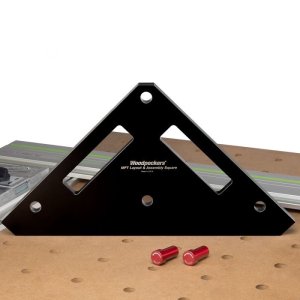
Michael, would the old Woodpeckers phenolic square work? Mine is 15" x 15" and 3/4" thick.
 

Attachments

  •  OTT 421125 MFT Square_MFTLASQR.jpg
    OTT 421125 MFT Square_MFTLASQR.jpg
    54.9 KB · Views: 2
‘Mine is 15" x 15" and 3/4" thick.”

15” is okay for a reference (longer is always better) but 3/4” is only good for stock less that 3/4” tall, because the rail needs to be at the working height before setting the fence, using the 15" x 15" and 3/4" tool.

Phenolic is so robust you could figure out a way to make a detachable height extender if you didn’t want to permanently modify the thing. That could be done with a plywood square too but the plywood version is more likely to be a single purpose tool.
 
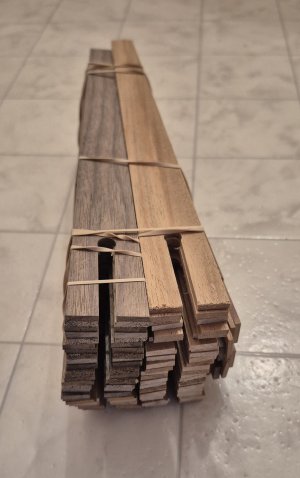
About versatility. I recently made about 60 tapered blanks on the table saw (last time, over 120) that included thin rippping (just under 4mm thick) -- with the microjig push block -- angled cuts and blind slots (with a jig).

I can't imagine completing that task with a tracksaw and mft.

Could I do that on the bandsaw? Yes, but I'd have spent at least 2x to 4x more of shop time, which would have required lots and lots of sanding.

1000109154.jpg
 
Last edited:
‘Mine is 15" x 15" and 3/4" thick.”

15” is okay for a reference (longer is always better) but 3/4” is only good for stock less that 3/4” tall, because the rail needs to be at the working height before setting the fence, using the 15" x 15" and 3/4" tool.

Phenolic is so robust you could figure out a way to make a detachable height extender if you didn’t want to permanently modify the thing. That could be done with a plywood square too but the plywood version is more likely to be a single purpose tool.
How about just raising the phenolic square with a few 1-2-3 blocks? I don't have an MFT and I have never used one so this is all very new.
 
How about just raising the phenolic square with a few 1-2-3 blocks? I don't have an MFT and I have never used one so this is all very new.
This would fine work for the rail side but you need a more secure fit between the square and the riser blocks on the fence side since the fence will probably only contact the steel riser blocks. Might work if the fence was tall but then you have the extra concern of monitoring whether the tall fence is square to the table and has no twist. A low fence is preferable for that reason and also so it can extend under the rail giving support (and angular orientation) to stock that is shorter than the rail is wide.

In cases where the stock being cut is thinner that the fence is tall I prefer to raise the stock with a thin piece of hardboard or mdf rather than withdraw the fence from under the rail. I try to keep the fence right up to kerf of the tracksaw. That’s why my fence has a 45 degree cut in the end. 😏
 
A sliding table saw is a great thing to have, don't know how I'd live without mine but I find myself reaching for the TS60 and rails more often than not. I'd be inclined to just sell the MFT and keep a few of the essentials.
 
A sliding table saw is a great thing to have, don't know how I'd live without mine but I find myself reaching for the TS60 and rails more often than not. I'd be inclined to just sell the MFT and keep a few of the essentials.
If I had a shop big enough I’d be sorely tempted to buy a good sliding table saw. And if I were younger and still making stuff for other people.
 
Not knowing a whole lot about the BenchDog system I took a look and found out he has addressed the inadequacy of squares for the MFT with a couple of posts that screw into his big triangle. I’d like them to be taller though.

Also looked at his Quad MFT? rig. I still think the DashBoard system is better, mainly because the shoulders that guide the part that slides up and down are longer. I watched his (BenchDog) quick intro to the thing and he simply put the parts together and tested with his square and pronounced it good. I watched Peter Millard’s video of the pre-production model and the same thing happened. I consider both results minor miracles, especially in Peter’s case as it appeared he kinda eyeballed where to put the front mounting holes. Neither addressed the problem of adjustment if the grid pattern isn’t perfectly perfect. Maybe that is the difficulty sarno is having?

I really don’t know how to adjust that BenchDog setup. How in the world do you do the 4 cut method with stuff that is locked into holes? Maybe there is some play where the rail joins the hinge? I guess that would be possible but awkward. I’d be lost without a simple pivoting fence on top of the table.
 
if the grid pattern isn’t perfectly perfect

I am sure Peter Parfitt’s angles are all perfect. 🙂

Benchdogs UK sells CNC-milled tabletops made to measure. Metabo sells a cheap replacement tabletop for their MFT knock-off. But a crosscut station can be built more simply without a full grid. I wouldn’t bother drilling 100 holes by hand for this purpose.
 
  • Like
Reactions: P_K
Back
Top