
You are using an out of date browser. It may not display this or other websites correctly.
You should upgrade or use an alternative browser.
You should upgrade or use an alternative browser.
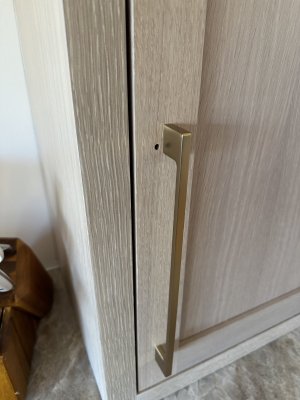
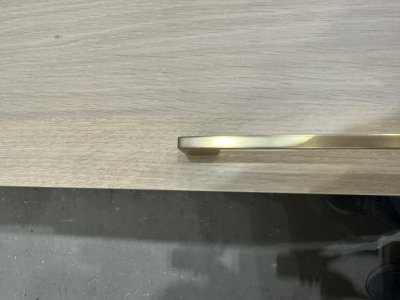
Doh…..
- Thread starter tjbnwi
- Start date

luvmytoolz
Member
Good coverup!

hdv
Member
Oh, I had that happen to me more than once I am ashamed to admit. But that's definitely very nicely repaired. Well done!

Cheese
Member
Nice repair job Tom...although it is still visible when looked at from the 1" height level. 
It's not like you've got extra doors around to swap out. Just curious how you repaired it?
It's not like you've got extra doors around to swap out. Just curious how you repaired it?

tjbnwi
Member
- Joined
- May 12, 2008
- Messages
- 7,402
Cut a piece of plain sawn white oak 1-1/2 x 3/4 x3/4, chucked it in the 4 jaw with the edge grain facing the tail stock (this is a rift edge), clamped a skew chisel in the tool post holder, turned a stem to 0.197, cut the stem off at 3/4, a little glue “squeezed” it in the hole with a quick clamp until the faces were flush. Daubed on a little stain, wiped, finished with a rattle can of No Hallow.Nice repair job Tom...although it is still visible when looked at from the 1" height level.
It's not like you've got extra doors around to swap out. Just curious how you repaired it?
Used the metal lath because it is more accurate than my wood lathe, used a skew chisel because without re-grinding one of the metal cutting tools they are painfully slow using them on wood and produce a very bad surface finish.
If I could invent a way to “undrill” a hole I’d be a billionaire.

Tom
Cheese
Member
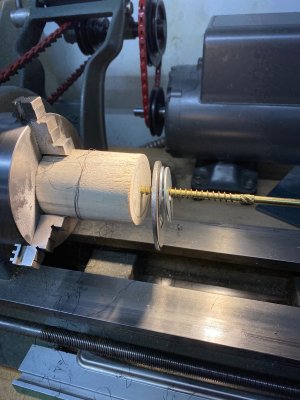
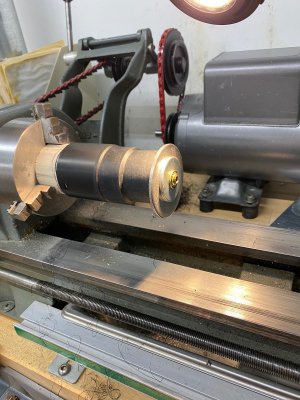
Thanks Tom, very interesting comment about using a skew chisel in the metal lathe. I've machined some wood products in the metal lathe using inserts for aluminum turning. They certainly worked better than the inserts used for SST turning but they always left a relatively rough surface. It was never a big deal because the wood turnings were always used as fixtures/jigs, but I was always curious about the rough surface finish they left. For instance, here's a turning fixture for modifying a Festool vac adapter.
Attachments
luvmytoolz
Member
Is it maybe the angle of attack giving rough results or the insert just isn't suitable for wood (which I wouldn't thought to be the case)?Thanks Tom, very interesting comment about using a skew chisel in the metal lathe. I've machined some wood products in the metal lathe using inserts for aluminum turning. They certainly worked better than the inserts used for SST turning but they always left a relatively rough surface. It was never a big deal because the wood turnings were always used as fixtures/jigs, but I was always curious about the rough surface finish they left. For instance, here's a turning fixture for modifying a Festool vac adapter.
There's also the negative rake insert tools that will give a really superb scraped finish.
Steve1
Member
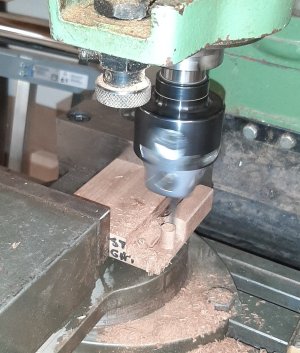
Cheese
Member
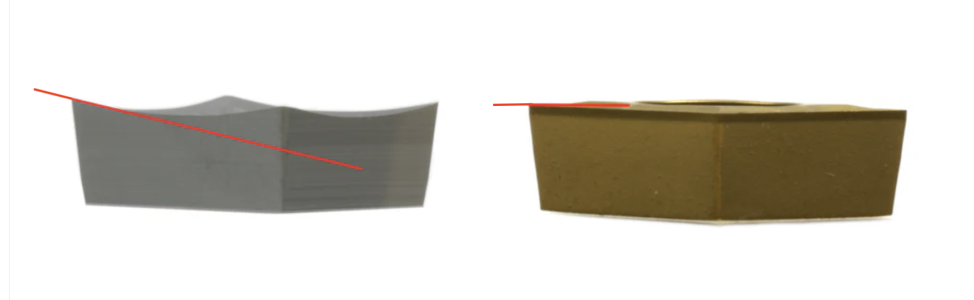
I typically use CCGT inserts on aluminum & plastic and CCMT inserts on steel & stainless. The CCGT insert produces a wonderful surface finish because of its ground edge but because of that sharp ground edge it's also fragile, it breaks easily and wears down quickly.Is it maybe the angle of attack giving rough results or the insert just isn't suitable for wood (which I wouldn't thought to be the case)?
There's also the negative rake insert tools that will give a really superb scraped finish.
For that photo of the lathe fixture that I showed, I assumed the rough surface finish was because the wood I was turning was soft pine but thinking about it now, I think the CCGT insert was also to blame. The next time I'll try turning wood with a CCMT insert. As you pointed out, that insert would have an edge profile closer to the skew chisel that Tom mentioned.
Here's a comparison of the 2 inserts.
Attachments
tjbnwi
Member
- Joined
- May 12, 2008
- Messages
- 7,402
Looked to see if I had a picture of the skew chisel in the quick change tool holder. I do not. It mounts in the holder no differently than any other insert holder or HSS ground tool. You need to be aware of the handle sticking out. I guess I could grind a HSS blank to match the skew but I’m too lazy for that……
I have a full set of turning tools for the wood lathe so it was a no brainer to use the skew.
If I’m wood turning hand held is more than accurate enough, in this case I needed the accuracy the DRO afforded me.
Tom
I have a full set of turning tools for the wood lathe so it was a no brainer to use the skew.
If I’m wood turning hand held is more than accurate enough, in this case I needed the accuracy the DRO afforded me.
Tom

RJNeal
Member
nice fix Tom.
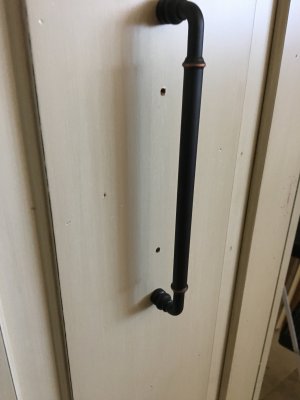
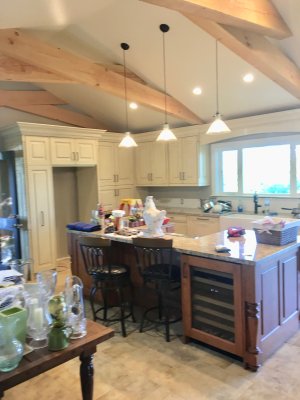
This reminded me of the cabinet I had in my Rutherford home.
The cabinet company made and install them.
I had a pull out pantry unit.
He drill for the handle along with the rest of the cabinets.
The pantry and dishwasher was a wide handle.
So he redrill both hole in the 6 1/2 foot tall pantry door.
I asked him why he didn’t just drill an additional hole so there was only one to repair instead of two.
He said he neede to keep it centered.
I think being an inch off or so of center no one would notice. Oh well.
This reminded me of the cabinet I had in my Rutherford home.
The cabinet company made and install them.
I had a pull out pantry unit.
He drill for the handle along with the rest of the cabinets.
The pantry and dishwasher was a wide handle.
So he redrill both hole in the 6 1/2 foot tall pantry door.
I asked him why he didn’t just drill an additional hole so there was only one to repair instead of two.
He said he neede to keep it centered.
I think being an inch off or so of center no one would notice. Oh well.
Attachments
luvmytoolz
Member
Clever idea! I never would have thought of using my boring head to make plugs!I have this crappy little boring head. But it allows me to make plugs and adjust the size in .001" increments.

- Joined
- Oct 16, 2015
- Messages
- 5,830
I did that with a 10mm Domino cutter, in a table leg. Fortunately, I still had a cut-off piece, that was big enough to cut a patch with my Shaper Origin. It was an apron mortise, that was 1" lower than it was supposed to be. It covered so well that the finish department didn't even notice it. These were purchased, turned legs, so it wasn't like I could just make another one quickly.


