
You are using an out of date browser. It may not display this or other websites correctly.
You should upgrade or use an alternative browser.
You should upgrade or use an alternative browser.
Not reeded……
- Thread starter tjbnwi
- Start date
Packard
Member
The things we do.
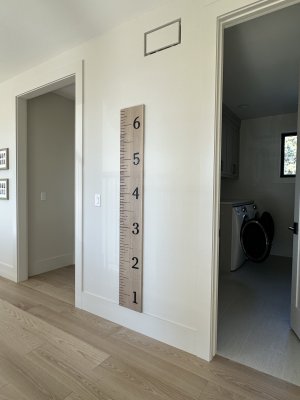
I made this 6 foot tall pencil for my niece when her daughter was born. She marks a line and a date for each marking. Three facets accommodates three kids. But she only had Emily. So Emily can use it, likely in 10 years or less (she’s in college now).
I made this 6 foot tall pencil for my niece when her daughter was born. She marks a line and a date for each marking. Three facets accommodates three kids. But she only had Emily. So Emily can use it, likely in 10 years or less (she’s in college now).
Last edited:
What great ideas!
Peter
Peter
Packard
Member
There is a really good reason for these height measuring devices.What great ideas!
Peter
While I was growing up, my parents marked my height, my brother’s and my sister’’s. And those heights were accompanied by a written date. All of which were noted on a doorway trim molding.
All that family history was lost when my parents had the kitchen remodeled. Not a huge loss, but an avoidable one.
Regardless of what you use for one of these hanging family history markers, make a note on the back of the pencil/ruler/etc. showing the exact height for the hanging hardware. Without that information, a future generation will not be able to compare results, and if you move to another dwelling, the results will be inconsistent.
I used picture framing hardware for my hanging system. Adequate for this purpose. I added a blank label at the hanger wire height that said: “Hanger Height”. I don’t know if she recorded that height; I do know she moved from her house to a townhouse a few years later.
Last edited:
Packard
Member
This “Pate knife” was hanging in my other niece’s kitchen. The blade is 3/4” by 12” x 6’ red oak. The handle is 2 layers of 3/4” MDF per side. It features a full tang. The “rivets” are fake, just glued disks. Overall length is 6 feet. Weighed a ton. Took 3 people to hang.
Mike Goetzke
Member
- Joined
- Jul 12, 2008
- Messages
- 1,215
Ha - I focused on the HVAC return vent. On YT I've been bombarded by ads for these lately.
Packard
Member
I recommend that you put the height of the screw for the keyhole on the back of the ruler. It will make a re-install quicker and easier than matching ruler lines,I machined keyholes in the back of the “ruler”, the bottom is 7-1/4” AFF. The 7-1/4” cutoff (to rest on the baseboard) puts the 1’ mark 1’ AFF.
Tom
What did you use to create the lines? My lettering skills seemed to fall short on the number “2”.
 All those nice, straight and parallel lines would have had me kill the project.
tjbnwi
Member
- Joined
- May 12, 2008
- Messages
- 7,402
I recommend that you put the height of the screw for the keyhole on the back of the ruler. It will make a re-install quicker and easier than matching ruler lines,
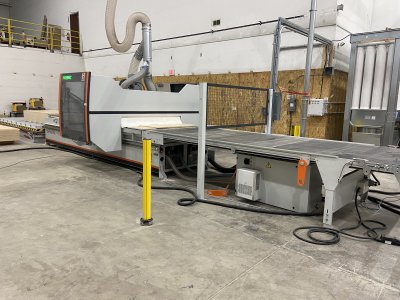
What did you use to create the lines? My lettering skills seemed to fall short on the number “2”.
Tom
Not very portable...
Packard
Member
I produced the pencil a bit more “old school”.

- Joined
- Oct 16, 2015
- Messages
- 5,830
Hahaha. That's kind of a "dynamite as a fly swatter" approach, but exactly what I expected too. 
For a one-off, I would probably do that with the MFT holes, along with stops and a router.
For more than one, maybe a 1/4 MDF template for a guide bushing, cut with the Shaper Origin. It would be massively wasteful of the tape, for cutting directly. I think a single foot of markings/slots would work. then just move it for ecah foot.
For a one-off, I would probably do that with the MFT holes, along with stops and a router.
For more than one, maybe a 1/4 MDF template for a guide bushing, cut with the Shaper Origin. It would be massively wasteful of the tape, for cutting directly. I think a single foot of markings/slots would work. then just move it for ecah foot.
Packard
Member
I guess I would have painted the lines.
I would apply a 3/4” wide piece of masking tape horizontally. Then a 1/4” wide strip adjacent. Then repeat over and over again.
When the “ruler” was fully covered, I would peel away the 1/4” strips revealing the area to paint.
Add a lengthwise strip of 3/4” tape to limit the line length.
I would have to take particular care to make sure that the strips of tape were all perpendicular to the length, but it should be manageable.
I would not invest in any CNC equipment for that project.
I would apply a 3/4” wide piece of masking tape horizontally. Then a 1/4” wide strip adjacent. Then repeat over and over again.
When the “ruler” was fully covered, I would peel away the 1/4” strips revealing the area to paint.
Add a lengthwise strip of 3/4” tape to limit the line length.
I would have to take particular care to make sure that the strips of tape were all perpendicular to the length, but it should be manageable.
I would not invest in any CNC equipment for that project.
tjbnwi
Member
- Joined
- May 12, 2008
- Messages
- 7,402
I’ve owned the CNC for 4 years and the Shaper Origin for about 6-7 years. Some months we’ll process 120+ sheets of material for cabinet fabrication, other months it may be as few as 10 sheets.I guess I would have painted the lines.
I would apply a 3/4” wide piece of masking tape horizontally. Then a 1/4” wide strip adjacent. Then repeat over and over again.
When the “ruler” was fully covered, I would peel away the 1/4” strips revealing the area to paint.
Add a lengthwise strip of 3/4” tape to limit the line length.
I would have to take particular care to make sure that the strips of tape were all perpendicular to the length, but it should be manageable.
I would not invest in any CNC equipment for that project.
There is more in the cost of the piece of wood than there is in the CNC time.
There are things the Origin out shines the CNC on. The pockets for the pulls/knobs on these two jobs were done using the Origin. The design was done on tool, stops are set, one set up per size of face.
13mm circle;
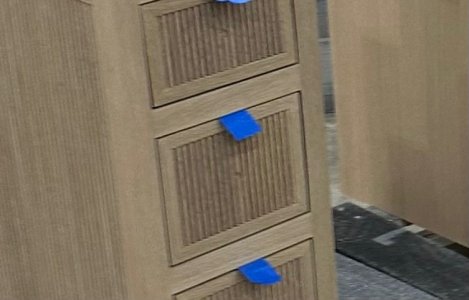
16mm x 16mm square (vertical offset is due to pull style);
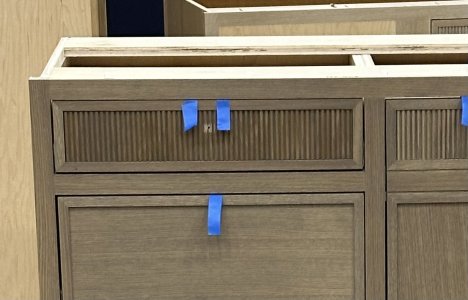
Tom
Last edited:
Packard
Member
I was talking about if I were to attempt that ruler. You already had the Origin and it made sense to use it. I was only saying how I, not a CNC or Origin owner would approach that project.I’ve owned the CNC for 4 years and the Shaper Origin for about 6-7 years. Some months we’ll process 120+ sheets of material for cabinet fabrication, other months it may be as few as 10 sheets.
There is more in the cost of the piece of wood than there is in the CNC time.
There are things the Origin out shines the CNC on. The pockets for the pulls/knobs on these two jobs were done using the Origin. The design was done on tool, stops are set, one set up per size of face.
13mm circle;
View attachment 380572
16mm x 16mm square (vertical offset is due to pull style);
View attachment 380573
Tom


